
Pulp Fiction, 1954 · page 34 of 133
Astounding Science Fiction (British Edition) — page 34: what you’re looking at
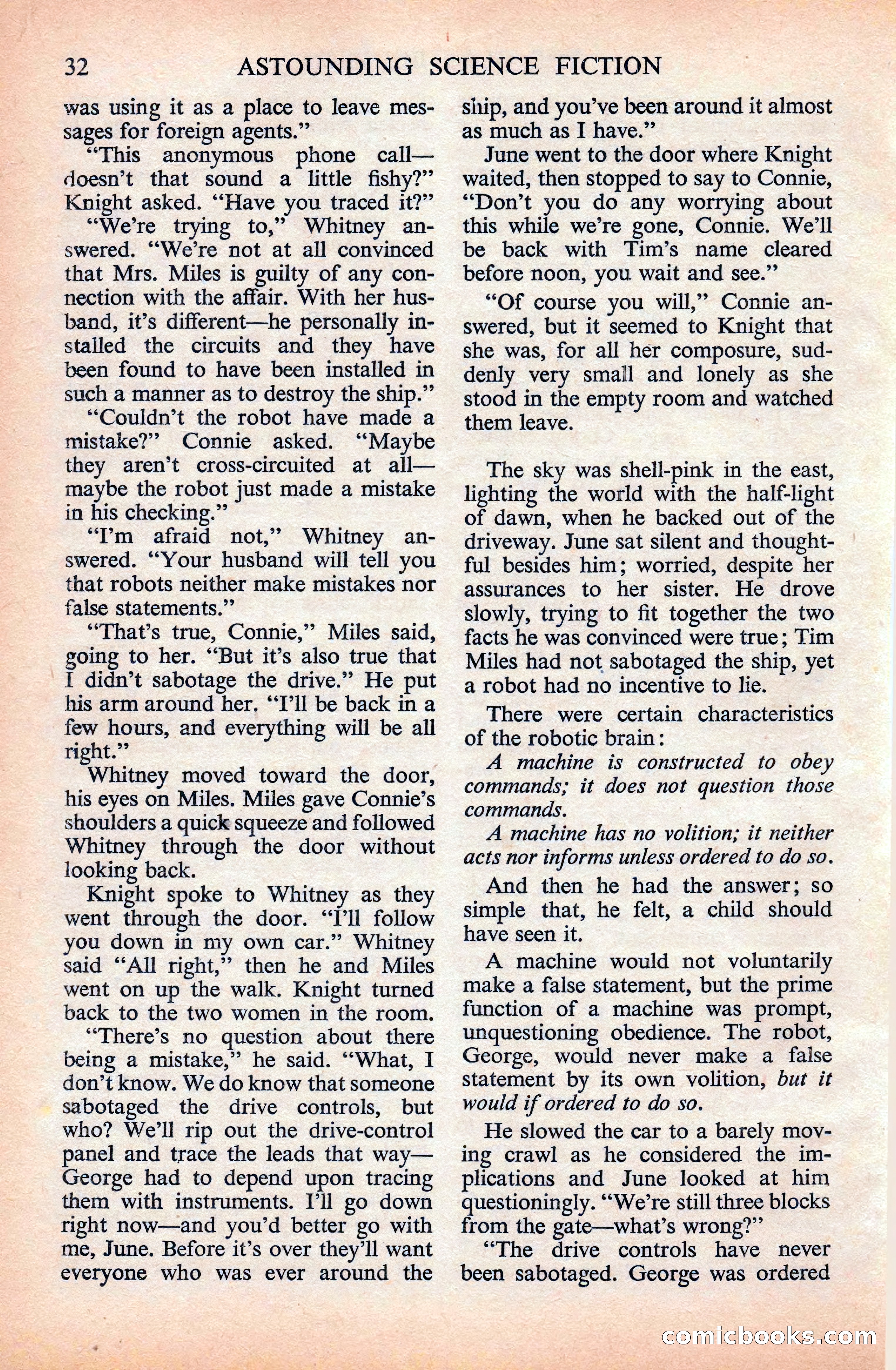
A restored page from Pulp Fiction, 1954. Page through the whole issue in the reader above.
📄 Transcribed text from this page (OCR, searchable)
Machine-transcribed from the original scan — historical spelling and the odd misread are preserved.
32 ASTOUNDING SCIENCE FICTION was using it as a place to leave mes- sages for foreign agents.” “This anonymous phone call— doesn’t that sound a little fishy?” Knight asked. “Have you traced it?” “We're trying to,” Whitney an- swered. ““We’re not at all convinced that Mrs. Miles is guilty of any con- nection with the affair. With her hus- band, it’s different—he personally in- stalled the circuits and they have been found to have been installed in such a manner as to destroy the ship.” “Couldn’t the robot have made a mistake?” Connie asked. “Maybe they aren’t cross-circuited at all— maybe the robot just made a mistake in his checking.” “T’m afraid not,” Whitney an- swered. “Your husband will tell you that robots neither make mistakes nor false statements.” ““That’s true, Connie,’ Miles said, going to her. “But it’s also true that I didn’t sabotage the drive.” He put his arm around her, “‘T’Il be back in a few hours, and everything will be all right.” Whitney moved toward the door, his eyes on Miles. Miles gave Connie’s shoulders a quick squeeze and followed Whitney through the door without looking back. Knight spoke to Whitney as they went through the door. “I'll follow you down in my own car.” Whitney said “All right,” then he and Miles went on up the walk. Knight turned back to the two women in the room. ““There’s no question about there being a mistake,” he said. “What, I don’t know. We do know that someone sabotaged the drive controls, but who? We'll rip out the drive-control panel and trace the leads that way— George had to depend upon tracing them with instruments. I’ll go down right now—and you'd better go with me, June. Before it’s over they’ll want everyone who was ever around the ship, and you’ve been around it almost as much as I have.” June went to the door where Knight waited, then stopped to say to Connie, “Don’t you do any worrying about this while we’re gone, Connie. We'll be back with Tim’s name cleared before noon, you wait and see.” “Of course you will,” Connie an- swered, but it seemed to Knight that she was, for all her composure, sud- denly very small and lonely as she stood in the empty room and watched them leave. : The sky was sheil-pink in the east, lighting the world with the half-light of dawn, when he backed out of the driveway. June sat silent and thought- ful besides him; worried, despite her assurances to her sister. He drove slowly, trying to fit together the two facts he was convinced were true; Tim Miles had not sabotaged the ship, yet a robot had no incentive to lie. There were certain characteristics of the robotic brain: A machine is constructed to obey commands; it does not question those commands. A machine has no volition; it neither acts nor informs unless ordered to do so. And then he had the answer; so simple that, he felt, a child should have seen it. A machine would not voluntarily make a false statement, but the prime function of a machine was prompt, unquestioning obedience. The robot, George, would never make a false statement by its own volition, but it would if ordered to do so. He slowed the car to a barely mov- ing crawl as he considered the im- plications and June looked at him questioningly. ““We’re still three blocks from the gate—what’s wrong?” “The drive controls have never been sabotaged. George was ordered EComichbooksco im