
Pulp Fiction, 1954 · page 28 of 133
Astounding Science Fiction (British Edition) — page 28: what you’re looking at
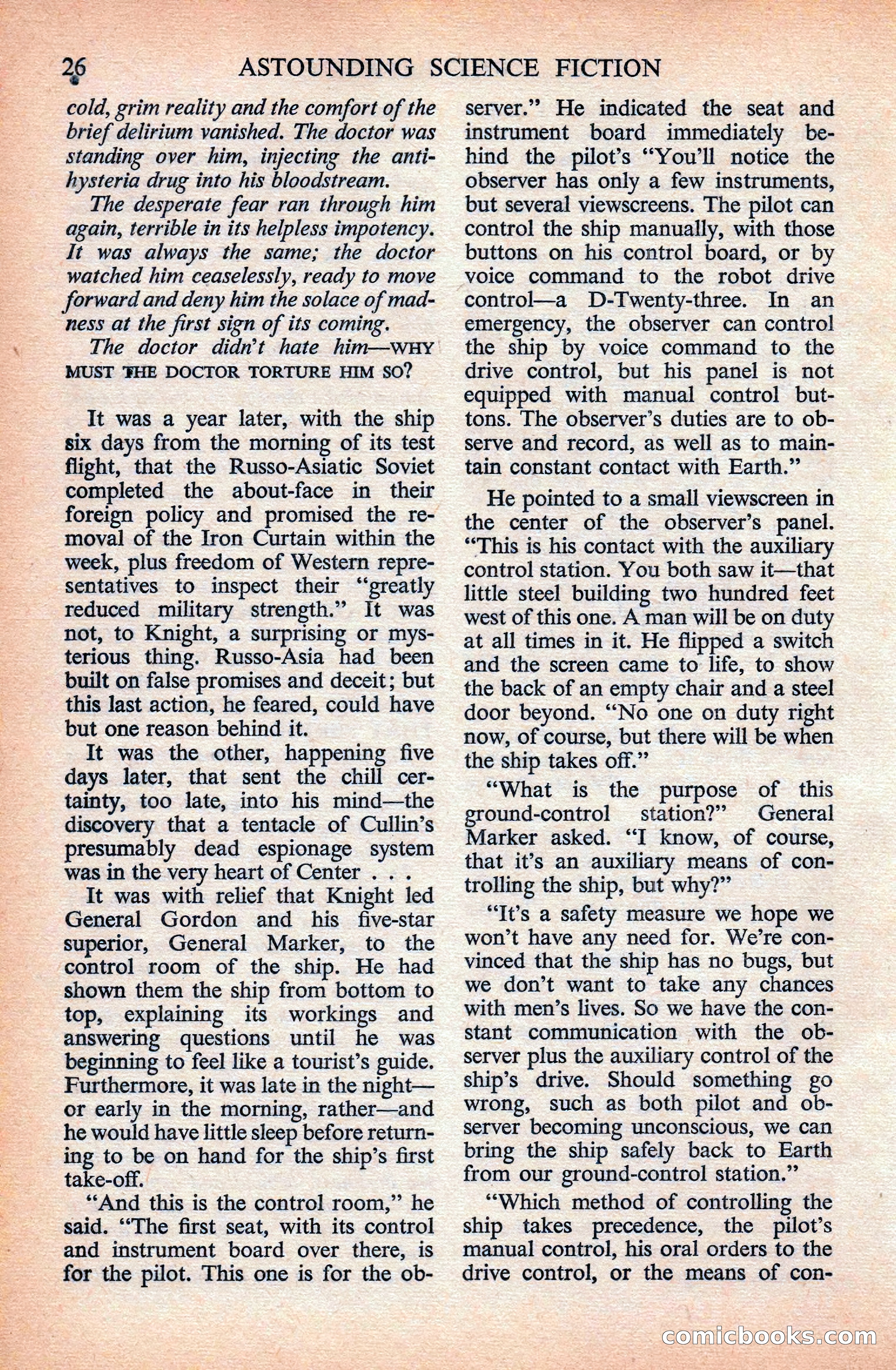
A restored page from Pulp Fiction, 1954. Page through the whole issue in the reader above.
📄 Transcribed text from this page (OCR, searchable)
Machine-transcribed from the original scan — historical spelling and the odd misread are preserved.
26 ASTOUNDING SCIENCE FICTION cold, grim reality and the comfort of the brief delirium vanished. The doctor was standing over him, injecting the anti- hysteria drug into his bloodstream. The desperate fear ran through him again, terrible in its helpless impotency. It was always the same; the doctor watched him ceaselessly, ready to move forward and deny him the solace of mad- ness at the first sign of its coming. The doctor didn’t hate him—wuHy MUST FHE DOCTOR TORTURE HIM SO? It was a year later, with the ship six days from the morning of its test flight, that the Russo-Asiatic Soviet completed the about-face in their foreign policy and promised the re- moval of the Iron Curtain within the week, plus freedom of Western repre- sentatives to inspect their “greatly reduced military strength.” It was not, to Knight, a surprising or mys- terious thing. Russo-Asia had been built on false promises and deceit; but this last action, he feared, could have but one reason behind it. It was the other, happening five days later, that sent the chill cer- tainty, too late, into his mind—the discovery that a tentacle of Cullin’s presumably dead espionage system was in the very heart of Center... It was with relief that Knight led General Gordon and his five-star superior, General Marker, to the control room of the ship. He had shown them the ship from bottom to top, explaining its workings and answering questions until he was beginning to feel like a tourist’s guide. Furthermore, it was late in the night— or early in the morning, rather—and he would have little sleep before return- ing to be on hand for the ship’s first take-off. *‘And this is the control room,” he said. ‘“‘The first seat, with its control and instrument board over there, is for the pilot. This one is for the ob- server.” He indicated the seat and instrument board immediately be- hind the pilot’s “You'll notice the observer has only a few instruments, but several viewscreens. The pilot can control the ship manually, with those buttons on his control board, or by voice command to the robot drive control—a D-Twenty-three. In an emergency, the observer can control the ship by voice command to the drive control, but his panel is not equipped with manual control but- tons. The observer’s duties are to ob- serve and record, as well as to main- tain constant contact with Earth.” He pointed to a small viewscreen in the center of the observer’s panel. “This is his contact with the auxiliary control station. You both saw it—that little steel building two hundred feet west of this one. A man will be on duty at all times in it. He flipped a switch and the screen came to life, to show the back of an empty chair and a steel door beyond. “No one on duty right now, of course, but there will be when the ship takes off.” “What is the purpose of this ground-control station?” General Marker asked. “I know, of course, that it’s an auxiliary means of con- trolling the ship, but why?” “It’s a safety measure we hope we won’t have any need for. We’re con- vinced that the ship has no bugs, but we don’t want to take any chances with men’s lives. So we have the con- stant communication with the ob- server plus the auxiliary control of the ship’s drive. Should something go wrong, such as both pilot and ob- server becoming unconscious, we can bring the ship safely back to Earth from our ground-control station.” “Which method of controlling the ship takes precedence, the pilot’s manual control, his oral orders to the drive control, or the means of con- EComichbooks.co im