
Pulp Fiction, 1954 · page 24 of 133
Astounding Science Fiction (British Edition) — page 24: what you’re looking at
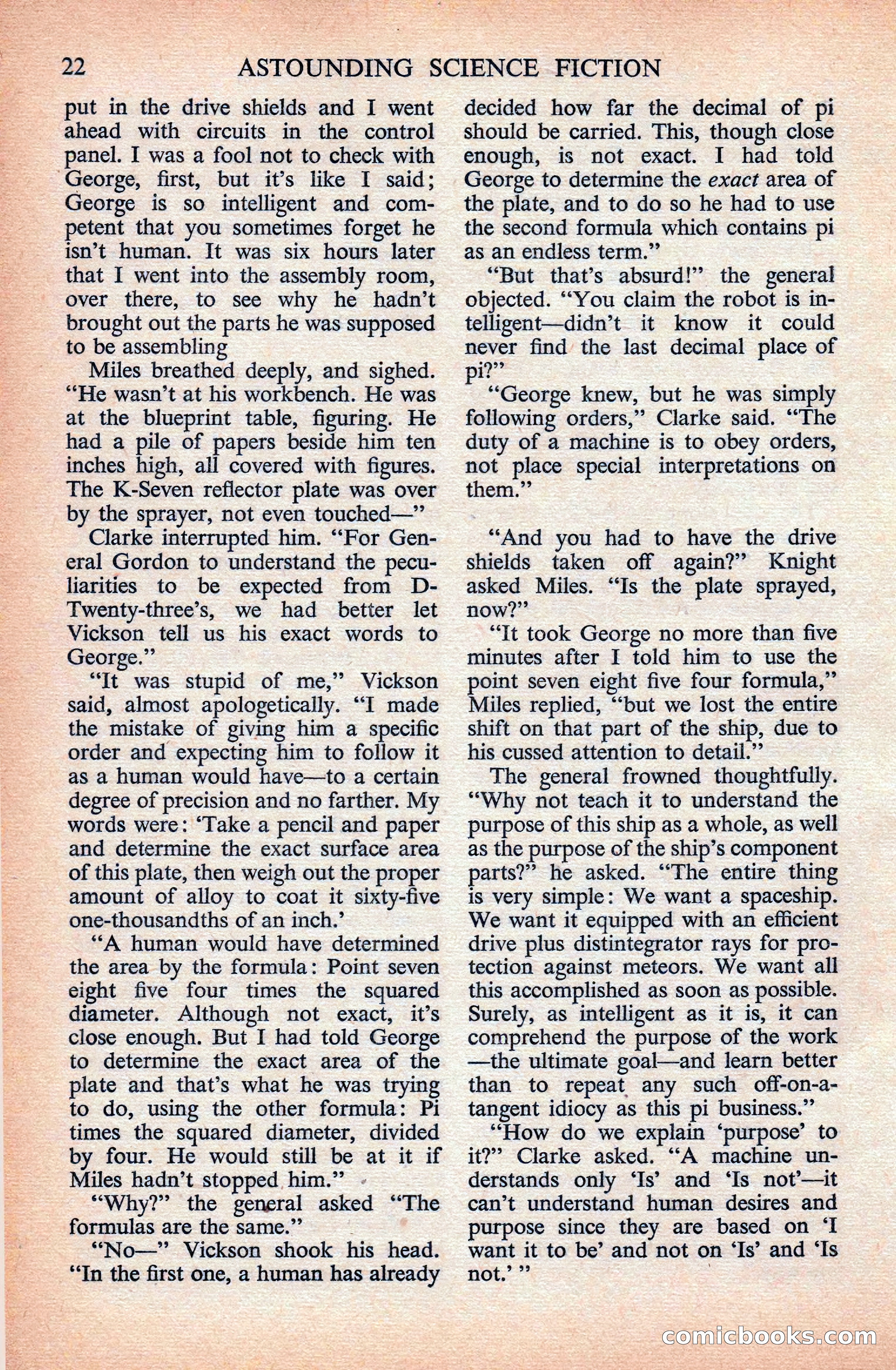
A restored page from Pulp Fiction, 1954. Page through the whole issue in the reader above.
📄 Transcribed text from this page (OCR, searchable)
Machine-transcribed from the original scan — historical spelling and the odd misread are preserved.
22 put in the drive shields and I went ahead with circuits in the control panel. I was a fool not to check with George, first, but it’s like I said; George is so intelligent and com- petent that you sometimes forget he isn’t human. It was six hours later that I went into the assembly room, over there, to see why he hadn’t brought out the parts he was supposed to be assembling Miles breathed deeply, and sighed. “He wasn’t at his workbench. He was at the blueprint table, figuring. He had a pile of papers beside him ten inches high, all covered with figures. The K-Seven reflector plate was over by the sprayer, not even touched—”’ Clarke interrupted him. “For Gen- eral Gordon to understand the pecu- liarities to be expected from D- Twenty-three’s, we had better let Vickson tell us his exact words to George.” “It was stupid of me,” Vickson said, almost apologetically. “I made the mistake of giving him a specific order and expecting him to follow it as a human would have—to a certain degree of precision and no farther. My words were: “Take a pencil and paper and determine the exact surface area of this plate, then weigh out the proper amount of alloy to coat it sixty-five one-thousandths of an inch.’ “A human would have determined the area by the formula: Point seven eight five four times the squared diameter. Although not exact, it’s close enough. But I had told George to determine the exact area of the plate and that’s what he was trying to do, using the other formula: Pi times the squared diameter, divided by four. He would still be at it if Miles hadn’t stopped him.” - “Why?” the general asked “The formulas are the same.” : “No—” Vickson shook his head. “In the first one, a human has already ASTOUNDING SCIENCE FICTION decided how far the decimal of pi should be carried. This, though close enough, is not exact. I had told George to determine the exact area of the plate, and to do so he had to use the second formula which contains pi as an endless term.” “But that’s absurd!’’ the general objected. ‘You claim the robot is in- telligent—didn’t it know it could never find the last decimal place of 5 ae “George knew, but he was simply following orders,” Clarke said. “The duty of a machine is to obey orders, not place special interpretations on them.” “And you had to have the drive shields taken off again?” Knight asked Miles. “Is the plate sprayed, now?” “It took George no more than five minutes after I told him to use the point seven eight five four formula,” Miles replied, “but we lost the entire shift on that part of the ship, due to his cussed attention to detail.” The general frowned thoughtfully. “Why not teach it to understand the purpose of this ship as a whole, as well as the purpose of the ship’s component parts?” he asked. “The entire thing is very simple: We want a spaceship. We want it equipped with an efficient drive plus distintegrator rays for pro- tection against meteors. We want all this accomplished as soon as possible. Surely, as intelligent as it is, it can comprehend the purpose of the work —the ultimate goal—and learn better than to repeat any such off-on-a- tangent idiocy as this pi business.” ‘““How do we explain ‘purpose’ to it?” Clarke asked. ““A machine un- derstands only ‘Is’ and ‘Is not’—it can’t understand human desires and purpose since they are based on ‘I want it to be’ and not on ‘Is’ and ‘Is not.’ ”’ | Eomichbooks:. co im