
Pulp Fiction, 1954 · page 12 of 133
Astounding Science Fiction (British Edition) — page 12: what you’re looking at
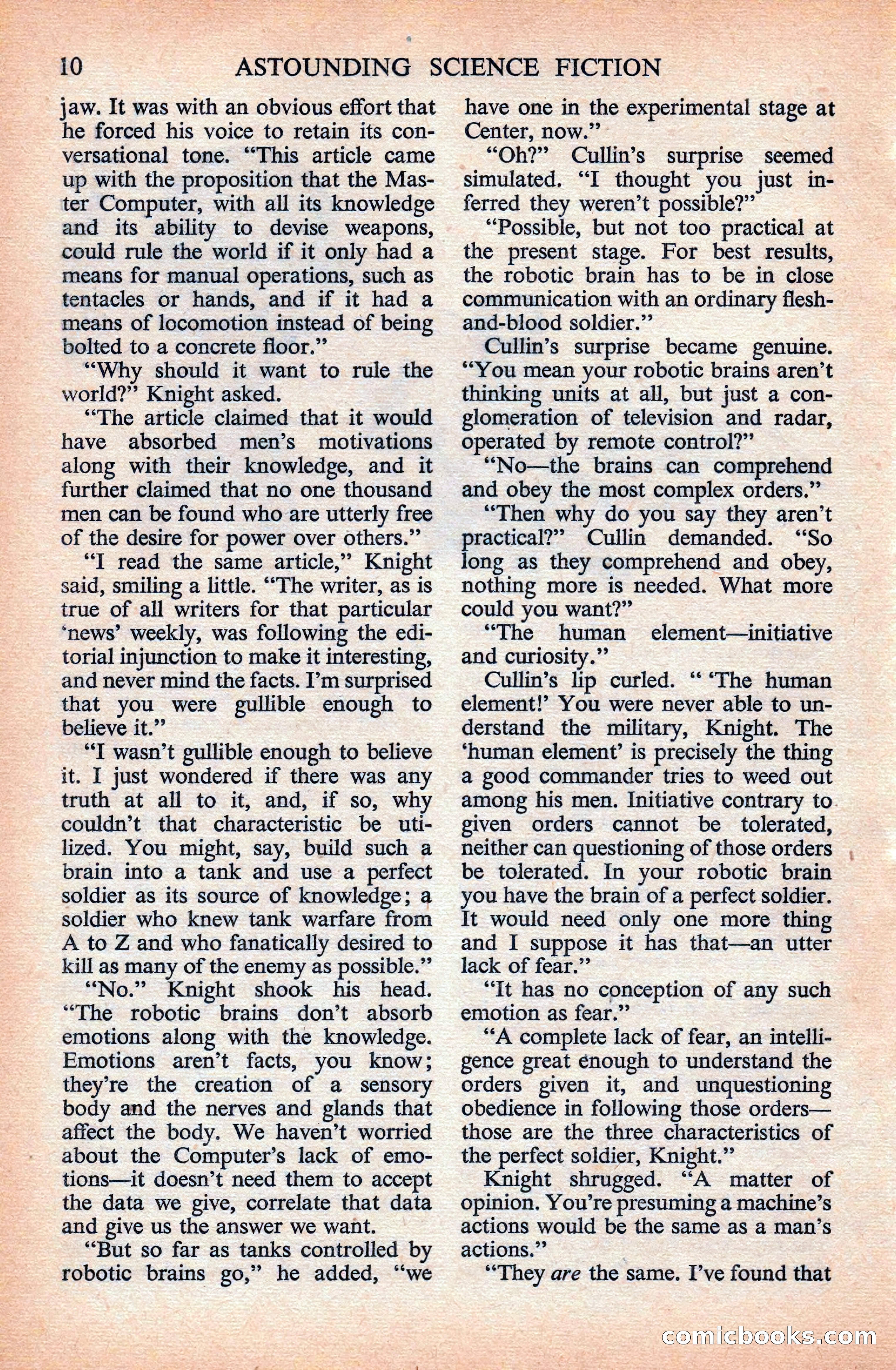
A restored page from Pulp Fiction, 1954. Page through the whole issue in the reader above.
📄 Transcribed text from this page (OCR, searchable)
Machine-transcribed from the original scan — historical spelling and the odd misread are preserved.
10 ASTOUNDING SCIENCE FICTION jaw. It was with an obvious effort that he forced his voice to retain its con- versational tone. “This article came up with the proposition that the Mas- ter Computer, with all its knowledge and its ability to devise weapons, could rule the world if it only had a means for manual operations, such as tentacles or hands, and if it had a means of locomotion instead of being bolted to a concrete floor.” “Why should it want to rule the world?” Knight asked. “The article claimed that it would have absorbed men’s motivations along with their knowledge, and it further claimed that no one thousand men can be found who are utterly free of the desire for power over others.” “I read the same article,” Knight said, smiling a little. ““The writer, as is true of all writers for that particular ‘news’ weekly, was following the edi- torial injunction to make it interesting, and never mind the facts. I’m surprised that you were gullible enough to believe it.” “I wasn’t gullible enough to believe it. I just wondered if there was any truth at all to it, and, if so, why couldn’t that characteristic be uti- lized. You might, say, build such a brain into a tank and use a perfect soldier as its source of knowledge; a soldier who knew tank warfare from A to Z and who fanatically desired to kill as many of the enemy as possible.” “No.” Knight shook his head. “The robotic brains don’t absorb emotions along with the knowledge. Emotions aren’t facts, you know; they’re the creation of a sensory body and the nerves and glands that affect the body. We haven’t worried about the Computer’s lack of emo- tions—it doesn’t need them to accept the data we give, correlate that data and give us the answer we want. “But so far as tanks controlled by robotic brains go,” he added, “we have one in the experimental stage at Center, now.” - “Oh?” Cullin’s surprise seemed simulated. “I thought you just in- ferred they weren’t possible?” “Possible, but not too practical at the present stage. For best results, the robotic brain has to be in close communication with an ordinary flesh- and-blood soldier.”’ Cullin’s surprise became genuine. *“You mean your robotic brains aren’t thinking units at all, but just a con- glomeration of television and radar, operated by remote control?” “‘No—the brains can comprehend and obey the most complex orders.” “Then why do you say they aren’t practical?” Cullin demanded. “So long as they comprehend and obey, nothing more is needed. What more could you want?” “The human element—initiative and curiosity.” Cullin’s lip curled. “ ‘The human element!’ You were never able to un- derstand the military, Knight. The ‘human element’ is precisely the thing a good commander tries to weed out among his men. Initiative contrary to. given orders cannot be tolerated, neither can questioning of those orders be tolerated. In your robotic brain you have the brain of a perfect soldier. It would need only one more thing and I suppose it has that—an utter lack of fear.”’ “It has no conception of any such emotion as fear.” “A complete lack of fear, an intelli- gence great enough to understand the orders given it, and unquestioning obedience in following those orders— those are the three characteristics of the perfect soldier, Knight.” Knight shrugged. “A matter of opinion, You're presuming a machine’s actions would be the same as a man’s actions.” | *“They are the same. I’ve found that - im comicbookssco