
Pulp Fiction, 1954 · page 118 of 133
Astounding Science Fiction (British Edition) — page 118: what you’re looking at
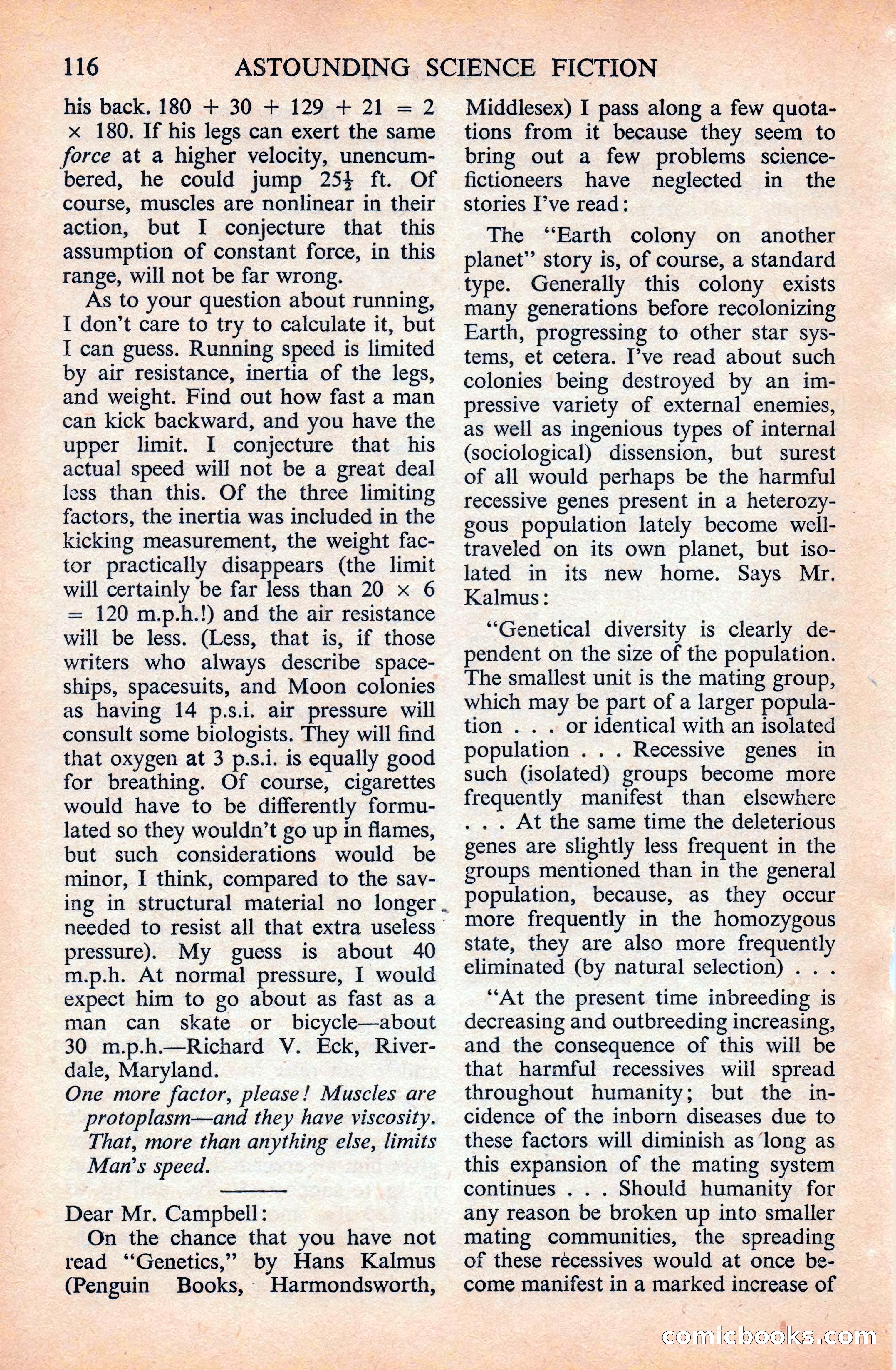
A restored page from Pulp Fiction, 1954. Page through the whole issue in the reader above.
📄 Transcribed text from this page (OCR, searchable)
Machine-transcribed from the original scan — historical spelling and the odd misread are preserved.
116 his back. 180 + 30 + 129 + 21 =2 x 180. If his legs can exert the same force at a higher velocity, unencum- bered, he could jump 254 ft. Of course, muscles are nonlinear in their action, but I conjecture that this assumption of constant force, in this range, will not be far wrong. As to your question about running, I don’t care to try to calculate it, but I can guess. Running speed is limited by air resistance, inertia of the legs, and weight. Find out how fast a man can kick backward, and you have the upper limit. I conjecture that his actual speed will not be a great deal less than this. Of the three limiting factors, the inertia was included in the kicking measurement, the weight fac- tor practically disappears (the limit will certainly be far less than 20 x 6 = 120 m.p.h.!) and the air resistance will be less. (Less, that is, if those writers who always describe space- ships, spacesuits, and Moon colonies as having 14 p.s.i. air pressure will consult some biologists. They will find that oxygen at 3 p.s.i. is equally good for breathing. Of course, cigarettes would have to be differently formu- lated so they wouldn’t go up in flames, but such considerations would be minor, I think, compared to the sav- ing in structural material no longer . needed to resist all that extra useless pressure). My guess is about 40 m.p.h. At normal pressure, I would expect him to go about as fast as a man can skate or bicycle—about 30 m.p.h.—Richard V. Eck, River- dale, Maryland. One more factor, please! Muscles are protoplasm—and they have viscosity. That, more than anything else, limits Man’s speed. Dear Mr. Campbell: On the chance that you have not read ‘‘Genetics,” by Hans Kalmus (Penguin Books, Harmondsworth, ASTOUNDING SCIENCE FICTION Middlesex) I pass along a few quota- tions from it because they seem to bring out a few problems science- fictioneers have neglected in the stories I’ve read: The “Earth colony on another planet” story is, of course, a standard type. Generally this colony exists many generations before recolonizing Earth, progressing to other star sys- tems, et cetera. I’ve read about such colonies being destroyed by an im- pressive variety of external enemies, as well as ingenious types of internal (sociological) dissension, but surest of all would perhaps be the harmful recessive genes present in a heterozy- | gous population lately become well- traveled on its own planet, but iso- lated in its new home. Says Mr. Kalmus: ‘““Genetical diversity is clearly de- pendent on the size of the population. The smallest unit is the mating group, which may be part of a larger popula- tion . . . or identical with an isolated population .. . Recessive genes in such (isolated) groups become more frequently manifest than elsewhere . . . At the same time the deleterious genes are slightly less frequent in the groups mentioned than in the general population, because, as they occur more frequently in the homozygous state, they are also more frequently eliminated (by natural selection) .. . “At the present time inbreeding is decreasing and outbreeding increasing, and the consequence of this will be that harmful recessives will spread throughout humanity; but the in- cidence of the inborn diseases due to these factors will diminish as ‘long as this expansion of the mating system continues . . . Should humanity for any reason be broken up into smaller mating communities, the spreading of these recessives would at once be- come manifest in a marked increase of me comiclooks.co