
Pulp Fiction, 1954 · page 110 of 133
Astounding Science Fiction (British Edition) — page 110: what you’re looking at
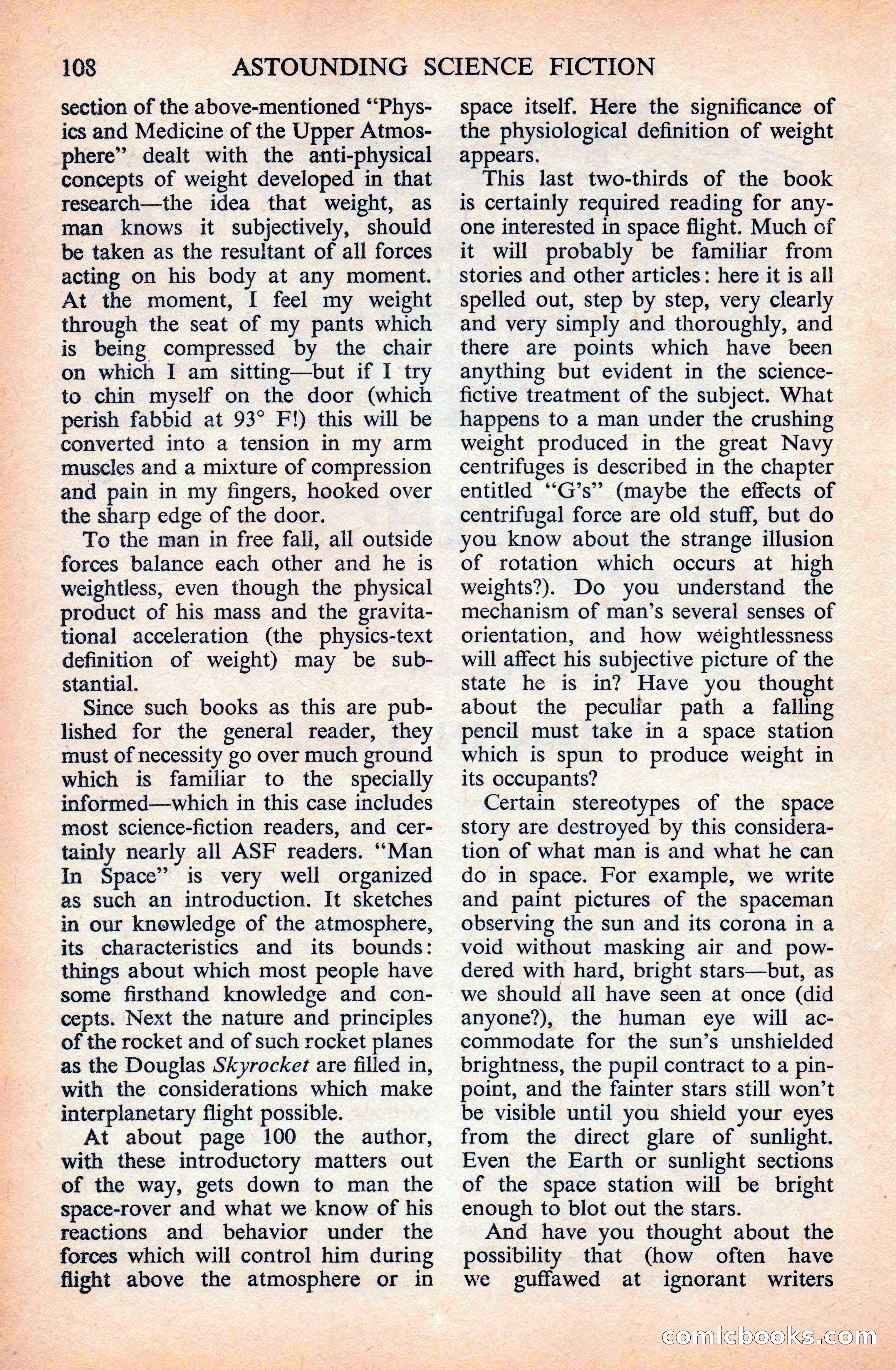
A restored page from Pulp Fiction, 1954. Page through the whole issue in the reader above.
📄 Transcribed text from this page (OCR, searchable)
Machine-transcribed from the original scan — historical spelling and the odd misread are preserved.
108 section of the above-mentioned ‘‘Phys- ics and Medicine of the Upper Atmos- phere’ dealt with the anti-physical concepts of weight developed in that research—the idea that weight, as man knows it subjectively, should be taken as the resultant of all forces acting on his body at any moment. At the moment, I feel my weight through the seat of my pants which is being compressed by the chair on which I am sitting—but if I try to chin myself on the door (which perish fabbid at 93° F!) this will be converted into a tension in my arm muscles and a mixture of compression and pain in my fingers, hooked over the sharp edge of the door. To the man in free fall, all outside forces balance each other and he is weightless, even though the physical product of his mass and the gravita- tional acceleration (the physics-text definition of weight) may be sub- stantial. Since such books as this are pub- lished for the general reader, they must of necessity go over much ground which is familiar to the specially informed—which in this case includes most science-fiction readers, and cer- tainly nearly all ASF readers. ‘““Man In Space” is very well organized as such an introduction. It sketches in our knowledge of the atmosphere, its characteristics and its bounds: things about which most people have some firsthand knowledge and con- cepts. Next the nature and principles of the rocket and of such rocket planes as the Douglas Skyrocket are filled in, with the considerations which make interplanetary flight possible. At about page 100 the author, with these introductory matters out of the way, gets down to man the space-rover and what we know of his reactions and behavior under the forces which will control him during flight above the atmosphere or in ASTOUNDING SCIENCE FICTION space itself. Here the significance of the physiological definition of weight appears. This last two-thirds of the book is certainly required reading for any- one interested in space flight. Much of it will probably be familiar from stories and other articles: here it is all spelled out, step by step, very clearly and very simply and thoroughly, and there are points which have been anything but evident in the science- fictive treatment of the subject. What happens to a man under the crushing weight produced in the great Navy centrifuges is described in the chapter entitled “‘G’s’’ (maybe the effects of centrifugal force are old stuff, but do you know about the strange illusion of rotation which occurs at high weights?). Do you understand the mechanism of man’s several senses of orientation, and how weightlessness will affect his subjective picture of the state he is in? Have you thought about the peculiar path a falling pencil must take in a space station which is spun to produce weight in its occupants? Certain stereotypes of the space story are destroyed by this considera- tion of what man is and what he can do in space. For example, we write and paint pictures of the spaceman — observing the sun and its corona in a void without masking air and pow- dered with hard, bright stars—but, as we should all have seen at once (did anyone?), the human eye will ac- commodate for the sun’s unshielded brightness, the pupil contract to a pin- point, and the fainter stars still won’t be visible until you shield your eyes from the direct glare of sunlight. Even the Earth or sunlight sections of the space station will be bright enough to blot out the stars. And have you thought about the possibility that (how often have we guffawed at ignorant writers EComicdooks. co im