
Pulp Fiction, 1954 · page 94 of 132
Astounding Science Fiction, British Edition — page 94: what you’re looking at
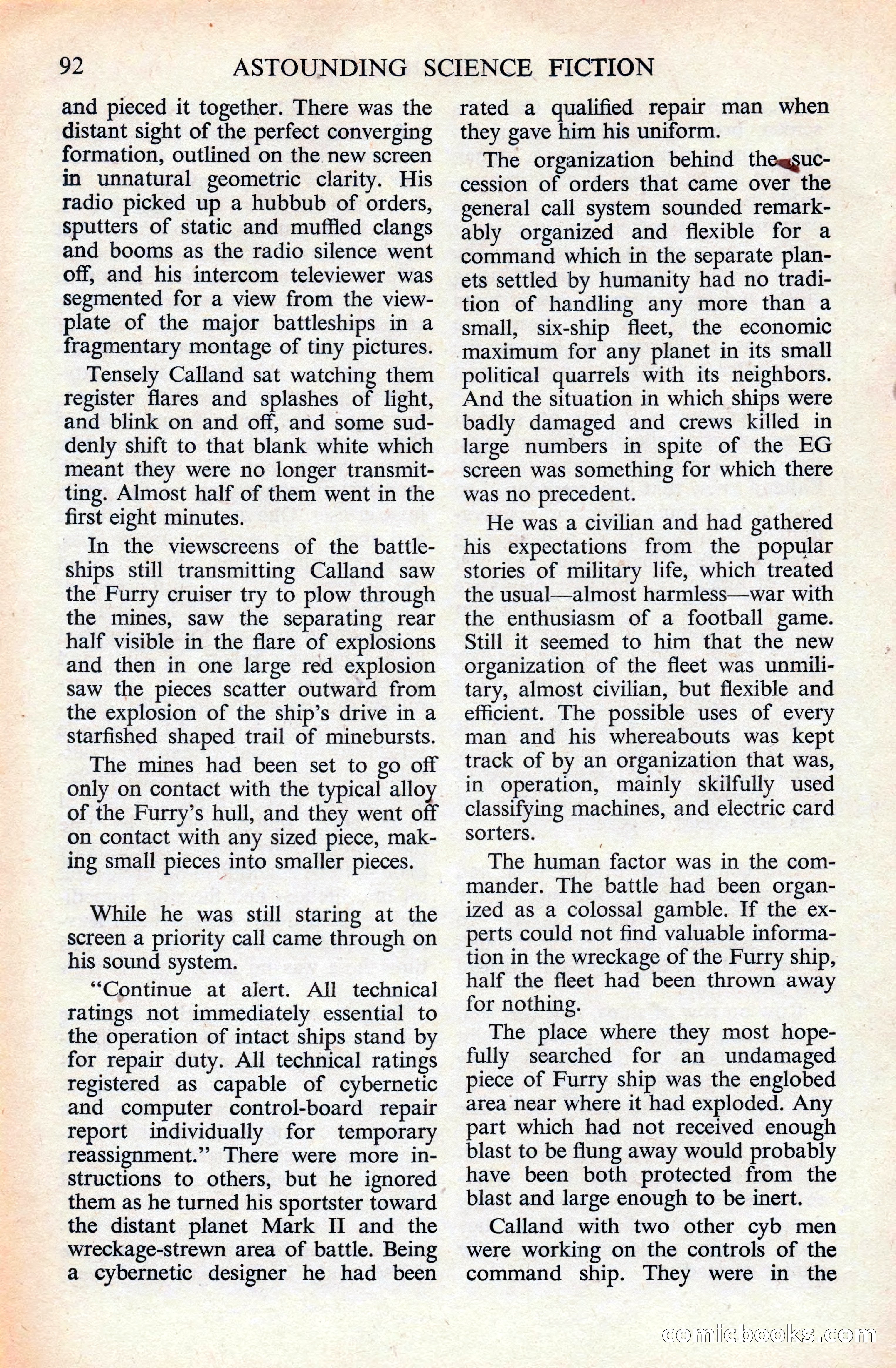
A restored page from Pulp Fiction, 1954. Page through the whole issue in the reader above.
📄 Transcribed text from this page (OCR, searchable)
Machine-transcribed from the original scan — historical spelling and the odd misread are preserved.
92 ASTOUNDING SCIENCE FICTION and pieced it together. There was the distant sight of the perfect converging formation, outlined on the new screen in unnatural geometric clarity. His radio picked up a hubbub of orders, sputters of static and muffled clangs and booms as the radio silence went off, and his intercom televiewer was segmented for a view from the view- plate of the major battleships in a fragmentary montage of tiny pictures. Tensely Calland sat watching them register flares and splashes of light, and blink on and off, and some sud- denly shift to that blank white which meant they were no longer transmit- ting. Almost half of them went in the first eight minutes. In the viewscreens of the battle- ships still transmitting Calland saw the Furry cruiser try to plow through the mines, saw the separating rear half visible in the flare of explosions and then in one large red explosion saw the pieces scatter outward from the explosion of the ship’s drive in a starfished shaped trail of minebursts. The mines had been set to go off only on contact with the typical alloy of the Furry’s hull, and they went off on contact with any sized piece, mak- ing small pieces into smaller pieces. While he was still staring at the screen a priority call came through on his sound system. “Continue at alert. All technical ratings not immediately essential to the operation of intact ships stand by for repair duty. All technical ratings registered as capable of cybernetic and computer control-board repair report individually for temporary reassignment.” There were more in- structions to others, but he ignored them as he turned his sportster toward the distant planet Mark II and the wreckage-strewn area of battle. Being a cybernetic designer he had been rated a qualified repair man when they gave him his uniform. The organization behind thegguc- cession of orders that came over the general call system sounded remark- ably organized and flexible for a command which in the separate plan- ets settled by humanity had no tradi- tion of handling any more than a small, six-ship fleet, the economic maximum for any planet in its small political quarrels with its neighbors. And the situation in which ships were badly damaged and crews killed in large numbers in spite of the EG screen was something for which there was no precedent. : He was a civilian and had gathered his expectations from the popular stories of military life, which treated the usual—almost harmless—war with the enthusiasm of a football game. Still it seemed to him that the new organization of the fleet was unmili- tary, almost civilian, but flexible and efficient. The possible uses of every man and his whereabouts was kept track of by an organization that was, in operation, mainly skilfully used classifying machines, and electric card sorters. The human factor was in the com- mander. The battle had been organ- ized as a colossal gamble. If the ex- perts could not find valuable informa- tion in the wreckage of the Furry ship, half the fleet had been thrown away for nothing. The place where they most hope- fully searched for an undamaged piece of Furry ship was the englobed area near where it had exploded. Any part which had not received enough blast to be flung away would probably have been both protected from the blast and large enough to be inert. Calland with two other cyb men were working on the controls of the command ship. They were in the coniiclooolks.conn