
Pulp Fiction, 1954 · page 76 of 132
Astounding Science Fiction, British Edition — page 76: what you’re looking at
A restored page from Pulp Fiction, 1954. Page through the whole issue in the reader above.
📄 Transcribed text from this page (OCR, searchable)
Machine-transcribed from the original scan — historical spelling and the odd misread are preserved.
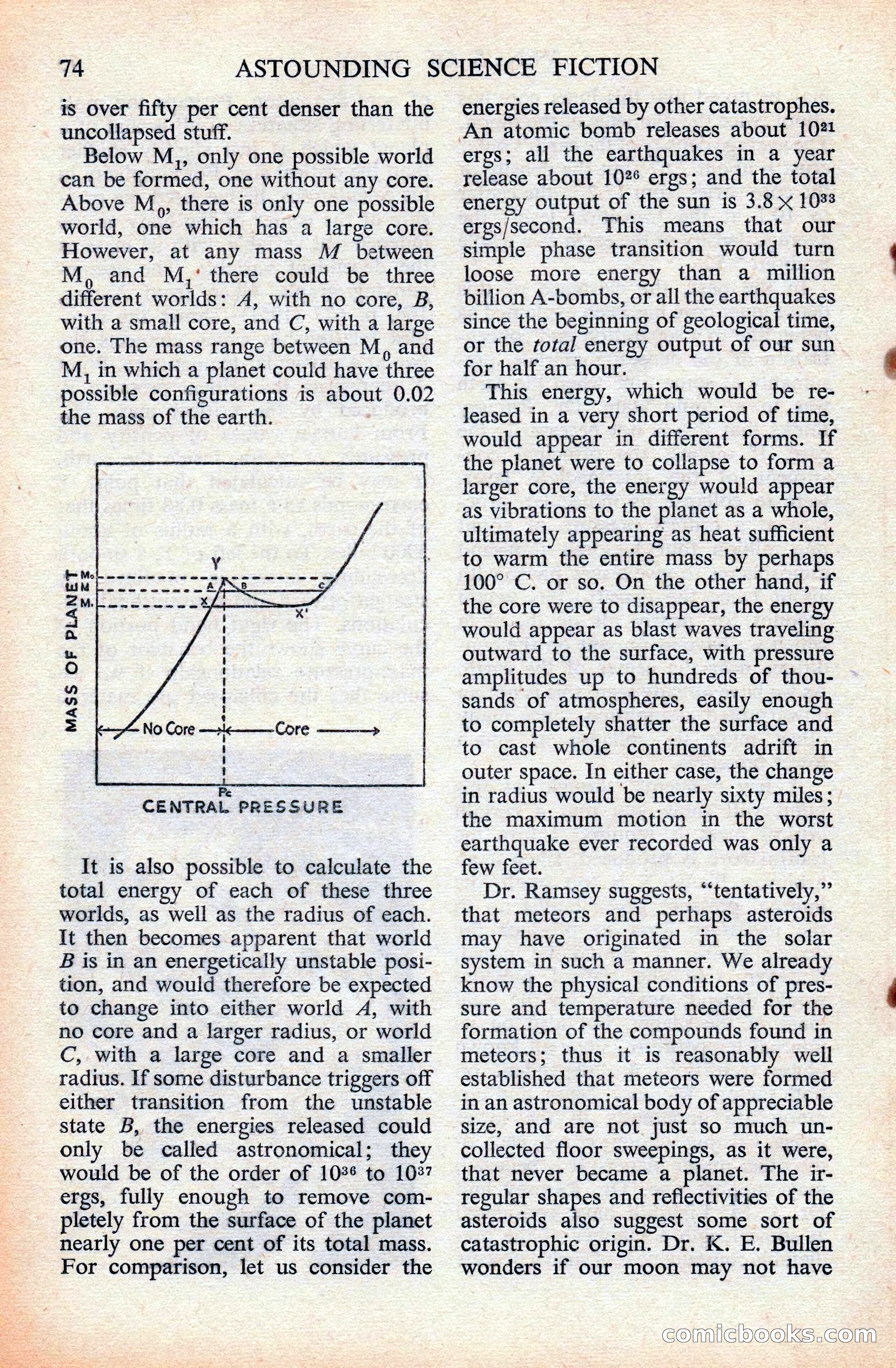
74 ASTOUNDING SCIENCE FICTION is over fifty per cent denser than the uncollapsed stuff. Below M,, only one possible world can be formed, one without any core. Above M,, there is only one possible world, one which has a large core. However, at any mass M between M, and M,‘ there could be three different worlds: A, with no core, B, with a small core, and C, with a large one. The mass range between M, and M, in which a planet could have three possible configurations is about 0.02 the mass of the earth. ——S oe ee eS oe nee 2s = = ay See e a= we eee = = MASS OF PLANET No Core —-e—_——-Core ———-—» 7 —— = CENTRAL PRESSURE It is also possible to calculate the total energy of each of these three worlds, as well as the radius of each. It then becomes apparent that world B is in an energetically unstable posi- tion, and would therefore be expected to change into either world A, with no core and a larger radius, or world C, with a large core and a smaller radius. If some disturbance triggers off either transition from the unstable state B, the energies released could only be called astronomical; the would be of the order of 10°* to 10%? ergs, fully enough to remove com- pletely from the surface of the planet nearly one per cent of its total mass. For comparison, let us consider the energies released by other catastrophes. An atomic bomb releases about 1071 ergs; all the earthquakes in a year release about 102° ergs; and the total energy output of the sun is 3.8 x 1038 ergs/second. This means that our simple phase transition would turn loose more energy than a million billion A-bombs, or all the earthquakes since the beginning of geological time, or the total energy output of our sun for half an hour. This energy, which would be re- leased in a very short period of time, would appear in different forms. If the planet were to collapse to form a larger core, the energy would appear as vibrations to the planet as a whole, ultimately appearing as heat sufficient to warm the entire mass by perhaps 100° C. or so. On the other hand, if the core were to disappear, the energy would appear as blast waves traveling outward to the surface, with pressure amplitudes up to hundreds of thou- sands of atmospheres, easily enough to completely shatter the surface and to cast whole continents adrift in outer space. In either case, the change in radius would be nearly sixty miles; the maximum motion in the worst earthquake ever recorded was only a few feet. Dr. Ramsey suggests, “‘tentatively,”’ that meteors and perhaps asteroids may have originated in the solar system in such a manner. We already know the physical conditions of pres- sure and temperature needed for the formation of the compounds found in meteors; thus it is reasonably well established that meteors were formed in an astronomical body of appreciable size, and are not just so much un- collected floor sweepings, as it were, that never became a planet. The ir- regular shapes and reflectivities of the asteroids also suggest some sort of catastrophic origin. Dr. K. E. Bullen wonders if our moon may not have conniclooolks.c© in