
Pulp Fiction, 1954 · page 73 of 132
Astounding Science Fiction, British Edition — page 73: what you’re looking at
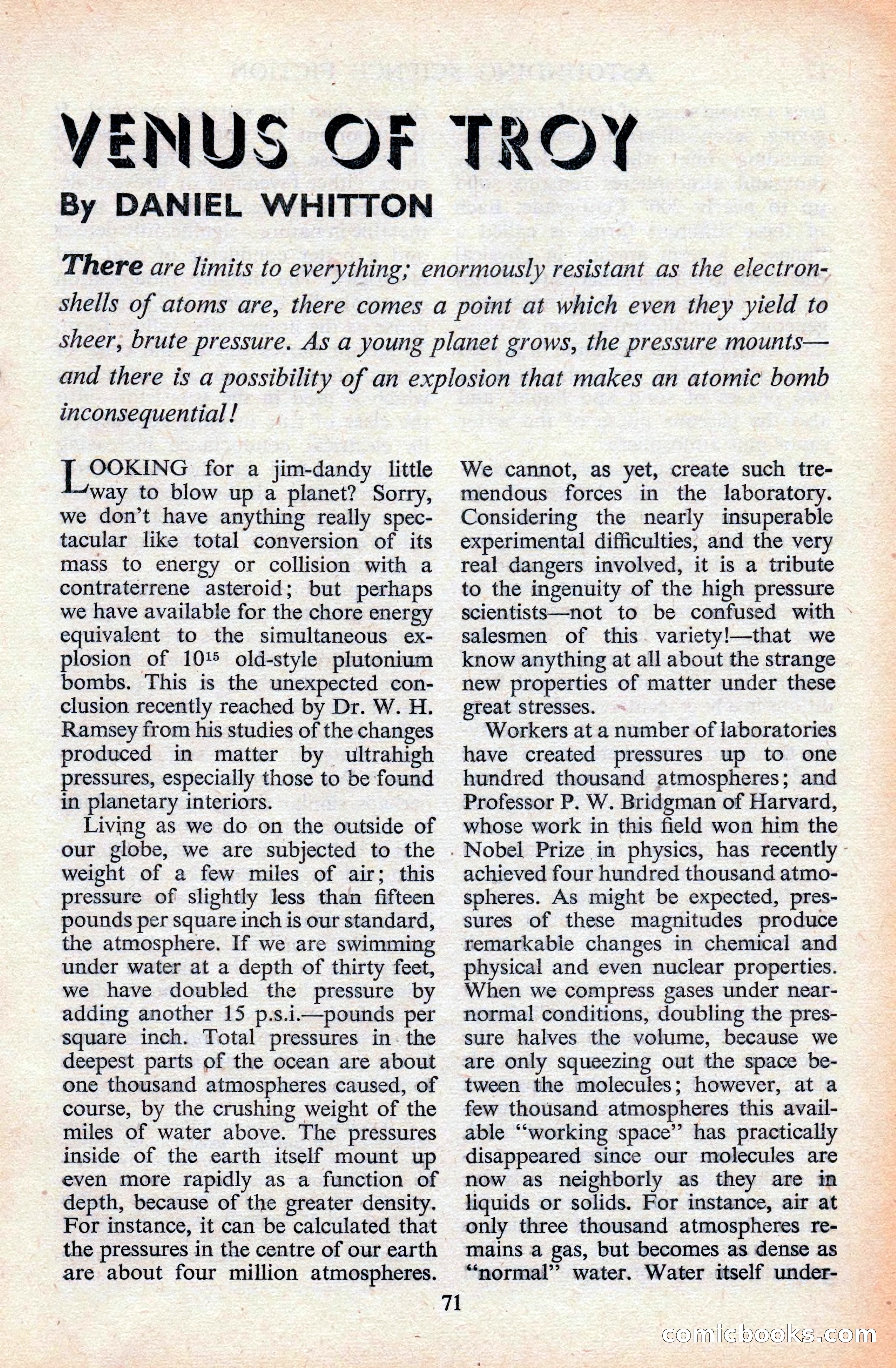
A restored page from Pulp Fiction, 1954. Page through the whole issue in the reader above.
📄 Transcribed text from this page (OCR, searchable)
Machine-transcribed from the original scan — historical spelling and the odd misread are preserved.
VENUS OF TROY By DANIEL WHITTON There are limits to everything; enormously resistant as the electron- shells of atoms are, there comes a point at which even they yield to sheer, brute pressure. As a young planet grows, the pressure mounts— and there is a possibility of an explosion that makes an atomic bomb inconsequential ! F OORING for a jim-dandy little way to blow up a planet? Sorry, we don’t have anything really spec- tacular like total conversion of its mass to energy or collision with a contraterrene asteroid; but perhaps we have available for the chore energy equivalent to the simultaneous ex- plosion of 1015 old-style plutonium bombs. This is the unexpected con- clusion recently reached by Dr. W. H. Ramsey from his studies of the changes produced in matter by ultrahigh pressures, especially those to be found in planetary interiors. Living as we do on the outside of our globe, we are subjected to the weight of a few miles of air; this pressure of slightly less than fifteen pounds per square inch is our standard, the atmosphere. If we are swimming under water at a depth of thirty feet, we have doubled the pressure by adding another 15 p.s.i—pounds per square inch. Total pressures in. the deepest parts of the ocean are about one thousand atmospheres caused, of course, by the crushing weight of the miles of water above. The pressures inside of the earth itself mount up even more rapidly as a function of depth, because of the greater density. For instance, it can be calculated that the pressures in the centre of our earth are about four million atmospheres. . Nobel Prize in physics, has recently - 71 We cannot, as yet, create such tre- mendous forces in the laboratory. Considering the nearly insuperable experimental difficulties, and the very real dangers involved, it is a tribute to the ingenuity of the high pressure scientists—not to be confused with - salesmen of this. variety!—that we know anything at all about the strange new properties of matter under these great stresses. Workers at a number of laboratories have created pressures up to one hundred thousand atmospheres; and Professor P. W. Bridgman of Harvard, whose work in this field won him the achieved four hundred thousand atmo- spheres. As might be expected, pres- sures of these magnitudes produce remarkable changes in chemical and physical and even nuclear properties. When we compress gases under near- normal conditions, doubling the pres- sure halves the volume, because we are only squeezing out the space be- tween the molecules; however, at a few thousand atmospheres this avail- able “working space’ has practically disappeared since our molecules are now as neighborly as they are in liquids or solids. For instance, air at only three thousand atmospheres re- mains a gas, but becomes as dense as “normal” water. Water itself under- connicloooks.c@© im