
Pulp Fiction, 1954 · page 70 of 132
Astounding Science Fiction, British Edition — page 70: what you’re looking at
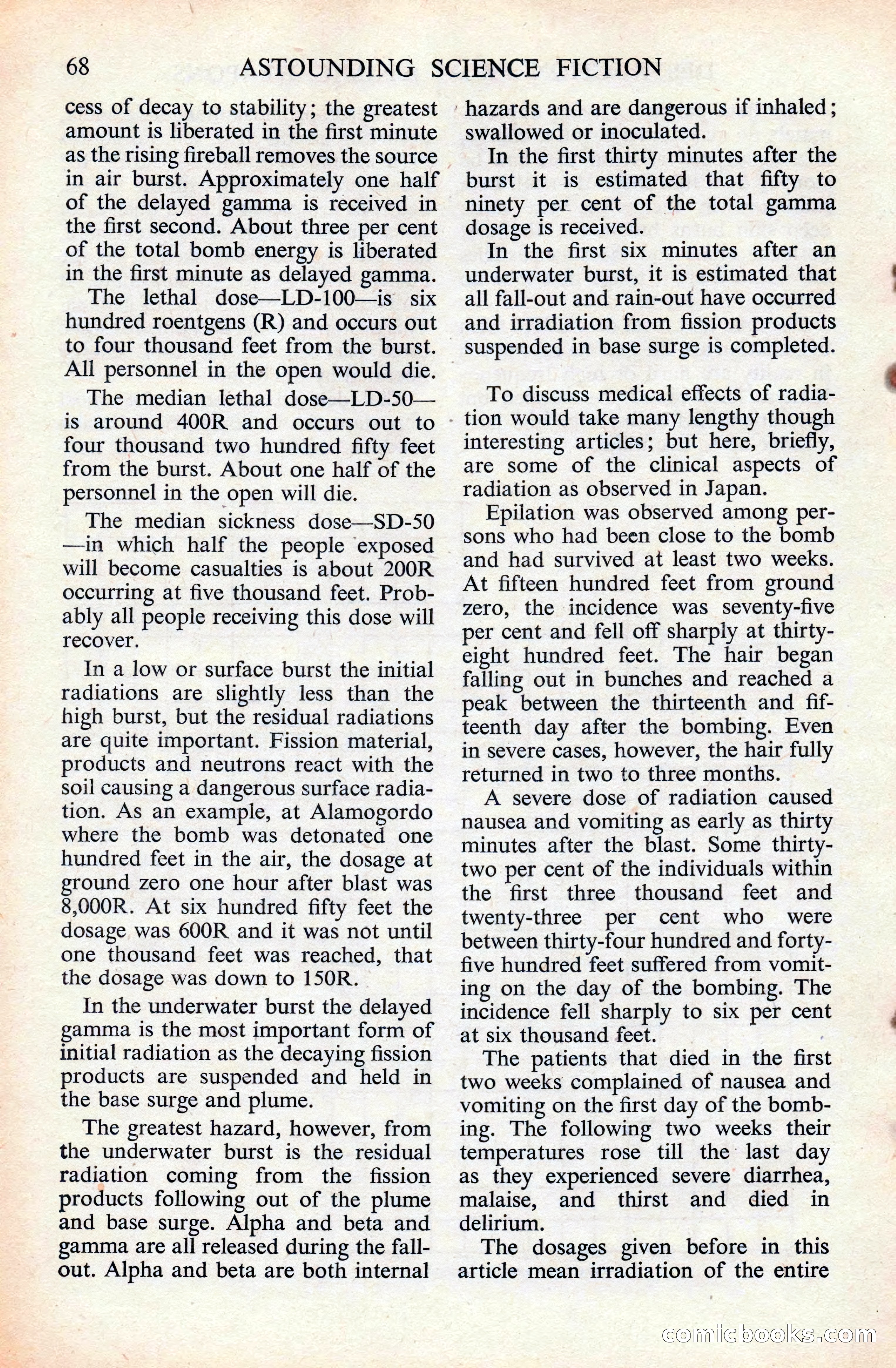
A restored page from Pulp Fiction, 1954. Page through the whole issue in the reader above.
📄 Transcribed text from this page (OCR, searchable)
Machine-transcribed from the original scan — historical spelling and the odd misread are preserved.
68 ASTOUNDING SCIENCE FICTION cess of decay to stability; the greatest amount is liberated in the first minute as the rising fireball removes the source in air burst. Approximately one half of the delayed gamma is received in the first second. About three per cent of the total bomb energy is liberated in the first minute as delayed gamma. The lethal dose—LD-100—is six hundred roentgens (R) and occurs out to four thousand feet from the burst. All personnel in the open would die. The median lethal dose—LD-50— is around 400R and occurs out to four thousand two hundred fifty feet from the burst. About one half of the personnel in the open will die. The median sickness dose—SD-50 —in which half the people exposed will become casualties is about 200R occurring at five thousand feet. Prob- ably all people receiving this dose will recover. In a low or surface burst the initial radiations are slightly less than the high burst, but the residual radiations are quite important. Fission material, products and neutrons react with the soil causing a dangerous surface radia- tion. As an example, at Alamogordo where the bomb was detonated one hundred feet in the air, the dosage at round zero one hour after blast was 8,000R. At six hundred fifty feet the dosage was 600R and it was not until one thousand feet was reached, that the dosage was down to 150R. In the underwater burst the delayed gamma is the most important form of initial radiation as the decaying fission products are suspended and held in the base surge and plume. The greatest hazard, however, from the underwater burst is the residual radiation coming from the fission products following out of the plume and base surge. Alpha and beta and gamma are all released during the fall- out. Alpha and beta are both internal hazards and are dangerous if inhaled ; swallowed or inoculated. In the first thirty minutes after the burst it is estimated that fifty to ninety per cent of the total gamma dosage is received. In the first six minutes after an underwater burst, it is estimated that all fall-out and rain-out have occurred and irradiation from fission products _ suspended in base surge is completed. To discuss medical effects of radia- - tion would take many lengthy though interesting articles; but here, briefly, are some of the clinical aspects of radiation as observed in Japan. Epilation was observed among per- sons who had been close to the bomb and had survived at least two weeks. At fifteen hundred feet from ground zero, the incidence was seventy-five per cent and fell off sharply at thirty- eight hundred feet. The hair began falling out in bunches and reached a peak between the thirteenth and fif- teenth day after the bombing. Even in severe cases, however, the hair fully returned in two to three months. A severe dose of radiation caused nausea and vomiting as early as thirty minutes after the blast. Some thirty- two per cent of the individuals within the first three thousand feet and twenty-three per cent who were between thirty-four hundred and forty- five hundred feet suffered from vomit- ing on the day of the bombing. The incidence fell sharply to six per cent at six thousand feet. ! The patients that died in the firs two weeks complained of nausea and vomiting on the first day of the bomb- ing. The following two weeks their temperatures rose till the last day as they experienced severe diarrhea, malaise, and thirst and died in delirium. The dosages given before in this article mean irradiation of the entire connicloooks.c© nn