
Pulp Fiction, 1954 · page 63 of 132
Astounding Science Fiction, British Edition — page 63: what you’re looking at
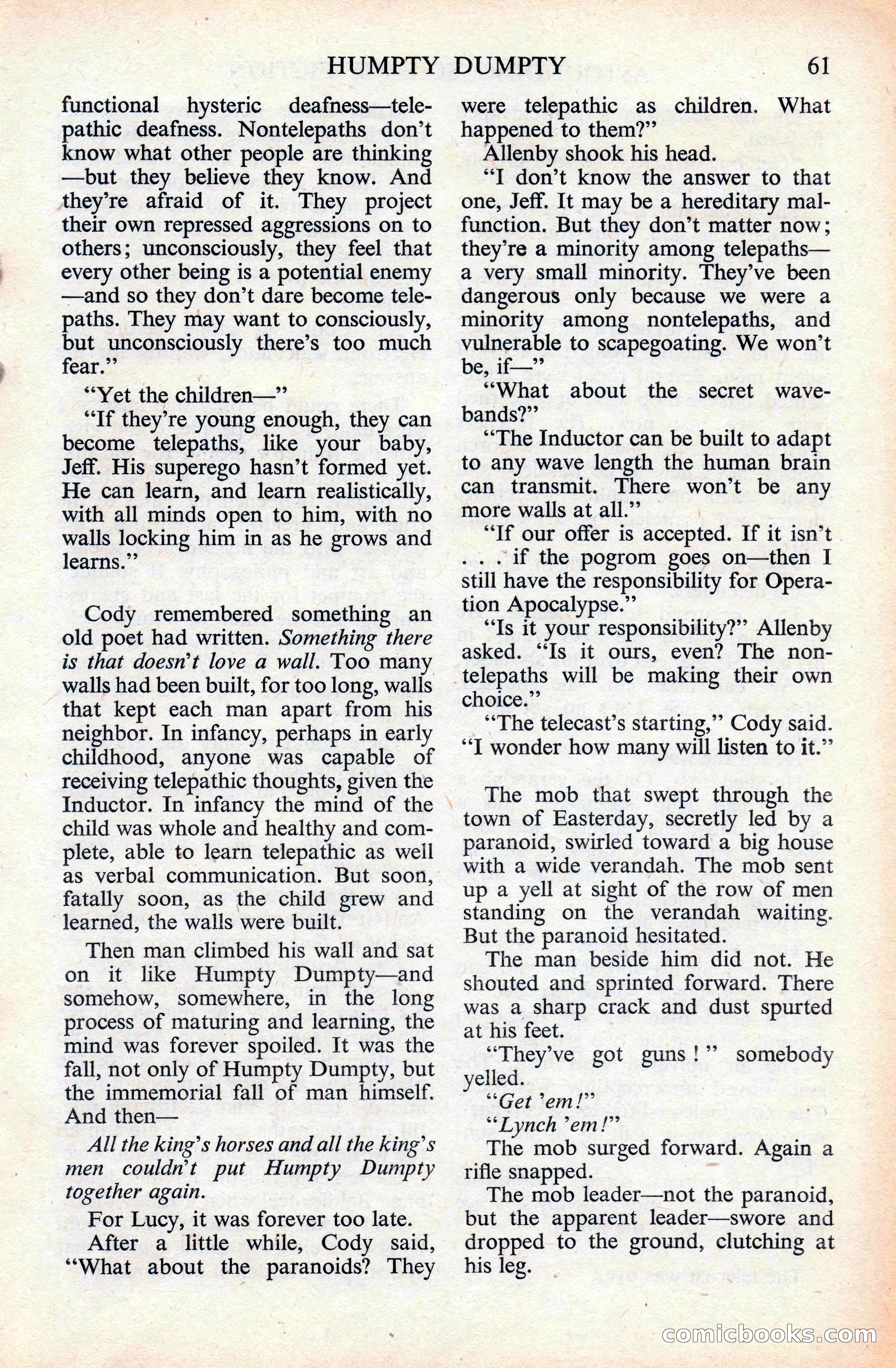
A restored page from Pulp Fiction, 1954. Page through the whole issue in the reader above.
📄 Transcribed text from this page (OCR, searchable)
Machine-transcribed from the original scan — historical spelling and the odd misread are preserved.
HUMPTY DUMPTY GE functional hysteric deafness—tele- pathic deafness. Nontelepaths don’t know what other people are thinking —but they believe they know. And they’re afraid of it. They project their own repressed aggressions on to others; unconsciously, they feel that every Other being is a potential enemy —and so they don’t dare become tele- paths. They may want to consciously, but unconsciously there’s too much fear.” “Yet the children—” “If they’re young enough, they can become telepaths, like your baby, Jeff. His superego hasn’t formed yet. He can learn, and learn realistically, with all minds open to him, with no walls locking him in as he grows and learns.” Cody remembered something an old poet had written. Something there is that doesn’t love a wall. Too many walls had been built, for too long, walls that kept each man apart from his neighbor. In infancy, perhaps in early childhood, anyone was capable of receiving telepathic thoughts, given the Inductor. In infancy the mind of the © child was whole and healthy and com- plete, able to learn telepathic as weil as verbal communication. But soon, fatally soon, as the child grew and learned, the walls were built. Then man climbed his wall and sat on it like Humpty Dumpty—and somehow, somewhere, in the long process of maturing and learning, the mind was forever spoiled. It was the fall, not only of Humpty Dumpty, but the immemorial fall of man himself. And then— All the king’s horses and all the king’s men couldn’t put Humpty Dumpty together again. For Lucy, it was forever too late. After a little while, Cody said, “What about the paranoids? They were telepathic as children. What happened to them?’’ Allenby shook his head. ‘I don’t know the answer to that one, Jeff. It may be a hereditary mal- — function. But they don’t matter now; they’re a minority among telepaths— a very small minority. They’ve been dangerous only because we were a minority among nontelepaths, and vulnerable to scapegoating. We won't be, if—” “What about the secret wave- bands?” “The Inductor can be built to adapt to any wave length the human brain can transmit. There won’t be any more walls at all.” “If our offer is accepted. If it isn’t . if the pogrom goes on—then I still have the responsibility for Opera- tion Apocalypse.” “Is it your responsibility?” Allenby asked. “Is it ours, even? The non- telepaths will be making their own choice.” “The telecast’s starting,’’ Cody said. “I wonder how many will listen to it.” The mob that swept through the town of Easterday, secretly led by a paranoid, swirled toward a big house with a wide verandah. The mob sent up a yell at sight of the row of men standing on the verandah waiting. But the paranoid hesitated. The man beside him did not. He shouted and sprinted forward. There was a sharp crack and dust spurted at his feet. “They've got guns!” somebody yelled. “Get ’em!” “Lynch ’em!”’ The mob surged forward. Again a rifle snapped. | The mob leader—not the paranoid, but the apparent leader—swore and dropped to the ground, clutching at his leg. connicloooks.c© im