
Pulp Fiction, 1954 · page 53 of 132
Astounding Science Fiction, British Edition — page 53: what you’re looking at
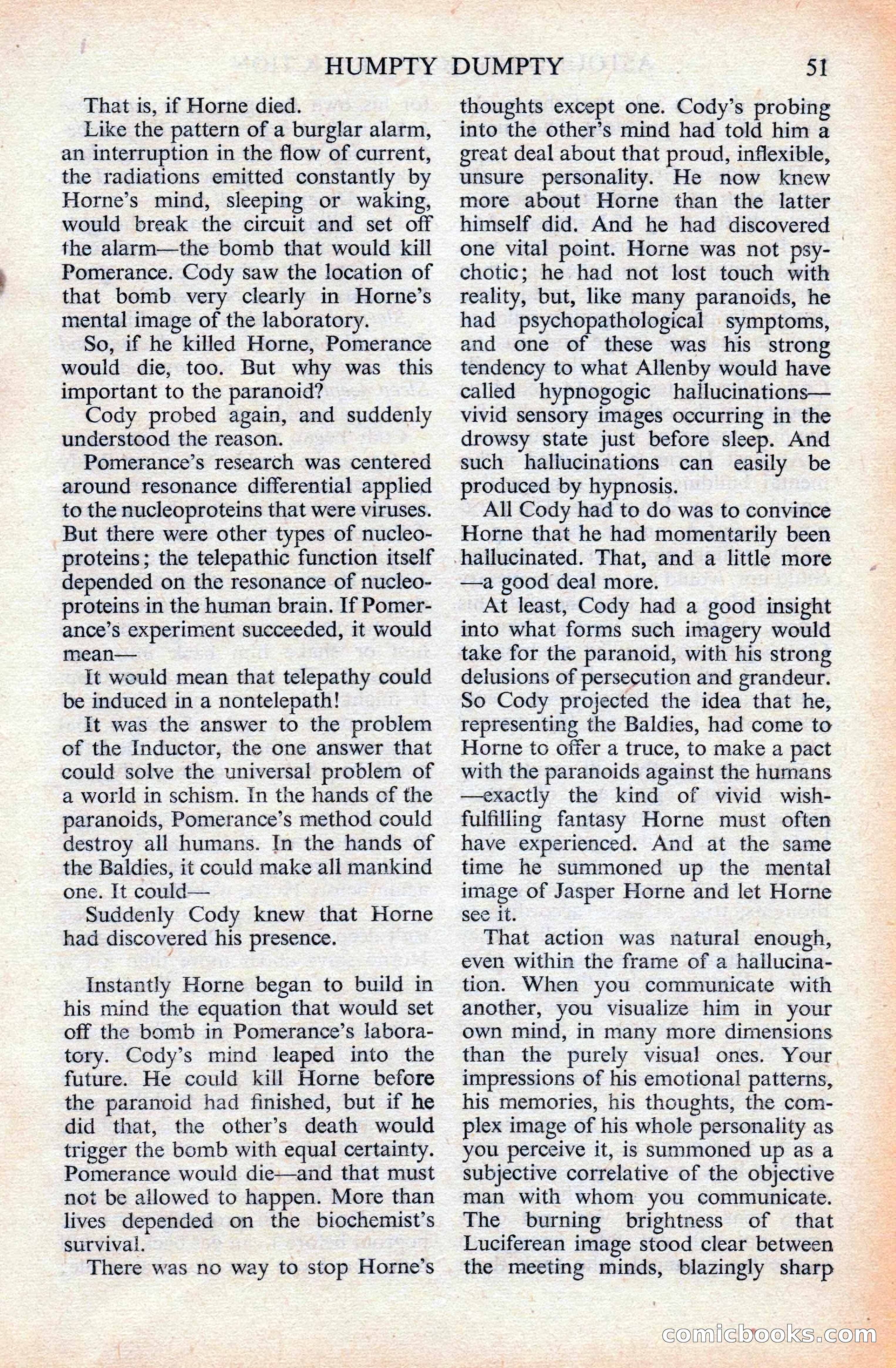
A restored page from Pulp Fiction, 1954. Page through the whole issue in the reader above.
📄 Transcribed text from this page (OCR, searchable)
Machine-transcribed from the original scan — historical spelling and the odd misread are preserved.
HUMPTY DUMPTY SI That is, if Horne died. Like the pattern of a burglar alarm, an interruption in the flow of current, the radiations emitted constantly by Horne’s mind, sleeping or waking, would break the circuit and set off the alarm—the bomb that would kill Pomerance. Cody saw the location of that bomb very clearly in Horne’s mental image of the laboratory. So, if he killed Horne, Pomerance would die, too. But why was. this important to the paranoid? Cody probed again, and suddenly understood the reason. : Pomerance’s research was centered around resonance differential applied to the nucleoproteins that were viruses. But there were other types of nucleo- proteins; the telepathic function itself depended on the resonance of nucleo- proteins in the human brain. If Pomer- ance’s experiment succeeded, it would mean— It would mean that telepathy could be induced in a nontelepath! It was the answer to the problem of the Inductor, the one answer that could solve the universal problem of a world in schism. In the hands of the paranoids, Pomerance’s method could destroy all humans. In the hands of the Baldies, it could make all mankind one. It could— Suddenly Cody knew that Horne had discovered his presence. Instantly Horne began to build in his mind the equation that would set off the bomb in Pomerance’s labora- tory. Cody’s mind leaped into the future. He could kill Horne before the paranoid had finished, but if he did that, the other’s death would trigger the bomb with equal certainty. Pomerance would die—and that must not be allowed to happen. More than lives depended on the biochemist’s survival. There was no way to stop Horne’s thoughts except one. Cody’s probing into the other’s mind had told him a great deal about that proud, inflexible, unsure personality. He now knew more about Horne than the latter himself did. And he had discovered — one vital point. Horne was not psy- chotic; he had not lost touch with reality, but, like many paranoids, he had psychopathological symptoms, and one of these was his strong tendency to what Allenby would have called hypnogogic hallucinations— vivid sensory images occurring in the drowsy state just before sleep. And such haliucinations can easily be produced by hypnosis. All Cody had to do was to convince Horne that he had momentarily been -hailucinated. That, and a little more —a good deal more. At least, Cody had a good insight into what forms such imagery would take for the paranoid, with his strong delusions of persecution and grandeur. So Cody projected the idea that he, representing the Baldies, had come to Horne to offer a truce, to make a pact with the paranoids against the humans —exactly the kind of vivid wish- fulfilling fantasy Horne must often have experienced. And at the same time he summoned up the mental image of Jasper Horne and let Horne see it. That action was natural enough, even within the frame of a hallucina- tion. When you communicate with another, you visualize him in your own mind, in many more dimensions than the purely visua! ones. Your impressions of his emotional patterns, his memories, his thoughts, the com- plex image of his whole personality as you perceive it, is summoned up as a subjective correlative of the objective man with whom you communicate. The burning brightness of that Luciferean image stood clear between the meeting minds, blazingly sharp COMmMIicoOokS.COha —