
Pulp Fiction, 1954 · page 24 of 132
Astounding Science Fiction, British Edition — page 24: what you’re looking at
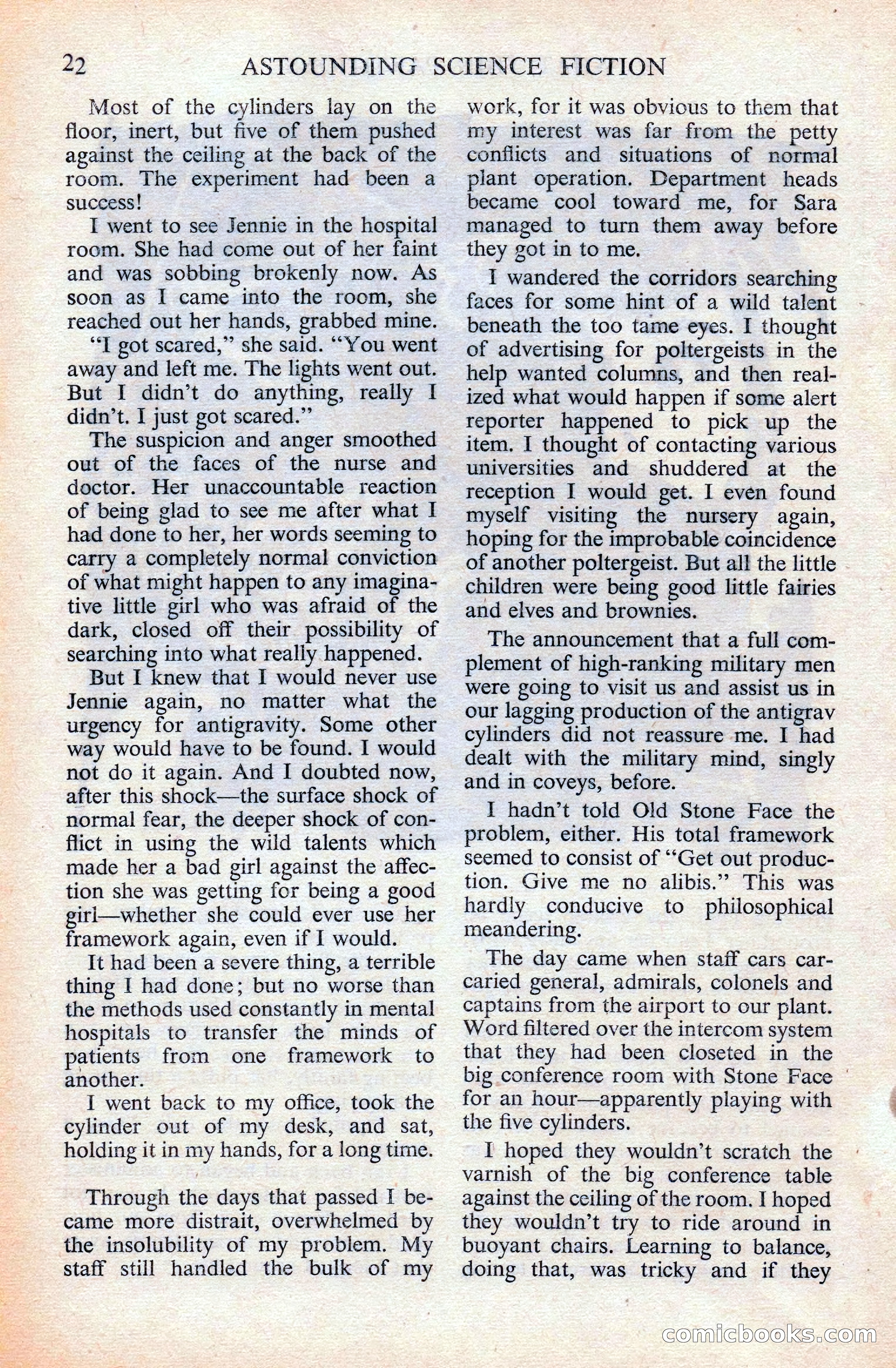
A restored page from Pulp Fiction, 1954. Page through the whole issue in the reader above.
📄 Transcribed text from this page (OCR, searchable)
Machine-transcribed from the original scan — historical spelling and the odd misread are preserved.
22 ASTOUNDING SCIENCE FICTION Most of the cylinders lay on the floor, inert, but five of them pushed against the ceiling at the back of the room. The experiment had been a success! I went to see Jennie in the hospital room. She had come out of her faint and was sobbing brokenly now. As soon as I came into the room, she reached out her hands, grabbed mine. “I got scared,” she said. “You went away and left me. The lights went out. But I didn’t do anything, really I didn’t. I just got scared.” The suspicion and anger smoothed out of the faces of the nurse and doctor. Her unaccountable reaction of being glad to see me after what I had done to her, her words seeming to carry a completely normal conviction of what might happen to any imagina- tive little girl who was afraid of the dark, closed off their possibility of searching into what really happened. But I knew that I would never use Jennie again, no matter what the urgency for antigravity. Some other way would have to be found. I would not do it again. And I doubted now, after this shock—the surface shock of normal fear, the deeper shock of con- flict in using the wild talents which made her a bad girl against the affec- tion she was getting for being a good girl—whether she could ever use her framework again, even if I would. It had been a severe thing, a terrible thing I had done; but no worse than the methods used constantly in mental hospitals to transfer the minds of patients from one framework to another. I went back to my office, took the cylinder out of my desk, and sat, holding it in my hands, for a long time. Through the days that passed I be- came more distrait, overwhelmed by the insolubility of my problem. My staff still handled the bulk of my work, for it was obvious to them that my interest was far from the petty conflicts and situations of normal plant operation. Department heads became cool toward me, for Sara managed to turn them away before they got in to me. I wandered the corridors searching faces for some hint of a wild talent beneath the too tame eyes. I thought of advertising for poltergeists in the help wanted columns, and then real- ized what would happen if some alert reporter happened to pick up the item, I thought of contacting various universities and shuddered at the reception I would get. I even found myself visiting the nursery again, hoping for the improbable coincidence of another poltergeist. But all the little children were being good little fairies and elves and brownies. The announcement that a full com- plement of high-ranking military men were going to visit us and assist us in our lagging production of the antigrav cylinders did not reassure me. I had dealt with the military mind, singly and in coveys, before. I hadn’t told Old Stone Face the problem, either. His total framework seemed to consist of ““Get out produc- tion. Give me no alibis.’”? This was hardly conducive to philosophical meandering. The day came when staff cars car- caried general, admirals, colonels and captains from the airport to our plant. Word filtered over the intercom system that they had been closeted in the big conference room with Stone Face | for an hour—apparently playing with the five cylinders. I hoped they wouldn’t scratch the varnish of the big conference table against the ceiling of the room. I hoped they wouldn’t try to ride around in buoyant chairs. Learning to balance, doing that, was tricky and if they connicloooks.€c© iim