
Pulp Fiction, 1954 · page 18 of 132
Astounding Science Fiction, British Edition — page 18: what you’re looking at
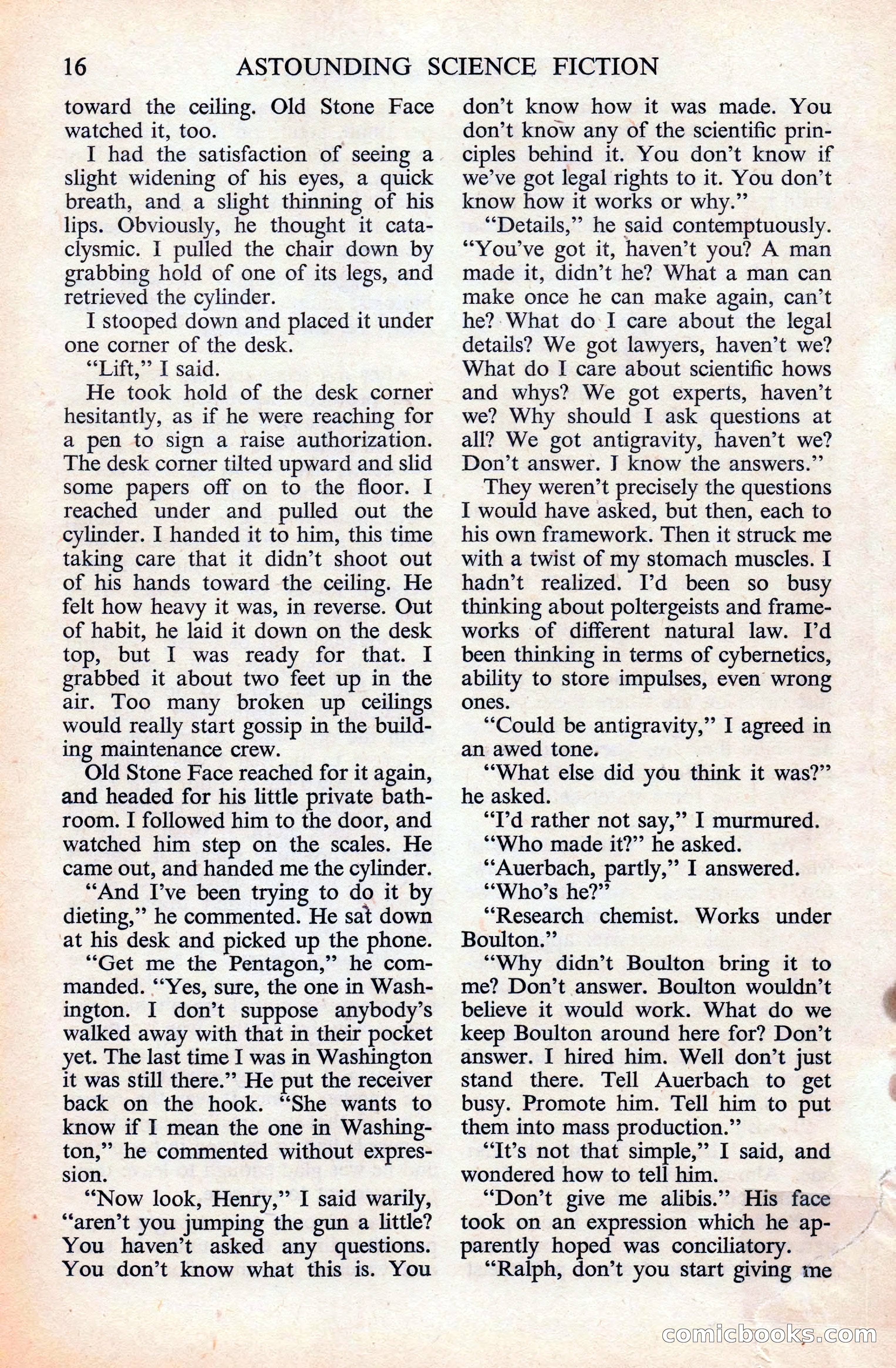
A restored page from Pulp Fiction, 1954. Page through the whole issue in the reader above.
📄 Transcribed text from this page (OCR, searchable)
Machine-transcribed from the original scan — historical spelling and the odd misread are preserved.
16: ASTOUNDING SCIENCE FICTION toward the ceiling. Old Stone Face watched it, too. I had the satisfaction of seeing a slight widening of his eyes, a quick breath, and a slight thinning of his lips. Obviously, he thought it cata- clysmic. I pulled the chair down by grabbing hold of one of its legs, and retrieved the cylinder. I stooped down and placed it under one corner of the desk. “D1; 4 said. He took hold of the desk corner hesitantly, as if he were reaching for a pen to sign a raise authorization. The desk corner tilted upward and slid some papers off on to the floor. I reached under and pulled out the cylinder. I handed it to him, this time taking care that it didn’t shoot out of his hands toward the ceiling. He felt how heavy it was, in reverse. Out of habit, he laid it down on the desk top, but I was ready for that. I grabbed it about two feet up in the air. Too many broken up ceilings would really start gossip in the build- ing maintenance crew. Old Stone Face reached for it again, and headed for his little private bath- room. I followed him to the door, and watched him step on the scales. He came out, and handed me the cylinder. ‘And I’ve been trying to do it by dieting,” he commented. He sat down at his desk and picked up the phone. “Get me the Pentagon,” he com- manded. “Yes, sure, the one in Wash- ington. I don’t suppose anybody’s walked away with that in their pocket yet. The last time I was in Washington it was still there.”” He put the receiver back on the hook. “She wants to know if I mean the one in Washing- ton,” he commented without expres- sion. ‘Now look, Henry,” I said warily, “aren’t you jumping the gun a little? You haven’t asked any questions. You don’t know what this is. You don’t know how it was made. You don’t know any of the scientific prin- ciples behind it. You don’t know if we’ve got legal rights to it. You don’t know how it works or why.” ‘“Details,” he said contemptuously. “You've got it, haven’t you? A man made it, didn’t he? What a man can make once he can make again, can’t he? What do I care about the legal details? We got lawyers, haven’t we? What do I care about scientific hows and whys? We got experts, haven’t we? Why should I ask questions at all? We got antigravity, haven’t we? Don’t answer. J know the answers.”’ They weren’t precisely the questions I would have asked, but then, each to his own framework. Then it struck me with a twist of my stomach muscles. I hadn’t realized. I’d been so busy thinking about poltergeists and frame- works of different natural law. I'd been thinking in terms of cybernetics, ability to store impulses, even wrong ones. “Could be antigravity,” I agreed in an awed tone. 3 “What else did you think it was?” he asked. “I'd rather not say,” I murmured. “Who made it?” he asked. *‘Auerbach, partly,” I answered. ““Who’s he?” ““Research chemist. Works under Boulton.” “Why didn’t Boulton bring it to me? Don’t answer. Boulton wouldn’t believe it would work. What do we keep Boulton around here for? Don’t answer. I hired him. Well don’t just stand there. Tell Auerbach to get busy. Promote him. Tell him to put them into mass production.” “It’s not that simple,” I said, and wondered how to tell him. “Don’t give me alibis.’’ His face took on an expression which he ap- parently hoped was conciliatory. “Ralph, don’t you start giving me ComiclOolkS.c© iim