
Pulp Fiction, 1954 · page 97 of 132
Astounding Science Fiction (British edition) — page 97: what you’re looking at
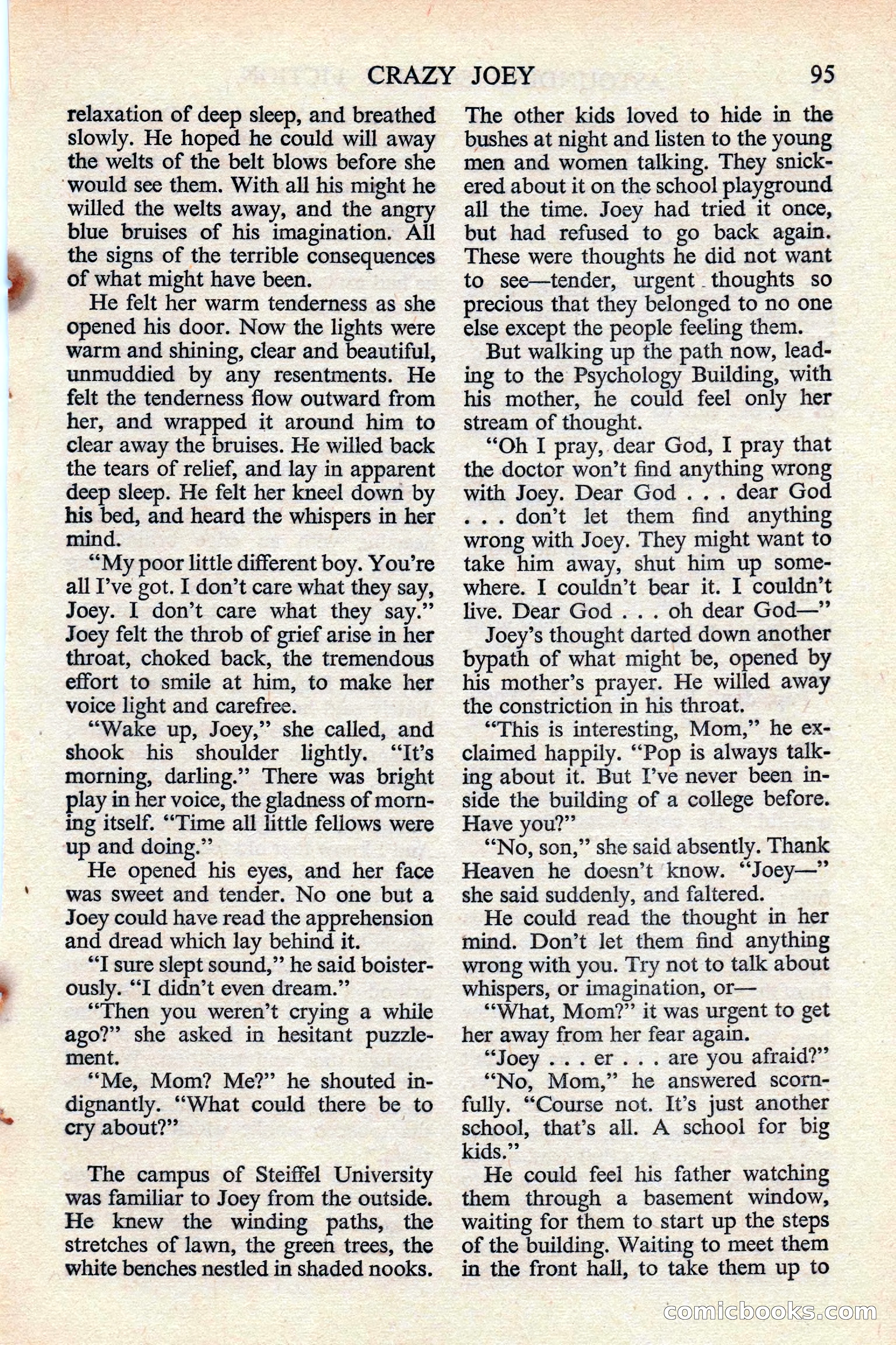
A restored page from Pulp Fiction, 1954. Page through the whole issue in the reader above.
📄 Transcribed text from this page (OCR, searchable)
Machine-transcribed from the original scan — historical spelling and the odd misread are preserved.
CRAZY JOEY 95 relaxation of deep sleep, and breathed slowly. He hoped he could will away the welts of the belt blows before she ‘would see them. With all his might he willed the welts away, and the angry blue bruises of his imagination. All the signs of the terrible consequences of what might have been. He felt her warm tenderness as she opened his door. Now the lights were warm and shining, clear and beautiful, unmuddied by any resentments. He felt the tenderness flow outward from her, and wrapped it around him to clear away the bruises. He willed back the tears of relief, and lay in apparent deep sleep. He felt her kneel down by his bed, and heard the whispers in her mind. “My poor little different boy. You’re all I’ve got. I don’t care what they say, Joey. I don’t care what they say.” Joey felt the throb of grief arise in her throat, choked back, the tremendous effort to smile at him, to make her voice light and carefree. “Wake up, Joey,” she called, and shook his shoulder lightly. “It’s morning, darling.” There was bright play in her voice, the gladness of morn- ing itself. ‘““Time all little fellows were up and doing.” He opened his eyes, and her face was sweet and tender. No one but a Joey could have read the apprehension and dread which lay behind it. “T sure slept sound,” he said boister- ously. “I didn’t even dream.” “Then you weren’t crying a while ago?’ she asked in hesitant puzzle- ment, *“Me, Mom? Me?’’ he shouted in- dignantly. “What could there be to cry about?” The campus of Steiffel University was familiar to Joey from the outside. He knew the winding paths, the stretches of lawn, the green trees, the white benches nestled in shaded nooks. The other kids loved to hide in the bushes at night and listen to the young men and women talking. They snick- ered about it on the school playground all the time. Joey had tried it once, but had refused to go back again. These were thoughts he did not want to see—tender, urgent thoughts so precious that they belonged to no one else except the people feeling them. But walking up the path now, lead- ing to the Psychology Building, with his mother, he could feel only her stream of thought. “Oh I pray, dear God, I pray that the doctor won’t find anything wrong with Joey. Dear God... dear God ... don’t let them find anything wrong with Joey. They might want to take him away, shut him up some- where. I couldn’t bear it. I couldn’t live. Dear God . . . oh dear God—” Joey’s thought darted down another bypath of what might be, opened by his mother’s prayer. He willed away the constriction in his throat. “This is interesting, Mom,” he ex- claimed happily. ‘Pop is always talk- ing about it. But I’ve never been in- side the building of a college before. Have you?”’ ‘No, son,”’ she said absently. Thank Heaven he doesn’t know. ‘“‘Joey—” she said suddenly, and faltered. He could read the thought in her mind. Don’t let them find anything wrong with you. Try not to talk about whispers, or imagination, or— “‘What, Mom?” it was urgent to get her away from her fear again. “Joey ...er... are you afraid?” ‘No, Mom,” he answered scorn- fully. “Course not. It’s just another school, that’s all. A school for big kids.” He could feel his father watching them through a basement window, waiting for them to start up the steps of the building. Waiting to meet them in the front hall, to take them up to conmiclooolks.conn