
Pulp Fiction, 1954 · page 95 of 132
Astounding Science Fiction (British edition) — page 95: what you’re looking at
A restored page from Pulp Fiction, 1954. Page through the whole issue in the reader above.
📄 Transcribed text from this page (OCR, searchable)
Machine-transcribed from the original scan — historical spelling and the odd misread are preserved.
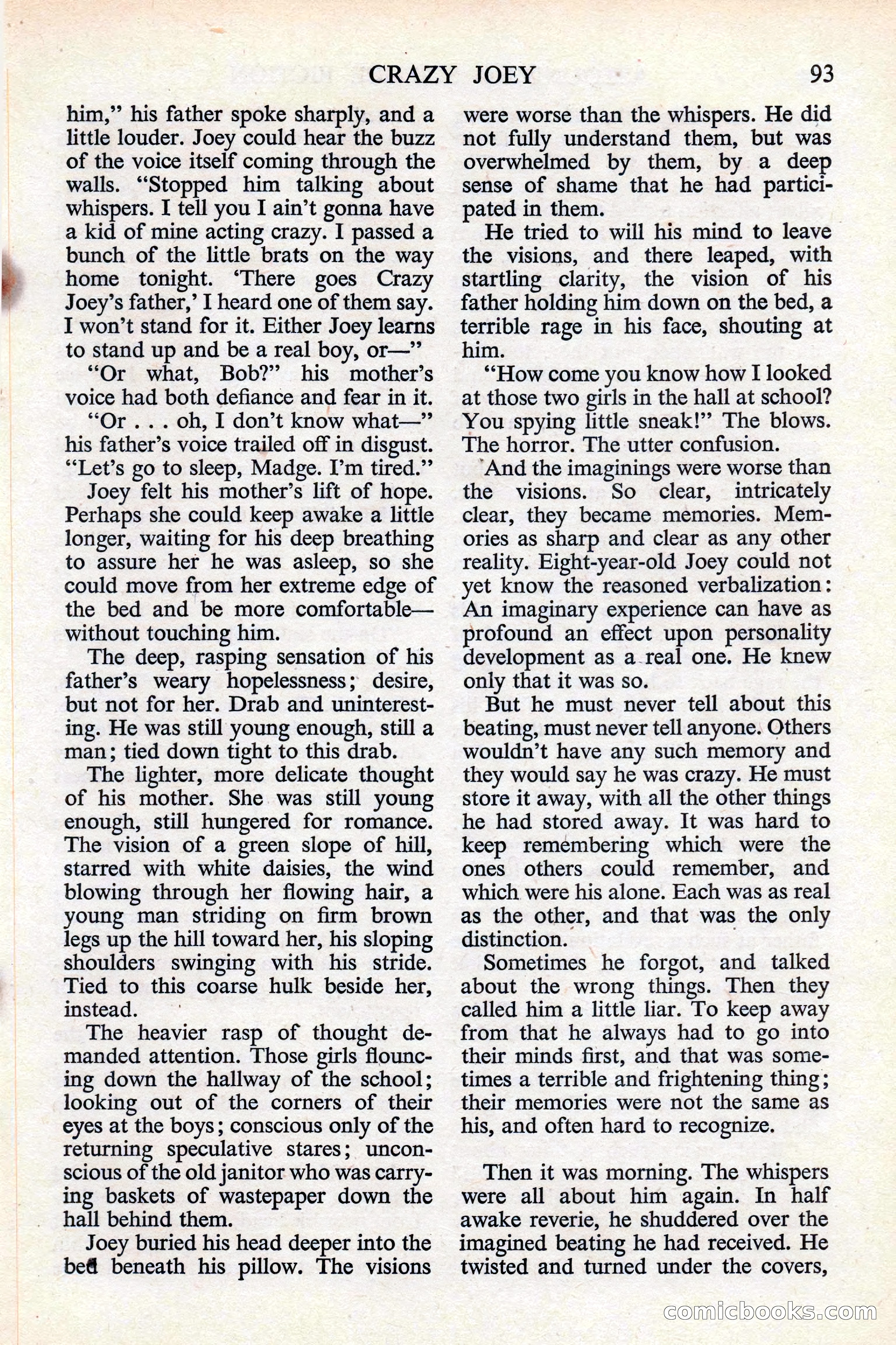
CRAZY JOEY 93 him,” his father spoke sharply, and a little louder. Joey could hear the buzz of the voice itself coming through the walls. “Stopped him talking about whispers. I tell you I ain’t gonna have a kid of mine acting crazy. I passed a bunch of the little brats on the way home tonight. “There goes Crazy Joey’s father,’ I heard one of them say. I won’t stand for it. Either Joey learns to stand up and be a real boy, or—”’ “Or what, Bob?’ his mother’s voice had both defiance and fear in it. “Or ...oh, I don’t know what—’”’ his father’s voice trailed off in disgust. ““Let’s go to sleep, Madge. I’m tired.” Joey felt his mother’s lift of hope. Perhaps she could keep awake a little longer, waiting for his deep breathing to assure her he was asleep, so she could move from her extreme edge of the bed and be more comfortable— without touching him. The deep, rasping sensation of his father’s weary hopelessness; desire, but not for her. Drab and uninterest- ing. He was still young enough, still a man; tied down tight to this drab. The lighter, more delicate thought of his mother. She was still young enough, still hungered for romance. The vision of a green slope of hill, starred with white daisies, the wind blowing through her flowing hair, a young man striding on firm brown legs up the hill toward her, his sloping shoulders swinging with his stride. Tied to this coarse hulk beside her, instead. The heavier rasp of thought de- manded attention. Those girls flounc- ing down the hallway of the school; looking out of the corners of their eyes at the boys; conscious only of the returning speculative stares; uncon- scious of the old janitor who was carry- ing baskets of wastepaper down the hall behind them. Joey buried his head deeper into the bef beneath his pillow. The visions were worse than the whispers. He did not fully understand them, but was overwhelmed by them, by a deep sense of shame that he had partici- ated in them. He tried to will his mind to leave the visions, and there leaped, with startling clarity, the vision of his father holding him down on the bed, a terrible rage in his face, shouting at him. “How come you know how I looked at those two girls in the hall at school? You spying little sneak!’ The blows. The horror. The utter confusion. ‘And the imaginings were worse than the visions. So clear, intricately clear, they became memories. Mem- ories as sharp and clear as any other reality. Eight-year-old Joey could not yet know the reasoned verbalization: An imaginary experience can have as profound an effect upon personality development as a_real one. He knew only that it was so. But he must never tell about this beating, must never tell anyone. Others wouldn’t have any such memory and they would say he was crazy. He must store it away, with all the other things he had stored away. It was hard to keep remembering which were the ones others could remember, and which were his alone. Each was as real as the other, and that was the only distinction. Sometimes he forgot, and talked about the wrong things. Then they called him a little liar. To keep away from that he always had to go into their minds first, and that was some- times a terrible and frightening thing; their memories were not the same as his, and often hard to recognize. Then it was morning. The whispers were all about him again. In half awake reverie, he shuddered over the imagined beating he had received. He twisted and turned under the covers, conniiclbooks.conn