
Pulp Fiction, 1954 · page 93 of 132
Astounding Science Fiction (British edition) — page 93: what you’re looking at
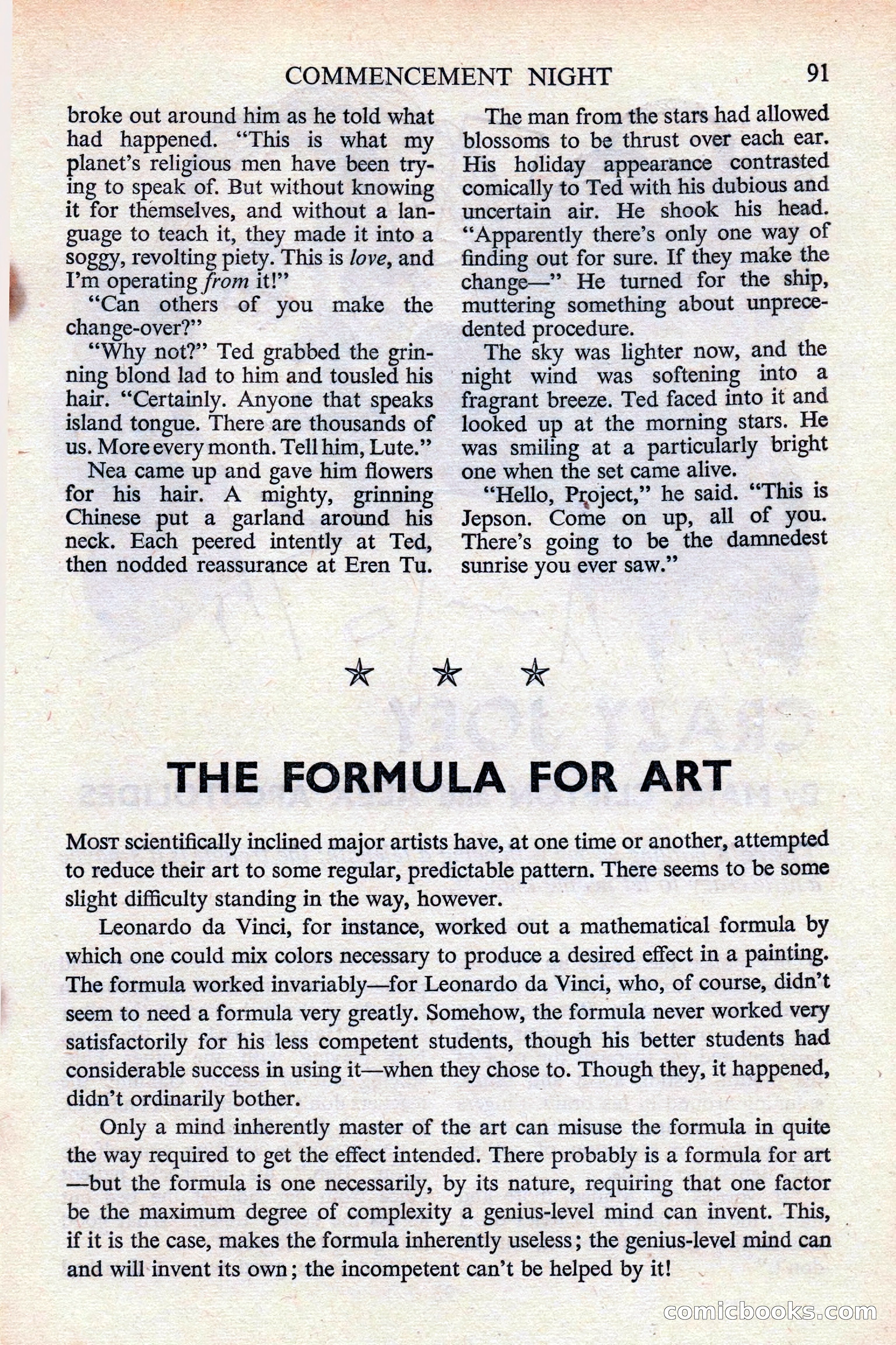
A restored page from Pulp Fiction, 1954. Page through the whole issue in the reader above.
📄 Transcribed text from this page (OCR, searchable)
Machine-transcribed from the original scan — historical spelling and the odd misread are preserved.
COMMENCEMENT NIGHT 91 broke out around him as he told what had happened. “This is what my planet’s religious men have been try- ing to speak of. But without knowing it for themselves, and without a lan- guage to teach it, they made it into a soggy, revolting piety. This is Jove, and I’m operating from it!” “Can others of you make the change-over?” “Why not?” Ted grabbed the grin- ning blond lad to him and tousled his hair. “Certainly. Anyone that speaks island tongue. There are thousands of us. Moreevery month. Tell him, Lute.” Nea came up and gave him flowers for his hair. A mighty, grinning Chinese put a garland around his neck. Each peered intently at Ted, then nodded reassurance at Eren Tu. The man from the stars had allowed blossoms to be thrust over each ear. His holiday appearance contrasted comically to Ted with his dubious and uncertain air. He shook his head. “Apparently there’s only one way of finding out for sure. If they make the change—” He turned for the ship, muttering something about unprece- dented procedure. The sky was lighter now, and the night wind was softening into a fragrant breeze. Ted faced into it and looked up at the morning stars. He was smiling at a particularly bright one when the set came alive. oe “Hello, Project,” he said. “‘This is Jepson. Come on up, all of you. There’s going to be the damnedest sunrise you ever saw.” Rok * THE FORMULA FOR ART Most scientifically inclined major artists have, at one time or another, attempted to reduce their art to some regular, predictable pattern. There seems to be some slight difficulty standing in the way, however. Leonardo da Vinci, for instance, worked out a mathematical formula by which one could mix colors necessary to produce a desired effect in a painting. The formula worked invariably—for Leonardo da Vinci, who, of course, didn’t seem to need a formula very greatly. Somehow, the formula never worked very satisfactorily for his less competent students, though his better students had considerable success in using it—when they chose to. Though they, it happened, didn’t ordinarily bother. : Only a mind inherently master of the art can misuse the formula in quite the way required to get the effect intended. There probably is a formula for art —but the formula is one necessarily, by its nature, requiring that one factor be the maximum degree of complexity a genius-level mind can invent. This, — if it is the case, makes the formula inherently useless; the genius-level mind can and will-invent its own; the incompetent can’t be helped by it! connicloooks. conn