
Pulp Fiction, 1954 · page 88 of 132
Astounding Science Fiction (British edition) — page 88: what you’re looking at
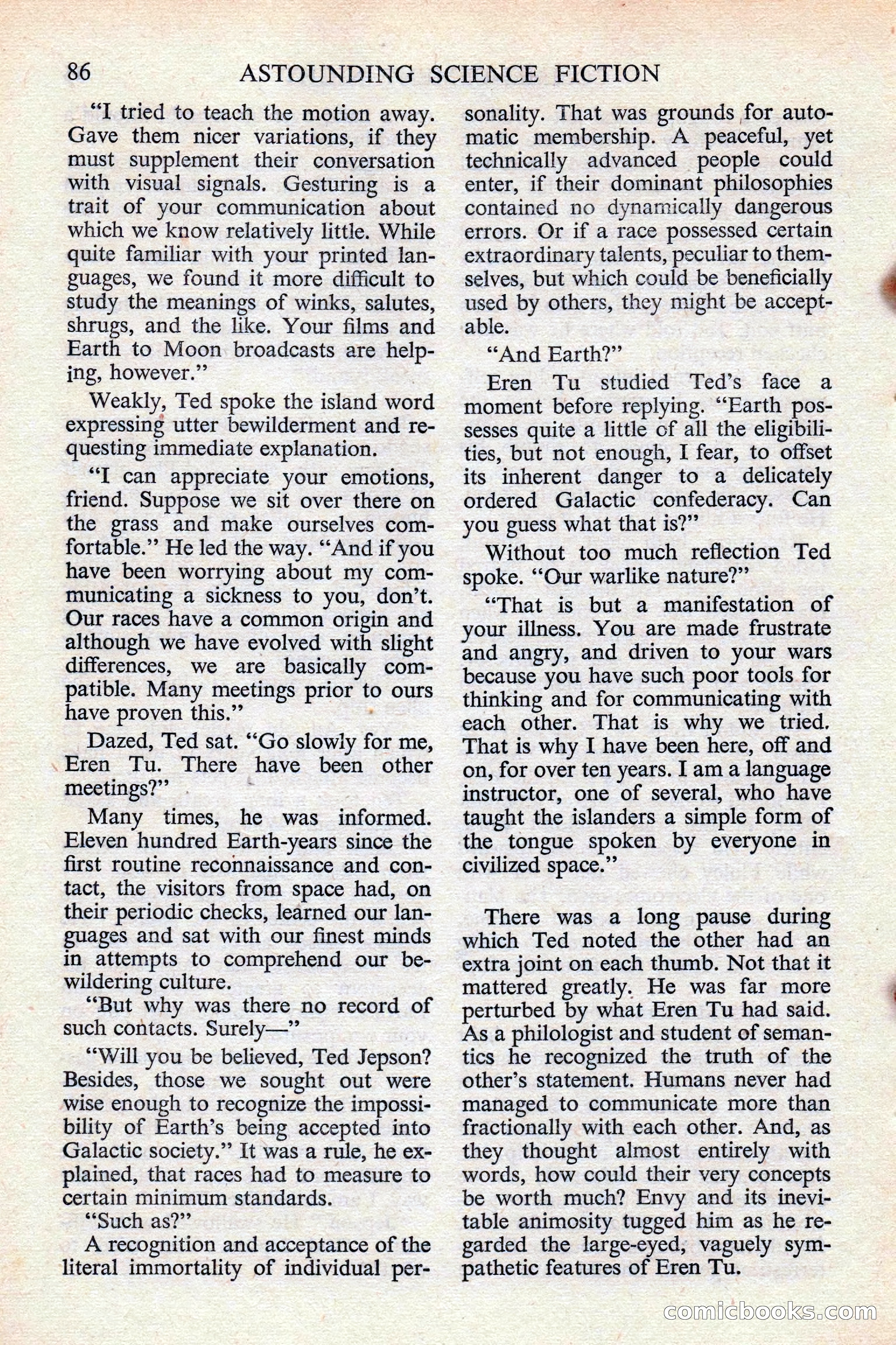
A restored page from Pulp Fiction, 1954. Page through the whole issue in the reader above.
📄 Transcribed text from this page (OCR, searchable)
Machine-transcribed from the original scan — historical spelling and the odd misread are preserved.
86 ASTOUNDING SCIENCE FICTION “I tried to teach the motion away. Gave them nicer variations, if they must supplement their conversation with visual signals. Gesturing is a trait of your communication about which we know relatively little. While quite familiar with your printed Jan- guages, we found it more difficult to study the meanings of winks, salutes, shrugs, and the like. Your films and Earth to Moon broadcasts are help- ing, however.” Weakly, Ted spoke the island word expressing utter bewilderment and re- questing immediate explanation. “I can appreciate your emotions, friend. Suppose we sit over there on the grass and make ourselves com- fortable.”” He led the way. “And if you have been worrying about my com- municating a sickness to you, don’t. Our races have a common origin and although we have evolved with slight differences, we are basically com- patible. Many meetings prior to ours have proven this.” Dazed, Ted sat. ‘““Go slowly for me, Eren Tu. There have been other meetings?” . Many times, he was informed. Eleven hundred Earth-years since the first routine reconnaissance and con- tact, the visitors from space had, on their periodic checks, learned our lan- guages and sat with our finest minds in attempts to comprehend our be- wildering culture. “But why was there no record of such contacts. Surely—”’ “Will you be believed, Ted Jepson? Besides, those we sought out were wise enough to recognize the impossi- bility of Earth’s being accepted into Galactic society.” It was a rule, he ex- plained, that races had to measure to certain minimum standards. “Such as?” A recognition and acceptance of the literal immortality of individual per- sonality. That was grounds for auto- matic membership. A peaceful, yet technically advanced people could enter, if their dominant philosophies contained no dynamically dangerous errors. Or if a race possessed certain extraordinary talents, peculiar to them- selves, but which could be beneficially used by others, they might be accept- able. “And Earth?” Eren Tu studied Ted’s face a moment before replying. “Earth pos- sesses quite a little of all the eligibili- ties, but not enough, I fear, to offset its inherent danger to a delicately ordered Galactic confederacy. Can you guess what that is?” Without too much reflection Ted spoke. ‘Our warlike nature?” “That is but a manifestation of your illness, You are made frustrate and angry, and driven to your wars because you have such poor tools for thinking and for communicating with each other. That is why we tried. That is why I have been here, off and on, for over ten years. I am a language instructor, one of several, who have taught the islanders a simple form of the tongue spoken by everyone in civilized space.” There was a long pause during which Ted noted the other had an extra joint on each thumb. Not that it mattered greatly. He was far more perturbed by what Eren Tu had said. As a philologist and student of seman- tics he recognized the truth of the other’s statement. Humans never had managed to communicate more than fractionally with each other. And, as they thought almost entirely with words, how could their very concepts be worth much? Envy and its inevi- table animosity tugged him as he re- garded the large-eyed, vaguely sym- pathetic features of Eren Tu. connicloookks.c© nn