
Pulp Fiction, 1954 · page 86 of 132
Astounding Science Fiction (British edition) — page 86: what you’re looking at
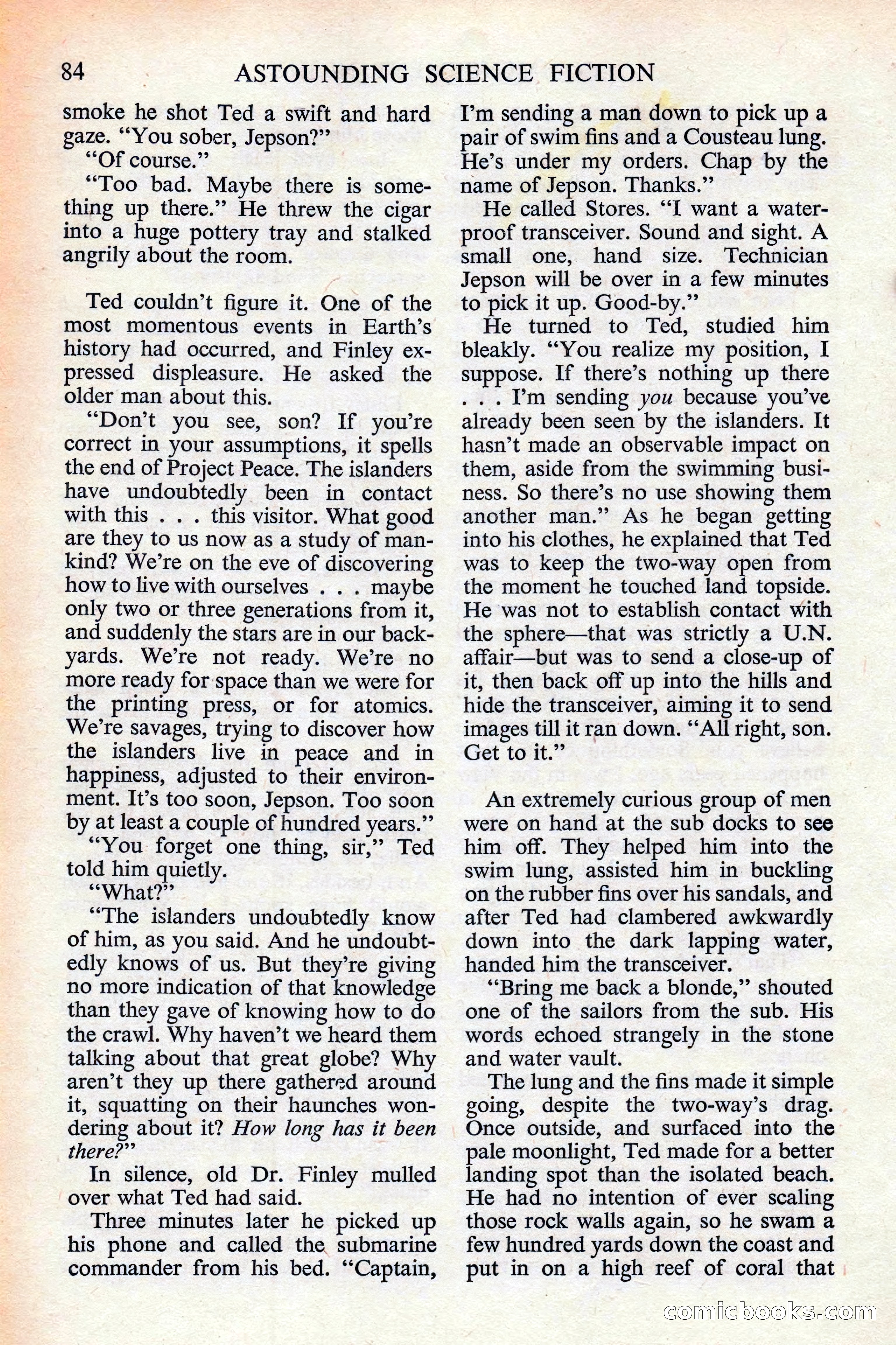
A restored page from Pulp Fiction, 1954. Page through the whole issue in the reader above.
📄 Transcribed text from this page (OCR, searchable)
Machine-transcribed from the original scan — historical spelling and the odd misread are preserved.
84 | ASTOUNDING SCIENCE FICTION smoke he shot Ted a swift and hard gaze. “You sober, Jepson?” “Of course.” “Too bad. Maybe there is some- thing up there.” He threw the cigar into a huge pottery tray and stalked angrily about the room. Ted couldn’t figure it. One of the most momentous events in Earth’s history had occurred, and Finley ex- pressed displeasure. He asked the older man about this. “Don’t you see, son? If you’re correct in your assumptions, it spells the end of Project Peace. The islanders have undoubtedly been in contact with this . . . this visitor. What good are they to us now as a study of man- kind? We’re on the eve of discovering how to live with ourselves . . . maybe only two or three generations from it, and suddenly the stars are in our back- yards. We’re not ready. We’re no more ready for space than we were for the printing press, or for atomics. We're savages, trying to discover how the islanders live in peace and in happiness, adjusted to their environ- ment. It’s too soon, Jepson. Too soon by at least a couple of hundred years.” “You forget one thing, sir,” Ted told him quietly. *“What?”’ “The islanders undoubtedly know of him, as you said. And he undoubt- edly knows of us. But they’re giving no more indication of that knowledge than they gave of knowing how to do the crawl. Why haven’t we heard them talking about that great globe? Why aren’t they up there gathered around it, squatting on their haunches won- dering about it? How long has it been there?” In silence, old Dr. Finley mulled over what Ted had said. Three minutes later he picked up his phone and called the submarine commander from his bed. “Captain, I’m sending a man down to pick up a pair of swim fins and a Cousteau lung. He’s under my orders. Chap by the name of Jepson. Thanks.” He called Stores. ““I want a water- proof transceiver. Sound and sight. A small one, hand size. Technician Jepson will be over in a few minutes to pick it up. Good-by.” He turned to Ted, studied him bleakly. ““You realize my position, I suppose. If there’s nothing up there . . . ’m sending you because you’ve already been seen by the islanders. It hasn’t made an observable impact on them, aside from the swimming busi- ness. So there’s no use showing them another man.” As he began getting into his clothes, he explained that Ted was to keep the two-way open from the moment he touched land topside. He was not to establish contact with the sphere—that was strictly a U.N. affair—but was to send a close-up of it, then back off up into the hills and hide the transceiver, aiming it to send images till it ran down. “All right, son. Get to it.” An extremely curious group of men were on hand at the sub docks to see him off. They helped him into the swim lung, assisted him in buckling on the rubber fins over his sandals, and after Ted had clambered awkwardly down into the dark lapping water, handed him the transceiver. “Bring me back a blonde,” shouted one of the sailors from the sub. His words echoed strangely in the stone and water vault. The lung and the fins made it simple going, despite the two-way’s drag. Once outside, and surfaced into the pale moonlight, Ted made for a better landing spot than the isolated beach. He had no intention of ever scaling those rock walls again, so he swam a few hundred yards down the coast and put in on a high reef of coral that conniicloolks.corn