
Pulp Fiction, 1954 · page 71 of 132
Astounding Science Fiction (British edition) — page 71: what you’re looking at
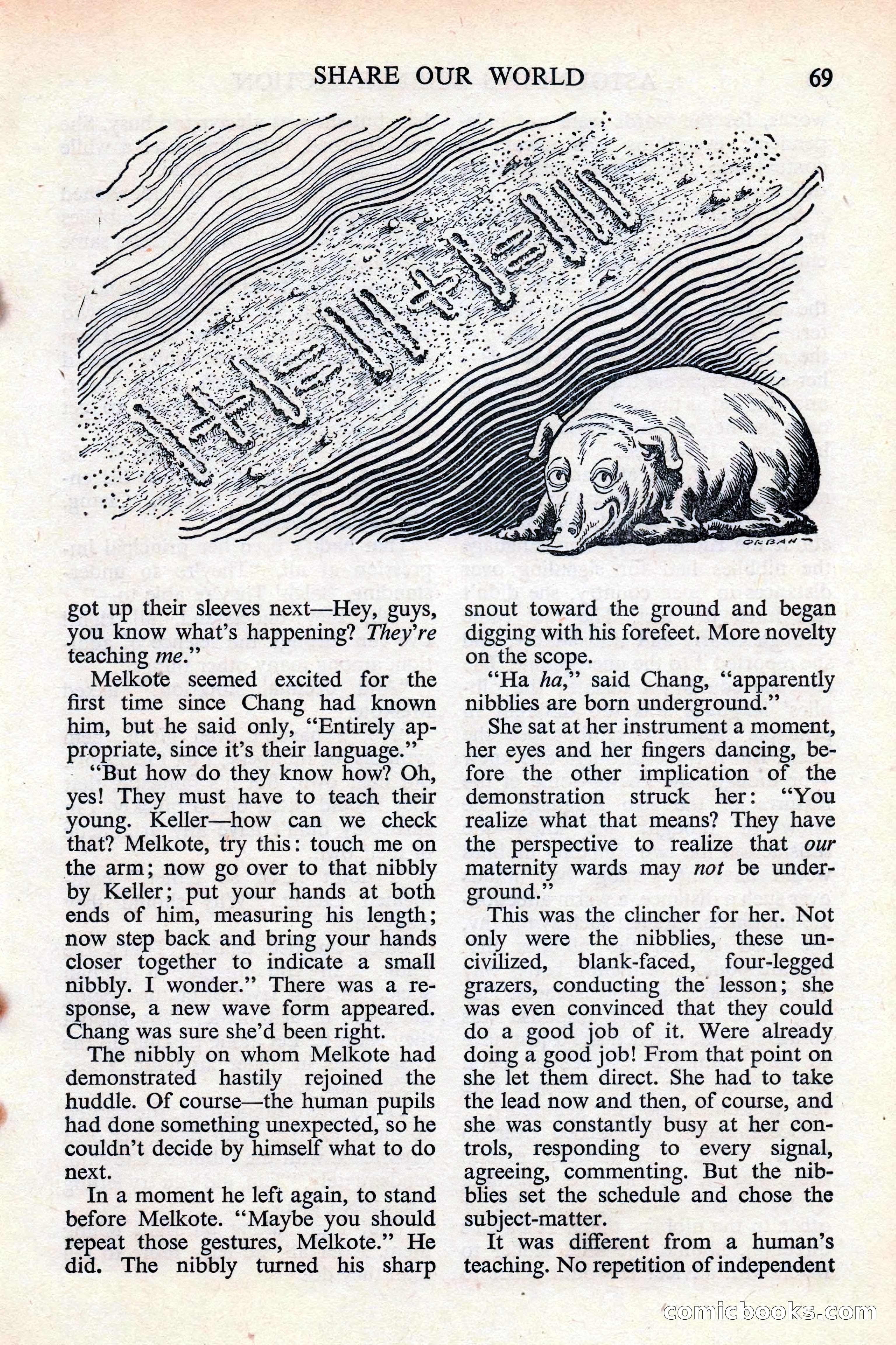
A restored page from Pulp Fiction, 1954. Page through the whole issue in the reader above.
📄 Transcribed text from this page (OCR, searchable)
Machine-transcribed from the original scan — historical spelling and the odd misread are preserved.
SHARE OUR WORLD 69 got up their sleeves next—Hey, guys, you know what’s happening? They’re teaching me.” Melkote seemed excited for the first time since Chang had known him, but he said only, “Entirely ap- propriate, since it’s their language.” “But how do they know how? Oh, yes! They must have to teach their oung. Keller—how can we check that? Melkote, try this: touch me on the arm; now go over to that nibbly by Keller; put your hands at both ends of him, measuring his length; now step back and bring your hands closer together to indicate a small nibbly. I wonder.’’ There was a re- sponse, a new wave form appeared. Chang was sure she’d been right. The nibbly on whom Melkote had demonstrated hastily rejoined the huddle. Of course—the human pupils had done something unexpected, so he couldn’t decide by himself what to do next. In a moment he left again, to stand before Melkote. ““Maybe you should repeat those gestures, Melkote.”’ He did. The nibbly turned his sharp 3S ee ANY snout toward the ground and began digging with his forefeet. More novelty on the scope. “Ha ha,” said Chang, “‘apparently nibblies are born underground.” She sat at her instrument a moment, her eyes and her fingers dancing, be- fore the other implication of the demonstration struck her: “You realize what that means? They have the perspective to realize that our maternity wards may not be under- ound.” This was the clincher for her. Not only were the nibblies, these un- civilized, blank-faced, four-legged grazers, conducting the lesson; she was even convinced that they could do a good job of it. Were already doing a good job! From that point on she let them direct. She had to take the lead now and then, of course, and she was constantly busy at her con- trols, responding to every signal, agreeing, commenting. But the nib- blies set the schedule and chose the subject-matter. It was different from a human’s teaching. No repetition of independent connicloooks.corm