
Pulp Fiction, 1954 · page 67 of 132
Astounding Science Fiction (British edition) — page 67: what you’re looking at
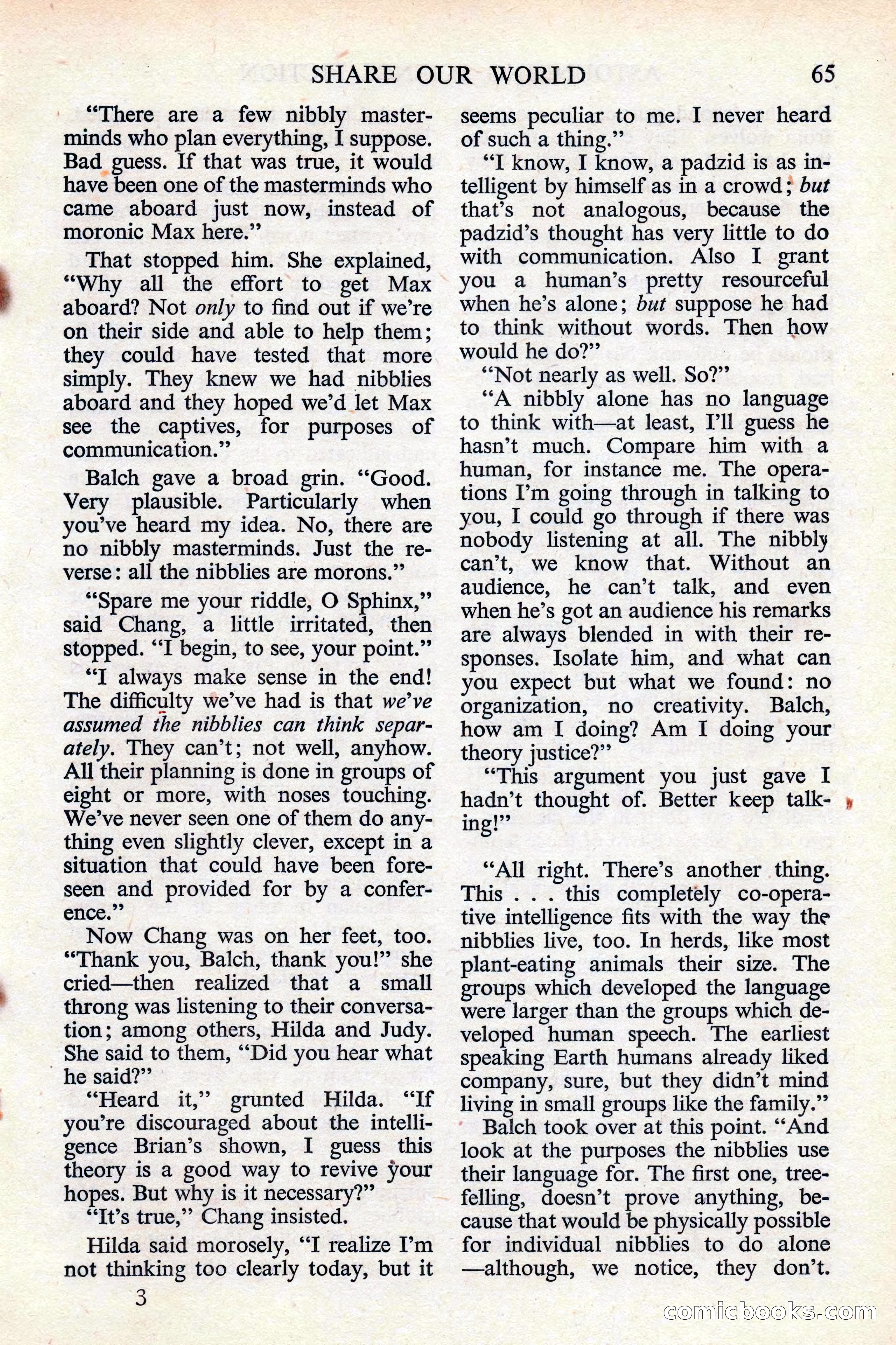
A restored page from Pulp Fiction, 1954. Page through the whole issue in the reader above.
📄 Transcribed text from this page (OCR, searchable)
Machine-transcribed from the original scan — historical spelling and the odd misread are preserved.
SHARE OUR WORLD “There are a few nibbly master- minds who plan everything, I suppose. Bad guess. If that was true, it would have been one of the masterminds who came aboard just now, instead of moronic Max here.” That stopped him. She explained, “Why all the effort to get Max aboard? Not only to find out if we’re on their side and able to help them; they could have tested that more simply. They knew we had nibblies aboard and they hoped we’d let Max see the captives, for purposes of communication.” Balch gave a broad grin. “Good. Very plausible. Particularly when you’ve heard my idea. No, there are no nibbly masterminds. Just the re- verse: all the nibblies are morons.” “Spare me your riddle, O Sphinx,” said Chang, a little irritated, then stopped. “I begin, to see, your point.” “I always make sense in the end! The difficulty we’ve had is that we’ve assumed the nibblies can think separ- ately. They can’t; not well, anyhow. All their planning is done in groups of eight or more, with noses touching. We’ve never seen one of them do any- thing even slightly clever, except in a situation that could have been fore- seen and provided for by a confer- ence.” Now Chang was on her feet, too. “Thank you, Balch, thank you!” she cried—then realized that a _ small throng was listening to their conversa- tion; among others, Hilda and Judy. _ She said to them, “Did you hear what he said?” “Heard it,” grunted Hilda. “If you’re discouraged about the intelli- gence Brian’s shown, I guess this theory is a good way to revive your hopes. But why is it necessary?” “It’s true,’ Chang insisted. Hilda said morosely, “I realize I’m not thinking too clearly today, but it 3 65 seems peculiar to me. I never heard of such a thing.” “T know, I know, a padzid is as in- telligent by himself as in a crowd; but that’s not analogous, because the padzid’s thought has very little to do with communication. Also I grant you a human’s pretty resourceful when he’s alone; but suppose he had to think without words. Then how would he do?” “Not nearly as well. So?’ “A nibbly alone has no language to think with—at least, Ill guess he hasn’t much. Compare him with a human, for instance me. The opera- tions I’m going through in talking to you, I could go through if there was nobody listening at all. The nibbly can’t, we know that. Without an audience, he can’t talk, and even when he’s got an audience his remarks are always blended in with their re- sponses. Isolate him, and what can you expect but what we found: no organization, no creativity. Balch, how am I doing? Am I doing your theory justice?”’ “This argument you just gave I hadn’t thought of. Better keep talk- ing!” b “All right. There’s another thing. This . . . this completely co-opera- tive intelligence fits with the way the nibblies live, too. In herds, like most plant-eating animals their size. The groups which developed the language were larger than the groups which de- veloped human speech. The earliest speaking Earth humans already liked company, sure, but they didn’t mind living in small groups like the family.” Balch took over at this point. “And look at the purposes the nibblies use their language for. The first one, tree- felling, doesn’t prove anything, be- cause that would be physically possible for individual nibblies to do alone —although, we notice, they don’t. connicloooks.conn