
Pulp Fiction, 1954 · page 59 of 132
Astounding Science Fiction (British edition) — page 59: what you’re looking at
A restored page from Pulp Fiction, 1954. Page through the whole issue in the reader above.
📄 Transcribed text from this page (OCR, searchable)
Machine-transcribed from the original scan — historical spelling and the odd misread are preserved.
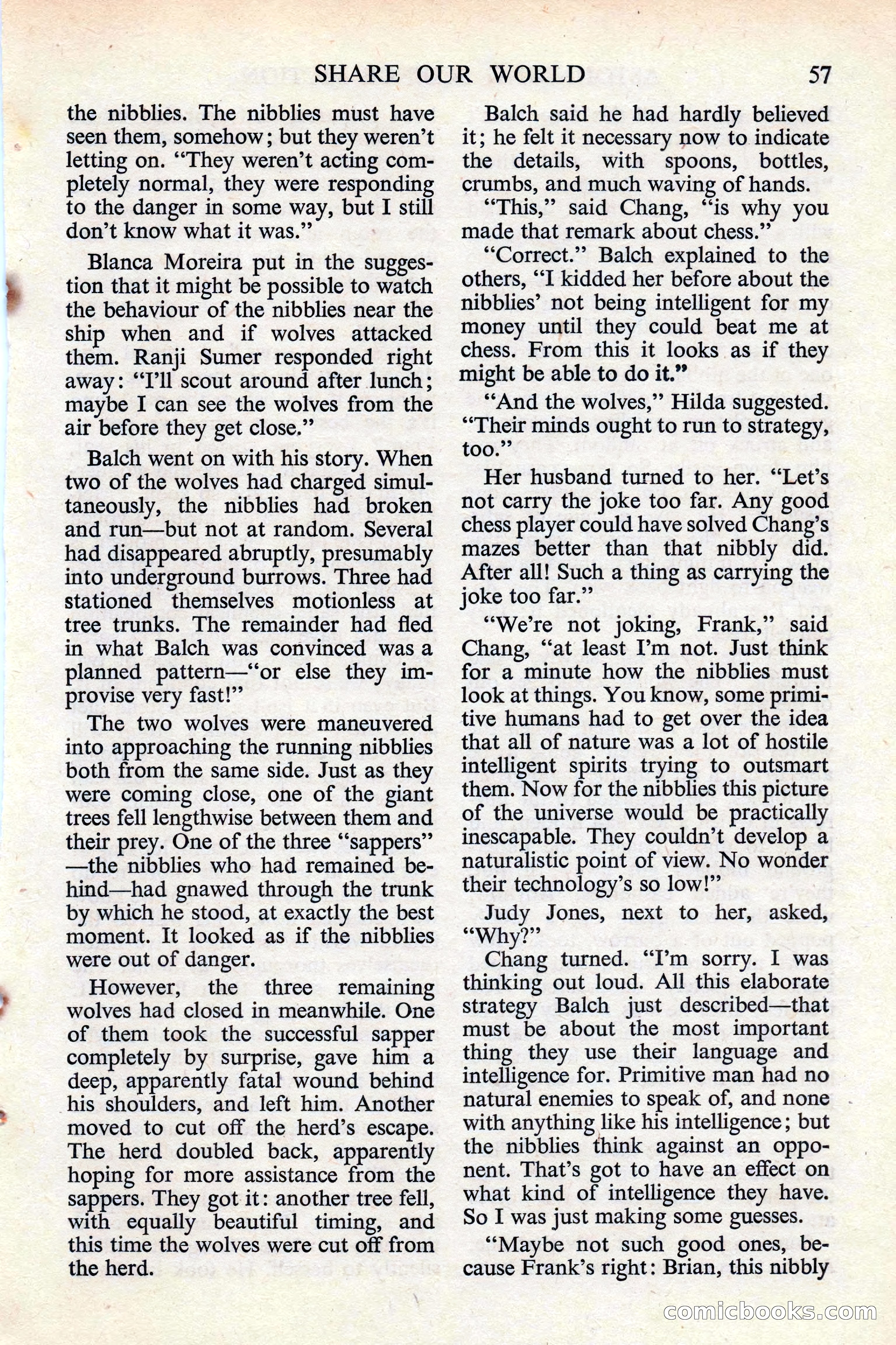
SHARE OUR WORLD | a7 the nibblies. The nibblies must have seen them, somehow; but they weren’t letting on. “They weren’t acting com- pletely normal, they were responding to the danger in some way, but I still don’t know what it was.” Blanca Moreira put in the sugges- tion that it might be possible to watch the behaviour of the nibblies near the ship when and if wolves attacked them. Ranji Sumer responded right away: “T’ll scout around after lunch; maybe I can see the wolves from the air before they get close.” Balch went on with his story. When two of the wolves had charged simul- taneously, the nibblies had broken and run—but not at random. Several had disappeared abruptly, presumably into underground burrows. Three had stationed themselves motionless at tree trunks. The remainder had fled in what Balch was convinced was a planned pattern—‘or else they im- provise very fast!” The two wolves were maneuvered into approaching the running nibblies both from the same side. Just as they were coming close, one of the giant trees fell lengthwise between them and their prey. One of the three ‘“‘sappers”’ —the nibblies who had remained be- hind—had gnawed through the trunk by which he stood, at exactly the best moment. It looked as if the nibblies were out of danger. However, the three remaining wolves had closed in meanwhile. One of them took the successful sapper completely by surprise, gave him a deep, apparently fatal wound behind his shoulders, and left him. Another moved to cut off the herd’s escape. The herd doubled back, apparently hoping for more assistance from the sappers. They got it: another tree fell, with equally beautiful timing, and this time the wolves were cut off from the herd. Balch said he had hardly believed it; he felt it necessary now to indicate the details, with spoons, bottles, crumbs, and much waving of hands. “This,” said Chang, “is why you made that remark about chess.” “Correct.” Balch explained to the others, “I kidded her before about the nibblies’ not being intelligent for my money until they could beat me at chess. From this it looks as if they might be able to do it.” ‘And the wolves,” Hilda suggested. “Their minds ought to run to strategy, too.” Her husband turned to her. “Let’s not carry the joke too far. Any good chess player could have solved Chang’s mazes better than that nibbly did. After all! Such a thing as carrying the joke too far.” “We’re not joking, Frank,” said Chang, “at least I’m not. Just think for a minute how the nibblies must look at things. You know, some primi- tive humans had to get over the idea that all of nature was a lot of hostile intelligent spirits trying to outsmart them. Now for the nibblies this picture of the universe would be practically inescapable. They couldn’t develop a naturalistic point of view. No wonder their technology’s so low!” Judy Jones, next to her, asked, “Why?” Chang turned. “I’m sorry. I was thinking out loud. All this elaborate strategy Balch just described—that must be about the most important thing they use their language and intelligence for. Primitive man had no natural enemies to speak of, and none . with anything like his intelligence; but the nibblies think against an oppo- nent. That’s got to have an effect on what kind of intelligence they have. So I was just making some guesses. “Maybe not such good ones, be- cause Frank’s right: Brian, this nibbly conniclooolks.conn