
Pulp Fiction, 1954 · page 5 of 132
Astounding Science Fiction (British edition) — page 5: what you’re looking at
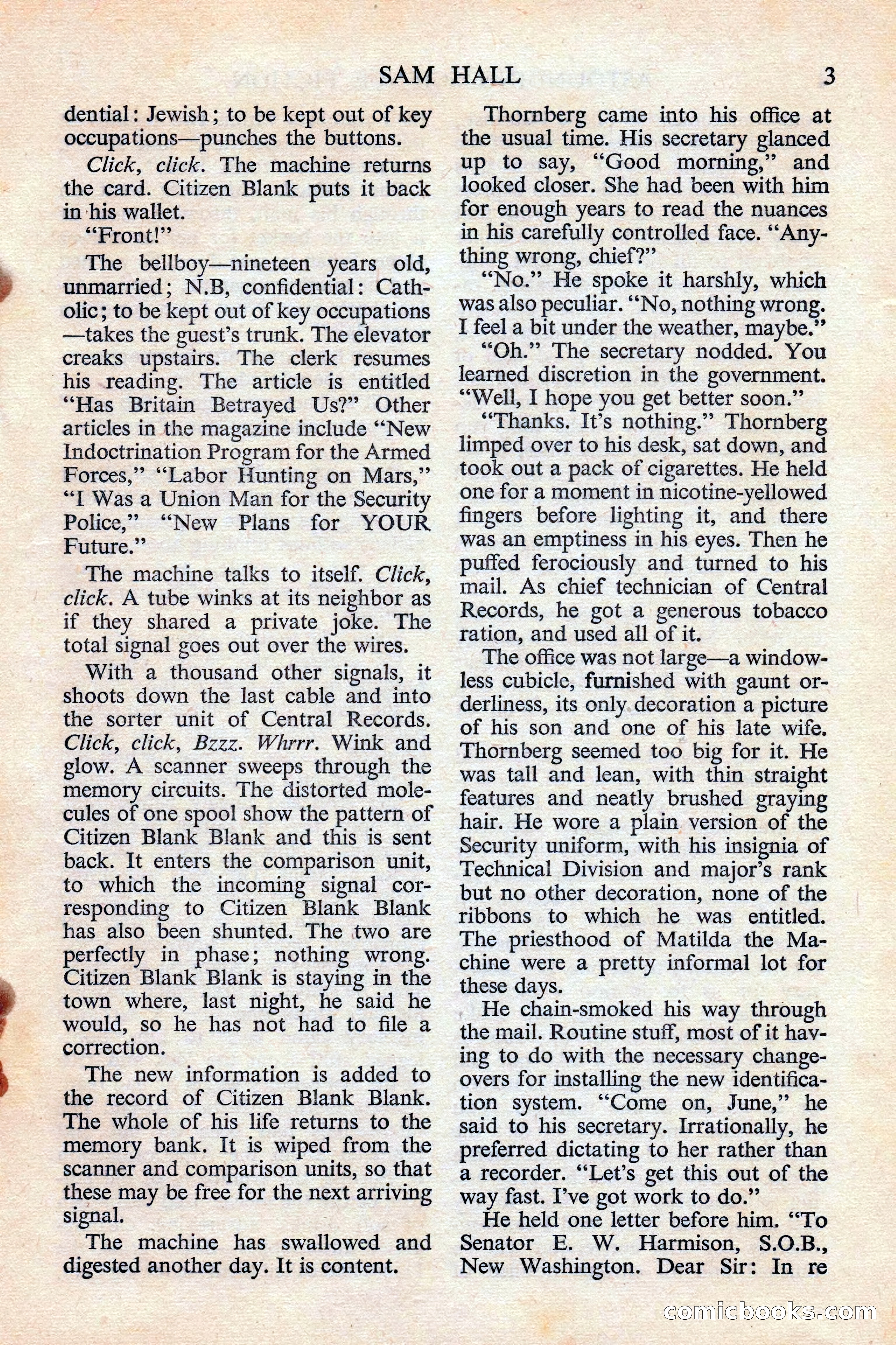
A restored page from Pulp Fiction, 1954. Page through the whole issue in the reader above.
📄 Transcribed text from this page (OCR, searchable)
Machine-transcribed from the original scan — historical spelling and the odd misread are preserved.
SAM HALL 3 dential: Jewish; to be kept out of key occupations—punches the buttons. Click, click. The machine returns the card. Citizen Blank puts it back in his wallet. “Front!” The beilboy—nineteen years old, unmarried; N.B, confidential: Cath- olic; to be kept out of key occupations —takes the guest’s trunk. The elevator creaks upstairs. The clerk resumes his .reading. The article is entitled “Has Britain Betrayed Us?’ Other articles in the magazine include ““New Indoctrination Program for the Armed Forces,” “Labor Hunting on Mars,” “IT Was a Union Man for the Security Police,” “‘New Plans for YOUR Future.” The machine talks to itself. Click, click. A tube winks at its neighbor as if they shared a private joke. The total signal goes out over the wires. With a thousand other signals, it shoots down the last cable and into the sorter unit of Central Records. Click, click, Bzzz. Whrrr. Wink and glow. A scanner sweeps through the memory circuits. The distorted mole- cules of one spool show the pattern of Citizen Blank Blank and this is sent back. It enters the comparison unit, to which the incoming signal cor- responding to Citizen Blank Blank has also been shunted. The two are perfectly in phase; nothing wrong. Citizen Blank Blank is staying in the town where, last night, he said he would, so he has not had to file a correction. The new information is added to the record of Citizen Blank Blank. The whole of his life returns to the memory bank. It is wiped from the scanner and comparison units, so that these may be free for the next arriving signal. The machine has swallowed and digested another day. It is content. Thornberg came into his office at the usual time. His secretary glanced up to say, “Good morning,” and looked closer. She had been with him for enough years to read the nuances in his carefully controlled face. ‘“Any- thing wrong, chief?’ “No.” He spoke it harshly, which was also peculiar. ‘No, nothing wrong. I feel a bit under the weather, maybe.” “Oh.” The secretary nodded. You learned discretion in the government. “Well, I hope you get better soon.” “Thanks, It’s nothing.” Thornberg limped over to his desk, sat down, and took out a pack of cigarettes. He held one for a moment in nicotine-yellowed fingers before lighting it, and there was an emptiness in his eyes. Then he puffed ferociously and turned to his mail. As chief technician of Central Records, he got a generous tobacco ration, and used all of it. The office was not large—a window- less cubicle, furnished with gaunt or- derliness, its only. decoration a picture of his son and one of his late wife. Thornberg seemed too big for it. He was tall and lean, with thin straight features and neatly brushed graying hair. He wore a plain. version of the Security uniform, with his insignia of Technical Division and major’s rank but no other decoration, none of the ribbons to which he was entitled. The priesthood of Matilda the Ma- chine were a pretty informal lot for these days. He chain-smoked his way through the mail. Routine stuff, most of it hav- ing to do with the necessary change- overs for installing the new identifica- tion system. “Come on, June,” he said to his secretary. Irrationally, he preferred dictating to her rather than a recorder. “‘Let’s get this out of the way fast. I’ve got work to do.” He held one letter before him. “To Senator E. W. Harmison, S.O.B., New Washington. Dear Sir: In re COMICHOOKS EO nl