
Pulp Fiction, 1954 · page 48 of 132
Astounding Science Fiction (British edition) — page 48: what you’re looking at
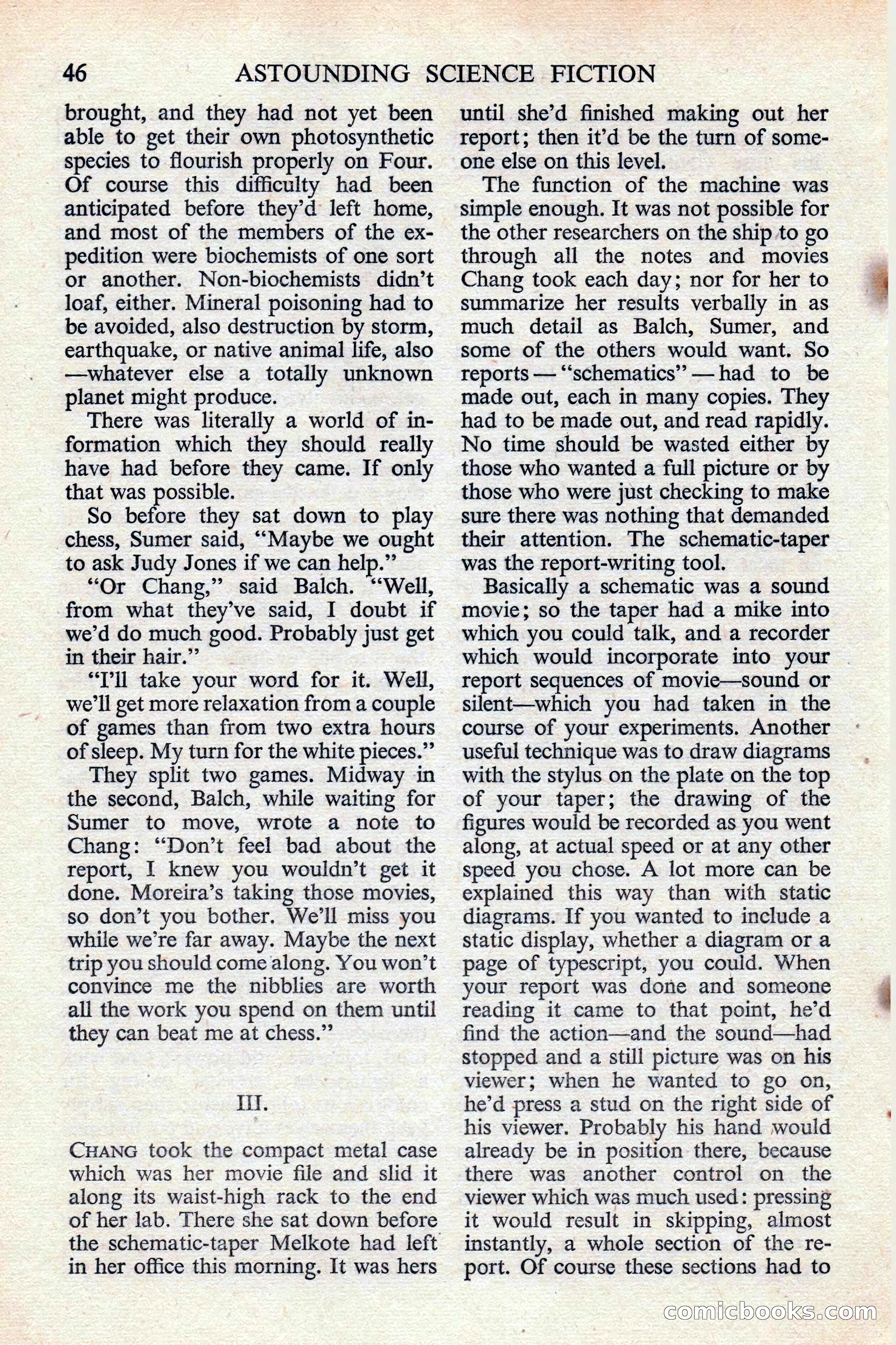
A restored page from Pulp Fiction, 1954. Page through the whole issue in the reader above.
📄 Transcribed text from this page (OCR, searchable)
Machine-transcribed from the original scan — historical spelling and the odd misread are preserved.
46 ASTOUNDING SCIENCE FICTION brought, and they had not yet been able to get their own photosynthetic species to flourish properly on Four. Of course this difficulty had been anticipated before they’d left home, and most of the members of the ex- pedition were biochemists of one sort or another. Non-biochemists didn’t loaf, either. Mineral poisoning had to be avoided, also destruction by storm, earthquake, or native animal life, also —whatever else a totally unknown planet might produce. There was literally a world of in- formation which they should really have had before they came. If only that was possible. So before they sat down to play chess, Sumer said, ““Maybe we ought to ask Judy Jones if we can help.” “Or Chang,” said Balch. ‘‘Well, from what they’ve said, I doubt if we’d do much good. Probably just get in their hair.” “Till take your word for it. Well, we'll get more relaxation from a couple of games than from two extra hours of sleep. My turn for the white pieces.” They split two games. Midway in the second, Balch, while waiting for Sumer to move, wrote a note to Chang: “Don’t feel bad about the report, I knew you wouldn’t get it done. Moreira’s taking those movies, so don’t you bother. We’ll miss you while we’re far away. Maybe the next trip you should come along. You won’t convince me the nibblies are worth all the work you spend on them until they can beat me at chess.” Tif. CHANG took the compact metal case which was her movie file and slid it along its waist-high rack to the end of her lab. There she sat down before the schematic-taper Melkote had left in her office this morning. It was hers until she’d finished making out her report; then it’d be the turn of some- one else on this level. The function of the machine was simple enough. It was not possible for the other researchers on the ship to go through all the notes and movies Chang took each day; nor for her to summarize her results verbally in as much detail as Balch, Sumer, and some of the others would want. So reports — “‘schematics” — had to be made out, each in many copies. They had to be made out, and read rapidly. No time should be wasted either by those who wanted a full picture or by those who were just checking to make sure there was nothing that demanded their attention. The schematic-taper was the report-writing tool. Basically a schematic was a sound movie; so the taper had a mike into which you could talk, and a recorder which would incorporate into your | report sequences of movie—sound or silent—which you had taken in the course of your experiments. Another useful technique was to draw diagrams with the stylus on the plate on the top of your taper; the drawing of the figures would be recorded as you went along, at actual speed or at any other speed you chose. A lot more can be explained this way than with static diagrams. If you wanted to include a static display, whether a diagram or a page of typescript, you could. When your report was done and someone reading it came to that point, he’d find the action—and the sound—had stopped and a still picture was on his viewer; when he wanted to go on, he’d press a stud on the right side of his viewer. Probably his hand would already be in position there, because there was another control on the viewer which was much used: pressing it would result in skipping, almost instantly, a whole section of the re- port. Of course these sections had to CconnicloookKks.c© i