
Pulp Fiction, 1954 · page 34 of 132
Astounding Science Fiction (British edition) — page 34: what you’re looking at
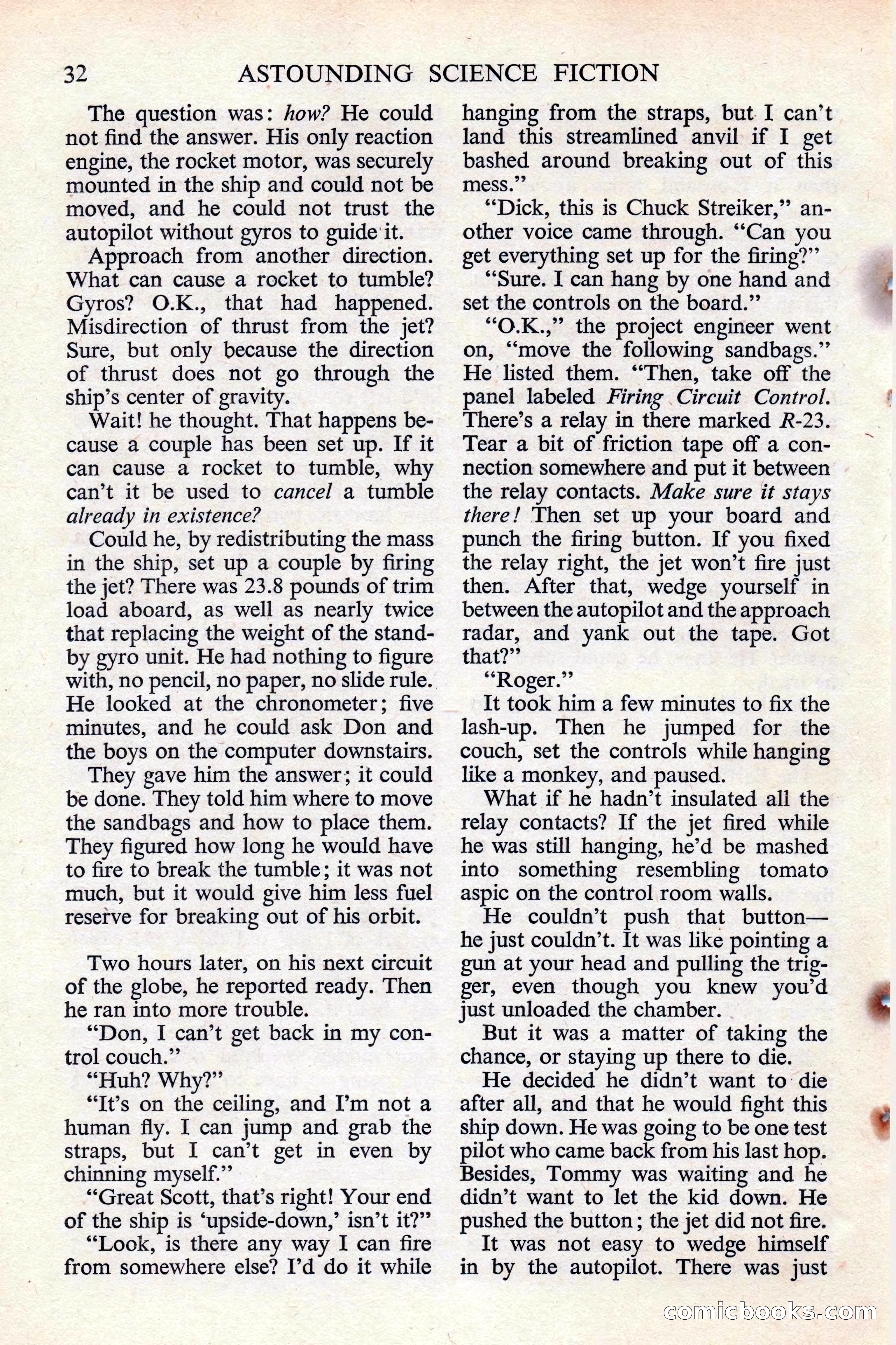
A restored page from Pulp Fiction, 1954. Page through the whole issue in the reader above.
📄 Transcribed text from this page (OCR, searchable)
Machine-transcribed from the original scan — historical spelling and the odd misread are preserved.
32 ASTOUNDING SCIENCE FICTION The question was: how? He could not find the answer. His only reaction engine, the rocket motor, was securely mounted in the ship and could not be moved, and he could not trust the autopilot without gyros to guide'it. Approach from another direction. What can cause a rocket to tumble? Gyros? O.K., that had happened. Misdirection of thrust from the jet? Sure, but only because the direction of thrust does not go through the ship’s center of gravity. Wait! he thought. That happens be- cause a couple has been set up. If it can cause a rocket to tumble, why can’t it be used to cancel a tumble already in existence? Could he, by redistributing the mass in the ship, set up a couple by firing the jet? There was 23.8 pounds of trim load aboard, as well as nearly twice that replacing the weight of the stand- by gyro unit. He had nothing to figure with, no pencil, no paper, no slide rule. . He looked at the chronometer; five minutes, and he could ask Don and the boys on the computer downstairs. They gave him the answer; it could be done. They told him where to move the sandbags and how to place them. They figured how long he would have to fire to break the tumble; it was not much, but it would give him less fuel resetve for breaking out of his orbit. Two hours later, on his next circuit of the globe, he reported ready. Then he ran into more trouble. “Don, I can’t get back in my con- trol couch.” “Huh? Why?” “It’s on the ceiling, and I’m not a human fly. I can jump and grab the straps, but I can’t get in even by chinning myself.”’ “Great Scott, that’s right! Your end of the ship is “upside-down,” isn’t it?” “Look, is there any way I can fire from somewhere else? I’d do it while hanging from the straps, but I can’t land this streamlined anvil if I get bashed around breaking out of this mess.” “Dick, this is Chuck Streiker,’’ an- other voice came through. “Can you get everything set up for the firing?”’ “Sure. I can hang by one hand and set the controls on the board.” “O.K.,” the project engineer went on, “move the following sandbags.” He listed them. ‘“‘Then, take off the panel labeled Firing .Circuit Control. There’s a relay in there marked R-23. Tear a bit of friction tape off a con- nection somewhere and put it between the relay contacts. Make sure it stays there! Then set up your board and punch the firing button. If you fixed the relay right, the jet won’t fire just then. After that, wedge yourself in between the autopilot and the approach radar, and yank out the tape. Got that?’ **Roger.”’ It took him a few minutes to fix the lash-up. Then he jumped for the couch, set the controls while hanging like a monkey, and paused. What if he hadn’t insulated all the relay contacts? If the jet fired while he was still hanging, he’d be mashed into something resembling tomato aspic on the control room walls. He couldn’t push that button— he just couldn’t. It was like pointing a gun at your head and pulling the trig- ger, even though you knew you'd just unloaded the chamber. But it was a matter of taking the chance, or staying up there to die. He decided he didn’t want to die after all, and that he would fight this ship down. He was going to be one test pilot who came back from his last hop. Besides, Tommy was waiting and he didn’t want to let the kid down. He pushed the button ; the jet did not fire. It was not easy to wedge himself in by the autopilot. There was just connicloooks.c© im