
Pulp Fiction, 1954 · page 21 of 132
Astounding Science Fiction (British edition) — page 21: what you’re looking at
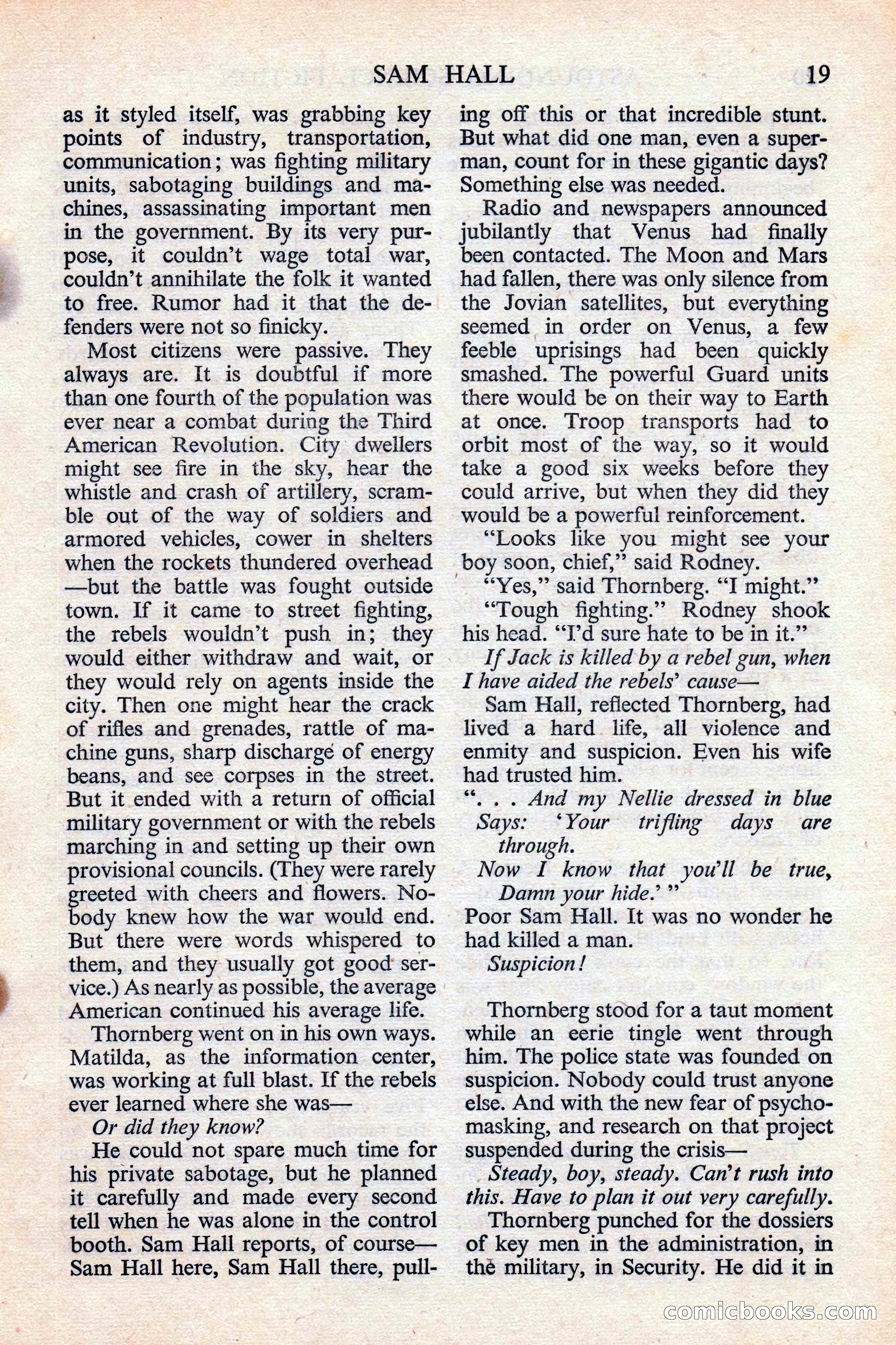
A restored page from Pulp Fiction, 1954. Page through the whole issue in the reader above.
📄 Transcribed text from this page (OCR, searchable)
Machine-transcribed from the original scan — historical spelling and the odd misread are preserved.
SAM as it styled itself, was grabbing key points of industry, transportation, communication; was fighting military units, sabotaging buildings and ma- chines, assassinating important men in the government. By its very pur- pose, it couldn’t wage total war, couldn’t annihilate the folk it wanted to free. Rumor had it that the de- fenders were not so finicky. Most citizens were passive. They always are. It is doubtful if more than one fourth of the population was ever near a combat during the Third American Revolution. City dwellers might see fire in the sky, hear the whistle and crash of artillery, scram- ble out of the way of soldiers and armored vehicles, cower in shelters when the rockets thundered overhead —but the battle was fought outside town. If it came to street fighting, the rebels wouldn’t push in; they would either withdraw and wait, or they would rely on agents inside the city. Then one might hear the crack of rifles and grenades, rattle of ma- chine guns, sharp discharge of energy beans, and see corpses in the street. But it ended with a return of official military government or with the rebels marching in and setting up their own provisional councils. (They were rarely reeted with cheers and flowers. No- ody knew how the war would end. But there were words whispered to them, and they usually got good ser- vice.) As nearly as possible, the average American continued his average life. Thornberg went on in his own ways. Matilda, as the information center, was working at full blast. If the rebels ever learned where she was— Or did they know? He could not spare much time for his private sabotage, but he planned it carefully and made every second tell when he was alone in the control booth. Sam Hall reports, of course— Sam Hall here, Sam Hall there, pull- HALL : 19 ing off this or that incredible stunt. But what did one man, even a super- man, count for in these gigantic days? Something else was needed. Radio and newspapers announced jubilantly that Venus had finally been contacted. The Moon and Mars had fallen, there was only silence from the Jovian satellites, but everything seemed in order on Venus, a few feeble uprisings had been quickly smashed. The powerful Guard units there would be on their way to Earth at once. Troop transports had to orbit most of the way, so it would take a good six weeks before they could arrive, but when they did they would be a powerful reinforcement. “Looks like you might see your boy soon, chief,” said Rodney. “Yes,” said Thornberg. “I might.” “Tough fighting.” Rodney shook his head. “‘I’d sure hate to be in it.” If Jack is killed by a rebel gun, when I have aided the rebels’ cause— Sam Hall, reflected Thornberg, had lived a hard life, all violence and enmity and suspicion. Even his wife had trusted him. *“. . . And my Nellie dressed in blue Says: ‘Your trifling days are through. Now I know that you'll be true, Damn your hide.’ ”’ Poor Sam Hall. It was no wonder he had killed a man. Suspicion ! Thornberg stood for a taut moment while an eerie tingle went through him. The police state was founded on suspicion. Nobody could trust anyone else. And with the new fear of psycho- masking, and research on that project suspended during the crisis— Steady, boy, steady. Can’t rush into this. Have to plan it out very carefully. Thornberg punched for the dossiers of key men in the administration, in thé military, in Security. He did it in connicloooks.conn