
Pulp Fiction, 1954 · page 127 of 132
Astounding Science Fiction (British edition) — page 127: what you’re looking at
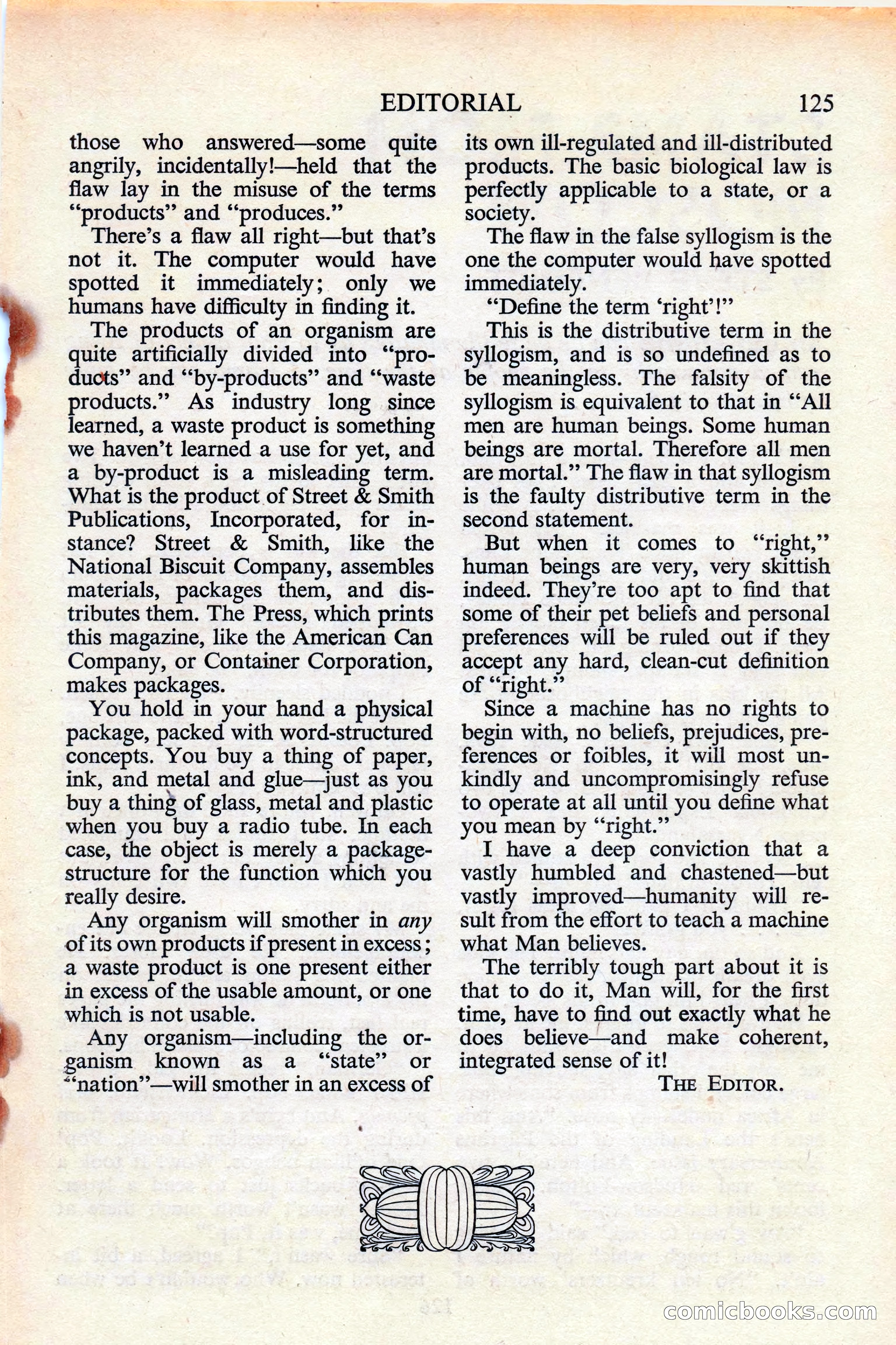
A restored page from Pulp Fiction, 1954. Page through the whole issue in the reader above.
📄 Transcribed text from this page (OCR, searchable)
Machine-transcribed from the original scan — historical spelling and the odd misread are preserved.
EDITORIAL those who answered—some quite angrily, incidentally!—held that the flaw lay in the misuse of the terms “products” and “produces.” There’s a flaw all right—but that’s not it. The computer would have spotted it immediately; only we humans have difficulty in finding it. The products of an organism are quite artificially divided into “pro- ducts” and “by-products” and “waste products.” As industry long since learned, a waste product is something we haven’t learned a use for yet, and a by-product is a misleading term. What is the product of Street & Smith Publications, Incorporated, for in- stance? Street & Smith, like the National Biscuit Company, assembles materials, packages them, and dis- tributes them. The Press, which prints this magazine, like the American Can Company, or Container Corporation, _ makes packages. You hold in your hand a physical package, packed with word-structured concepts. You buy a thing of paper, ink, and metal and glue—just as you buy a thing of glass, metal and plastic when you buy a radio tube. In each case, the object is merely a package- structure for the function which you really desire. Any organism will smother in any of its own products if present in excess ; a waste product is one present either in excess of the usable amount, or one which is not usable. Any organism—including the or- ganism known as a “state” or “‘nation’’—will smother in an excess of 125 its own ill-regulated and ill-distributed products. The basic biological law is perfectly applicable to a state, or a society. The flaw in the false syllogism is the one the computer would have spotted immediately. | “Define the term ‘right’!”’ This is the distributive term in the syllogism, and is so undefined as to be meaningless. The falsity of the syllogism is equivalent to that in “‘All men are human beings. Some human beings are mortal. Therefore all men are mortal.” The flaw in that syllogism is the faulty distributive term in the second statement. But when it comes to “right,” human beings are very, very skittish indeed. They’re too apt to find that some of their pet beliefs and personal preferences will be ruled out if they accept any hard, clean-cut definition of “right.” Since a machine has no rights to begin with, no beliefs, prejudices, pre- ferences or foibles, it will most un- kindly and uncompromisingly refuse to operate at all until you define what you mean by “right.” I have a deep conviction that a vastly humbled and chastened—but vastly improved—humanity will re- sult from the effort to teach a machine what Man believes. The terribly tough part about it is that to do it, Man will, for the first time, have to find out exactly what he does believe—and make coherent, integrated sense of it! THE EDITOR. conniclooolks.con