
Pulp Fiction, 1954 · page 103 of 132
Astounding Science Fiction (British edition) — page 103: what you’re looking at
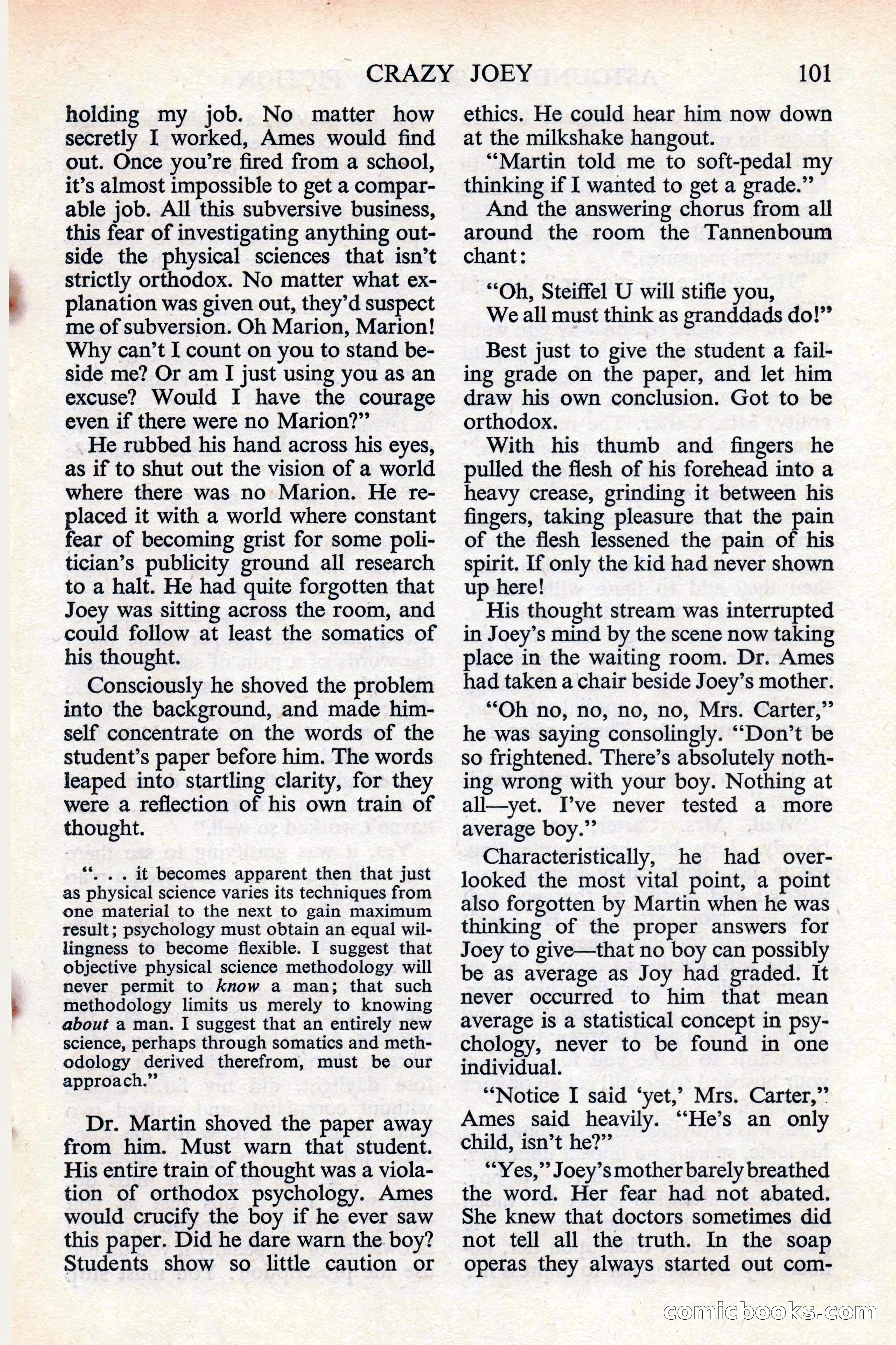
A restored page from Pulp Fiction, 1954. Page through the whole issue in the reader above.
📄 Transcribed text from this page (OCR, searchable)
Machine-transcribed from the original scan — historical spelling and the odd misread are preserved.
CRAZY JOEY holding my job. No matter how secretly I worked, Ames would find out. Once you're fired from a school, it’s almost impossible to get a compar- able job. All this subversive business, this fear of investigating anything out- side the physical sciences that isn’t strictly orthodox. No matter what ex- planation was given out, they’d suspect me of subversion. Oh Marion, Marion! Why can’t I count on you to stand be- side me? Or am I just using you as an excuse? Would I have the courage even if there were no Marion?” He rubbed his hand across his eyes, as if to shut out the vision of a world where there was no Marion. He re- placed it with a world where constant fear of becoming grist for some poli- tician’s publicity ground all research to a halt. He had quite forgotten that Joey was sitting across the room, and could follow at least the somatics of his thought. Consciously he shoved the problem into the background, and made him- self concentrate on the words of the student’s paper before him. The words leaped into startling clarity, for they were a reflection of his own train of thought. **. . . it becomes apparent then that just as physical science varies its techniques from one material to the next to gain maximum result; psychology must obtain an equal wil- lingness to become flexible. I suggest that Objective physical science methodology will mever permit to know a man; that such methodology limits us merely to knowing about a man. I suggest that an entirely new science, perhaps through somatics and meth- odology derived therefrom, must be our approach.” Dr. Martin shoved the paper away from him. Must warn that student. His entire train of thought was a viola- tion of orthodox psychology. Ames would crucify the boy if he ever saw this paper. Did he dare warn the boy? Students show so little caution or 101 ethics. He could hear him now down at the milkshake hangout. “Martin told me to soft-pedal my thinking if I wanted to get a grade.” And the answering chorus from all around the room the Tannenboum chant: “Oh, Steiffel U will stifie you, We all must think as granddads do!” Best just to give the student a fail- ing grade on the paper, and let him draw his own conclusion. Got to be orthodox. With his thumb and fingers he pulled the fiesh of his forehead into a heavy crease, grinding it between his fingers, taking pleasure that the pain of the flesh lessened the pain of his spirit, If only the kid had never shown up here! His thought stream was interrupted in Joey’s mind by the scene now taking place in the waiting room. Dr. Ames had taken a chair beside Joey’s mother. “Oh no, no, no, no, Mrs. Carter,” he was saying consolingly. ““Don’t be so frightened. There’s absolutely noth- ing wrong with your boy. Nothing at all—yet. I’ve never tested a more average boy.” Characteristically, he had _ over- looked the most vital point, a point also forgotten by Martin when he was thinking of the proper answers for Joey to give—that no boy can possibly be as average as Joy had graded. It never occurred to him that mean average is a Statistical concept in psy- chology, never to be found in one individual. “Notice I said ‘yet,’ Mrs. Carter,” Ames said heavily. ““He’s an only child, isn’t he?” ““Yes,”’ Joey’s mother barely breathed the word. Her fear had not abated. She knew that doctors sometimes did not tell all the truth. In the soap operas they always started out com- conniclooolks.cornn