
Pulp Fiction, 1953 · page 92 of 132
Astounding Science Fiction, British Edition — page 92: what you’re looking at
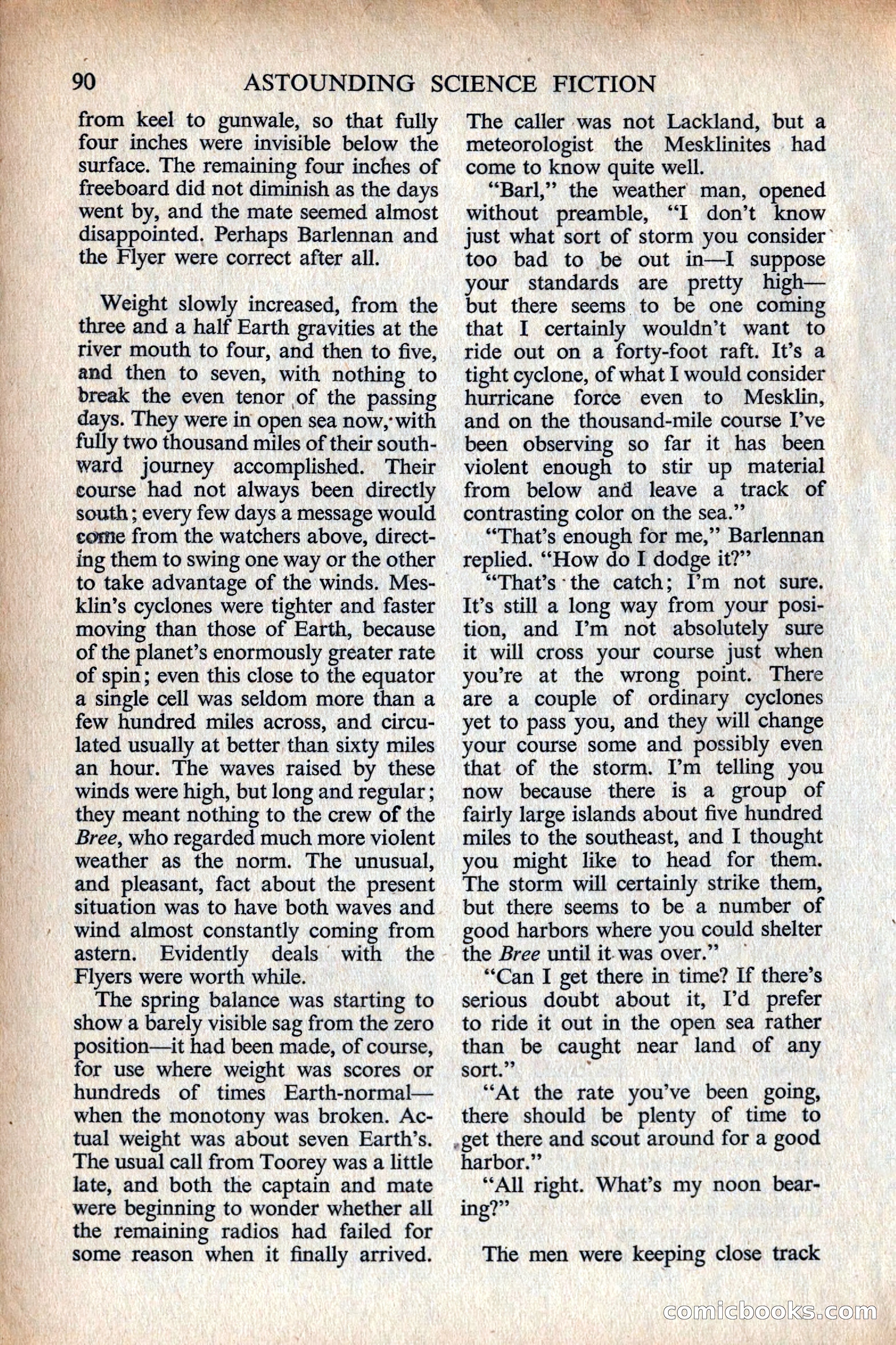
A restored page from Pulp Fiction, 1953. Page through the whole issue in the reader above.
📄 Transcribed text from this page (OCR, searchable)
Machine-transcribed from the original scan — historical spelling and the odd misread are preserved.
. ay 90 from keel to gunwale, so that fully four inches were invisible below the surface. The remaining four inches of freeboard did not diminish as the days went by, and the mate seemed almost disappointed. Perhaps Barlennan and the Flyer were correct after all. Weight slowly increased, from the three and a half Earth gravities at the river mouth to four, and then to five, and then to seven, with nothing to break the even tenor of the passing days. They were in open sea now,’ with fully two thousand miles of their south- ward journey accomplished. Their course had not always been directly south ; every few days a message would come from the watchers above, direct- ing them to swing one way or the other to take advantage of the winds. Mes- klin’s cyclones were tighter and faster moving than those of Earth, because of the planet’s enormously greater rate of spin; even this close to the equator a single cell was seldom more than a few hundred miles across, and circu- lated usually at better than sixty miles an hour. The waves raised by these winds were high, but long and regular ; they meant nothing to the crew of the Bree, who regarded much more violent weather as the norm. The unusual, and pleasant, fact about the present situation was to have both waves and wind almost constantly coming from astern. Evidently deals’ with the Flyers were worth while. The spring balance was starting to show a barely visible sag from the zero position—it had been made, of course, for use where weight was scores or hundreds of times Earth-normal— when the monotony was broken. Ac- tual weight was about seven Earth’s. The usual call from Toorey was a little late, and both the captain and mate were beginning to wonder whether all the remaining radios had failed for some reason when it finally arrived. OPA acc As fa ek A ll OH, act Se LS sa kN ; Ph ee +e Aes ASTOUNDING SCIENCE FICTION The caller was not Lackland, but a meteorologist the Mesklinites had come to know quite well. ““Barl,” the weather man, opened without preamble, “I don’t know just what sort of storm you consider’ too bad to be out in—I suppose your standards are pretty high— but there seems to be one coming that I certainly wouldn’t want to ride out on a forty-foot raft. It’s a tight cyclone, of what I would consider hurricane force even to Méesklin, and on the thousand-mile course I’ve been observing so far it has been violent enough to stir up material from below and leave a track of contrasting color on the sea.”’ “That’s enough for me,” Barlennan replied. “How do I dodge it?” ““That’s the catch; I’m not sure, It’s still a long way from your posi- tion, and I’m not absolutely sure it will cross your course just when you’re at the wrong point. There are a couple of ordinary cyclones yet to pass you, and they will change our course some and possibly even that of the storm. I’m telling you now because there is a group of fairly large islands about five hundred miles to the southeast, and I thought you might like to head for them. The storm will certainly strike them, but there seems to be a number of good harbors where you could shelter the Bree until it. was over.” — “Can I get there in time? If there’s serious doubt about it, I’d prefer to ride it out in the open sea rather than be caught near land of any sort.” “At the rate you’ve been going, there should be plenty of time to .get there and scout around for a good harbor.” ‘All right. What’s my noon bear- ing?” The men were keeping close track Connicloooks com