
Pulp Fiction, 1953 · page 48 of 132
Astounding Science Fiction, British Edition — page 48: what you’re looking at
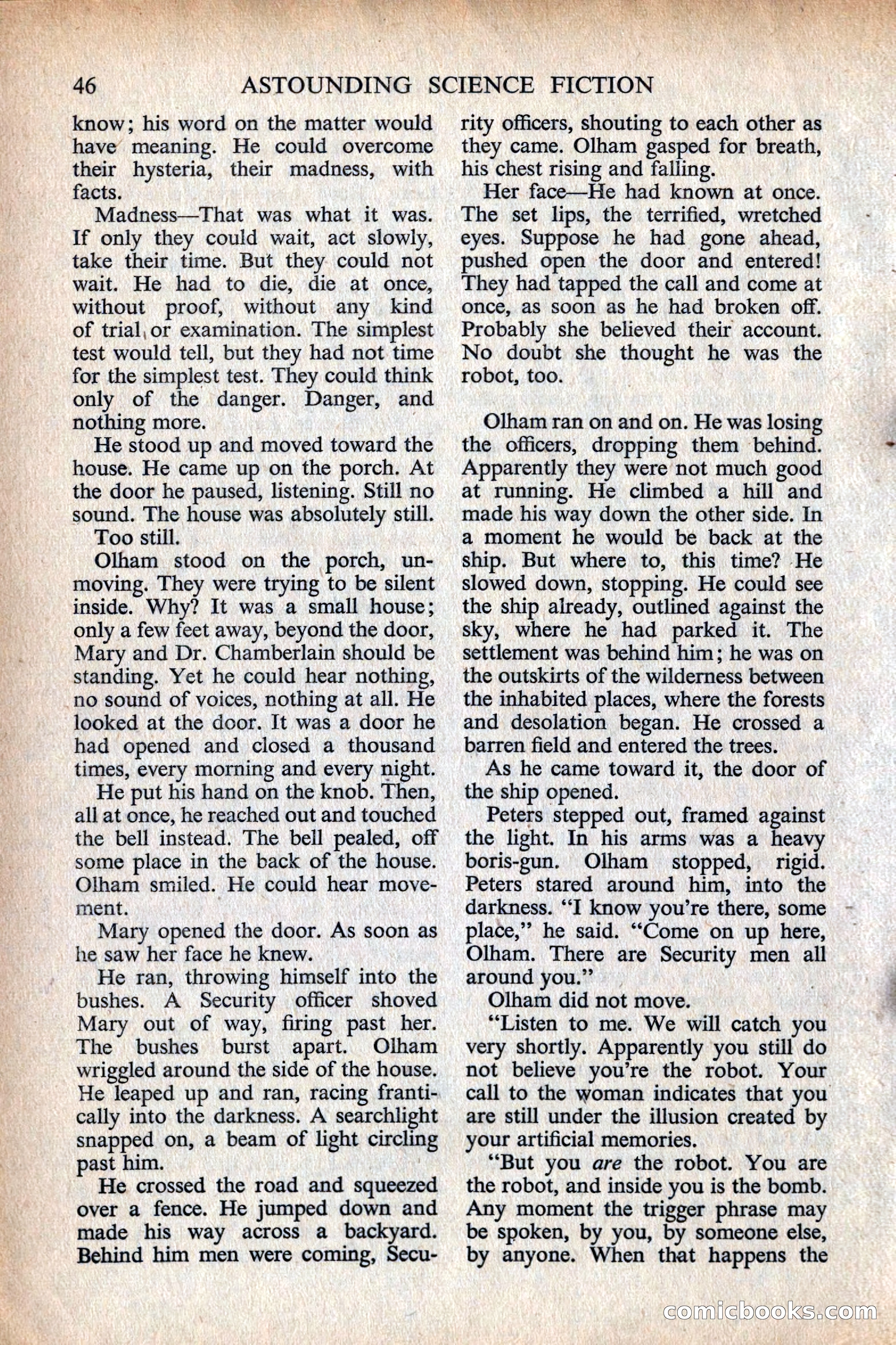
A restored page from Pulp Fiction, 1953. Page through the whole issue in the reader above.
📄 Transcribed text from this page (OCR, searchable)
Machine-transcribed from the original scan — historical spelling and the odd misread are preserved.
Bi ae RS . ~~, is) ae be apd bated tne Se Loree Uae a2) Yh cay eer TG aN Tar ANN CF af kaa ae AED : eee dy 4a OL 8\ a | ity tse) 46 ASTOUNDING SCIENCE FICTION know; his word on the matter would have meaning. He could overcome their hysteria, their madness, with facts. Madness—That was what it was. If only they could wait, act slowly, take their time. But they could not wait. He had to die, die at once, without proof, without any kind of trial,or examination. The simplest test would tell, but they had not time for the simplest test. They could think only of the danger. Danger, and nothing more. He stood up and moved toward the house. He came up on the porch. At the door he paused, listening. Still no sound. The house was absolutely still. Too still. Olham stood on the porch, un- moving. They were trying to be silent inside. Why? It was a small house; only a few feet away, beyond the door, Mary and Dr. Chamberlain should be standing. Yet he could hear nothing, no sound of voices, nothing at all. He looked at the door. It was a door he had opened and closed a thousand times, every morning and every night. He put his hand on the knob. Then, all at once, he reached out and touched the bell instead. The bell pealed, off some place in the back of the house. Olham smiled. He could hear move- ment. Mary opened the door. As soon as he saw her face he knew. He ran, throwing himself into the bushes. A Security officer shoved Mary out of way, firing past her. The bushes burst apart. Olham wriggled around the side of the house. He leaped up and ran, racing franti- cally into the darkness. A searchlight snapped on, a beam of light circling past him. He crossed the road and squeezed over a fence. He jumped down and made his way across a_ backyard. Behind him men were coming, Secu- rity officers, shouting to each other as they came. Olham gasped for breath, his chest rising and falling. Her face—He had known at once. The set lips, the terrified, wretched eyes. Suppose he had gone ahead, pushed open the door and entered! They had tapped the call and come at once, as soon as he had broken off. Probably she believed their account. No doubt she thought he was the robot, too. Olham ran on and on. He was losing the officers, dropping them behind. Apparently they were not much good at running. He climbed a hill and made his way down the other side. In a moment he would be back at the ship. But where to, this time? He slowed down, stopping. He could see the ship already, outlined against the sky, where he had parked it. The settlement was behind him; he was on the outskirts of the wilderness between the inhabited places, where the forests and desolation began. He crossed a barren field and entered the trees. As he came toward it, the door of the ship opened. Peters stepped out, framed against the light. In his arms was a heavy boris-gun. Olham_ stopped, rigid. Peters stared around him, into the darkness. “I know you’re there, some place,” he said. ““Come on up here, Olham. There are Security men all around you.” Olham did not move. “Listen to me. We will catch you very shortly. Apparently you still do not believe you’re the robot. Your call to the woman indicates that you are still under the illusion created by your artificial memories. “But you are the robot. You are the robot, and inside you is the bomb. Any moment the trigger phrase may be spoken, by you, by someone else, by anyone. When that happens the CORE DOOKS Onn