
Pulp Fiction, 1953 · page 46 of 132
Astounding Science Fiction, British Edition — page 46: what you’re looking at
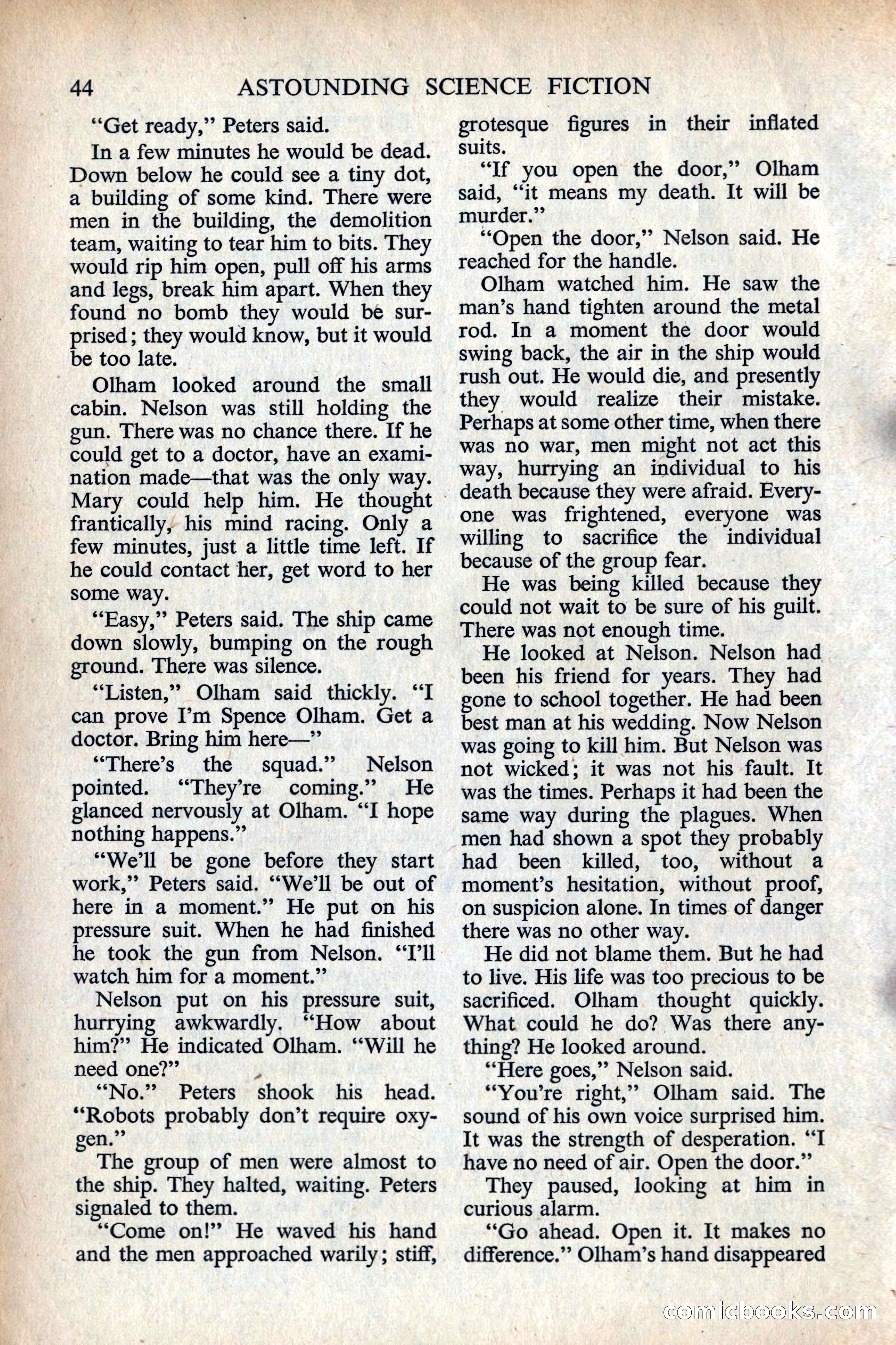
A restored page from Pulp Fiction, 1953. Page through the whole issue in the reader above.
📄 Transcribed text from this page (OCR, searchable)
Machine-transcribed from the original scan — historical spelling and the odd misread are preserved.
a4 ASTOUNDING SCIENCE FICTION “Get ready,” Peters said. In a few minutes he would be dead. Down below he could see a tiny dot, a building of some kind. There were men in the building, the demolition team, waiting to tear him to bits. They would rip him open, pull off his arms and legs, break him apart. When they found no bomb they would be sur- prised; they would know, but it would be too late. Olham looked around the small cabin. Nelson was still holding the gun. There was no chance there. If he could get to a doctor, have an exami- nation made—that was the only way. Mary could help him. He thought frantically, his mind racing. Only a few minutes, just a little time left. If he could contact her, get word to her some way. ““Rasy,”’ Peters said. The ship came down slowly, bumping on the rough ground. There was silence. “Listen,” Olham said thickly. “I can prove I’m Spence Olham. Get a doctor. Bring him here—”’ ““There’s the squad.” Nelson pointed. ‘“‘They’re coming.” He glanced nervously at Olham. “I hope nothing happens.” “We'll be gone before they start work,” Peters said. ““We’ll be out of here in a moment.” He put on his pressure suit. When he had finished he took the gun from Nelson. “T’ll watch him for a moment.” Nelson put on his pressure suit, hurrying awkwardly. “How about him?” He indicated Olham. “Will he need one?” , “No.” Peters shook his head. “Robots probably don’t require oxy- gen.” The group of men were almost to the ship. They halted, waiting. Peters signaled to them. “Come on!” He waved his hand and the men approached warily; stiff, grotesque figures in their inflated suits. “If you open the door,” Olham said, “it means my death. It will be murder.” ‘““Open the door,” Nelson said. He reached for the handle. Olham watched him. He saw the man’s hand tighten around the metal rod. In a moment the door would swing back, the air in the ship would rush out. He would die, and presently they would realize their mistake. Perhaps at some other time, when there was no war, men might not act this way, hurrying an individual to his death because they were afraid. Every- one was frightened, everyone was willing to sacrifice the individual because of the group fear. He was being killed because they could not wait to be sure of his guilt. There was not enough time. He looked at Nelson. Nelson had been his friend for years. They had gone to school together. He had been best man at his wedding. Now Nelson was going to kill him. But Nelson was not wicked; it was not his fault. It was the times. Perhaps it had been the same way during the plagues. When men had shown a spot they probably had been killed, too, without a moment’s hesitation, without proof, on suspicion alone. In times of danger there was no other way. He did not blame them. But he had to live. His life was too precious to be sacrificed. Olham thought quickly. What could he do? Was there any- thing? He looked around. “Here goes,”” Nelson said. “You’re right,” Olham said. The sound of his own voice surprised him. It was the strength of desperation. “I have no need of air. Open the door.” They paused, looking at him in curious alarm. “Go ahead. Open it. It makes no difference.’’ Olham’s hand disappeared Conmclboooks.con