
Pulp Fiction, 1953 · page 40 of 132
Astounding Science Fiction, British Edition — page 40: what you’re looking at
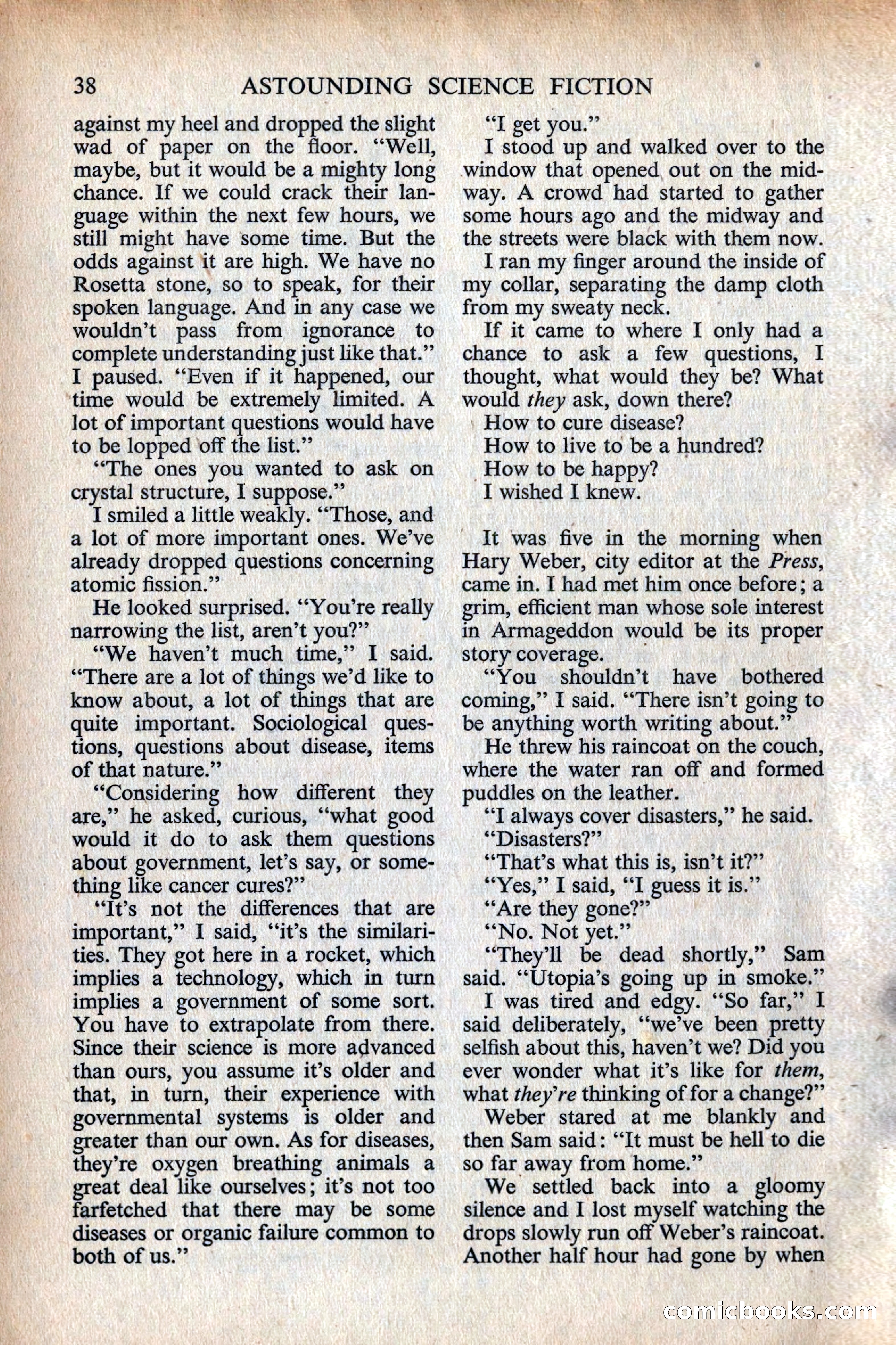
A restored page from Pulp Fiction, 1953. Page through the whole issue in the reader above.
📄 Transcribed text from this page (OCR, searchable)
Machine-transcribed from the original scan — historical spelling and the odd misread are preserved.
re it) hu day 1 EE ee ere: 6. Tee aA as 38 ASTOUNDING SCIENCE FICTION against my heel and dropped the slight wad of paper on the floor. “Well, maybe, but it would be a mighty long chance. If we could crack their lan- age within the next few hours, we still might have some time. But the odds against it are high. We have no Rosetta stone, so to speak, for their spoken language. And in any case we wouldn’t pass from ignorance to complete understanding just like that.” I paused. “‘Even if it happened, our time would be extremely limited. A lot of important questions would have to be lopped off the list.” “The ones you wanted to ask on crystal structure, I suppose.” I smiled a little weakly. ““Those, and a lot of more important ones. We’ve already dropped questions concerning atomic fission.” He looked surprised. ““You’re really narrowing the list, aren’t you?”’ ‘We haven’t much time,” I said. “There are a lot of things we’d like to know about, a lot of things that are quite important. Sociological ques- tions, questions about disease, items of that nature.” “Considering how different they are,” he asked, curious, “what good would it do to ask them questions about government, let’s say, or some- thing like cancer cures?’ “fe s not the differences that are important,” I said, “it’s the similari- ties. They got here in a rocket, which implies a technology, which in turn implies a government of some sort. You have to extrapolate from there. Since their science is more advanced than ours, you assume it’s older and that, in turn, their experience with governmental systems is older and greater than our own. As for diseases, they’re oxygen breathing animals a great deal like ourselves; it’s not too farfetched that there may be some diseases or organic failure common to both of us.” “I get you.” I stood up and walked over to the window that opened, out on the mid- way. A crowd had started to gather some hours ago and the midway and the streets were black with them now. I ran my finger around the inside of my collar, separating the damp cloth from my sweaty neck. If it came to where I only had a chance to ask a few questions, I thought, what would they be? What would they ask, down there? ' How to cure disease? How to live to be a hundred? _How to be happy? I wished I knew. It was five in the morning when Hary Weber, city editor at the Press, came in. I had met him once before; a grim, efficient man whose sole interest in Armageddon would be its proper story coverage. “You shouldn’t have bothered coming,”’ I said. ““There isn’t going to be anything worth writing about.”’ He threw his raincoat on the couch, where the water ran off and formed puddles on the leather. — ‘I always cover disasters,”’ he said. *‘Disasters?”’ *‘That’s what this is, isn’t it?” “Yes,” I said, “I guess it is.” ““Are they gone?” **No. Not yet.” “They'll be dead shortly,” Sam said. ““Utopia’s going up in smoke.” I was tired and edgy. “So far,” I said deliberately, “‘we’ve been pretty selfish about this, haven’t we? Did you ever wonder what it’s like for them, what they’re thinking of for a change?” Weber stared at me blankly and then Sam said: “It must be hell to die so far away from home.” We settled back into a gloomy silence and I lost myself watching the drops slowly run off Weber’s raincoat. Another half hour had gone by when CORMICOOK<GScOm