
Pulp Fiction, 1953 · page 36 of 132
Astounding Science Fiction, British Edition — page 36: what you’re looking at
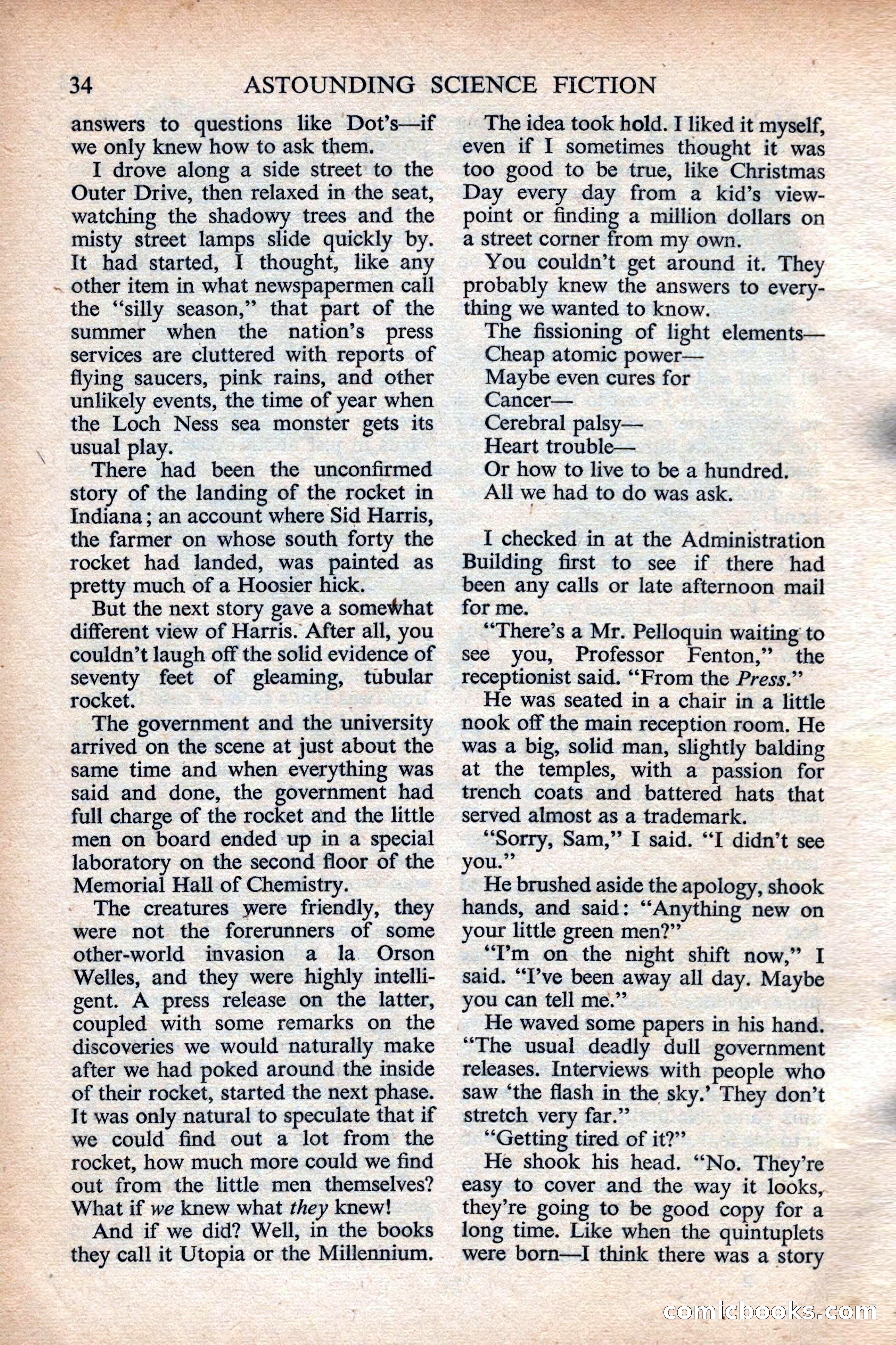
A restored page from Pulp Fiction, 1953. Page through the whole issue in the reader above.
📄 Transcribed text from this page (OCR, searchable)
Machine-transcribed from the original scan — historical spelling and the odd misread are preserved.
j 34 ASTOUNDING SCIENCE FICTION answers to questions like Dot’s—if we only knew how to ask them. I drove along a side street to the Outer Drive, then relaxed in the seat, watching the shadowy trees and the misty street lamps slide quickly by. It had started, I thought, like any other item in what newspapermen call the “‘silly season,” that part of the summer when the nation’s press services are cluttered with reports of flying saucers, pink rains, and other unlikely events, the time of year when the Loch Ness sea monster gets its usual play. There had been the unconfirmed story of the landing of the rocket in Indiana; an account where Sid Harris, the farmer on whose south forty the rocket had landed, was painted as pretty much of a Hoosier hick. But the next story gave a somewhat different view of Harris. After all, you couldn’t laugh off the solid evidence of seventy feet of gleaming, tubular rocket. The government and the university arrived on the scene at just about the same time and when everything was said and done, the government had full charge of the rocket and the little men on board ended up in a special laboratory on the second floor of the Memorial Hall of Chemistry. The creatures were friendly, they were not the forerunners of some other-world invasion a la Orson Welles, and they were highly intelli- gent. A press release on the latter, coupled with some remarks on the discoveries we would naturally make after we had poked around the inside of their rocket, started the next phase. It was only natural to speculate that if we could find out a lot from the rocket, how much more could we find out from the little men themselves? What if we knew what they knew! And if we did? Well, in the books they call it Utopia or the Millennium. _ The idea took hold. I liked it myself, even if I sometimes thought it was too good to be true, like Christmas Day every day from a kid’s view- point or finding a million dollars on a street corner from my own. You couldn’t get around it. They probably knew the answers to every- thing we wanted to know. The fissioning of light elements— Cheap atomic power— Maybe even cures for Cancer— Cerebral palsy— Heart trouble— Or how to live to be a hundred. All we had to do was ask. I checked in at the Administration Building first to see if there had been any calls or late afternoon mail for me. “There’s a Mr. Pelloquin waiting to see you, Professor Fenton,” the receptionist said. “From the Press.” He was seated in a chair in a little nook off the main reception room. He was a big, solid man, slightly balding at the temples, with a passion for trench coats and battered hats that served almost as a trademark. “Sorry, Sam,” I said. “I didn’t see you.” He brushed aside the apology, shook hands, and said: “Anything new on your little green men?” “T’m on the night shift now,” I said. “I’ve been away all day. Maybe you can tell me.” He waved some papers in his hand. “The usual deadly dull government releases. Interviews with people who saw ‘the flash in the sky.’ They don’t stretch very far.” “Getting tired of it?”’ He shook his head. “No. They’re easy to cover and the way it looks, they’re going to be good copy for a long time. Like when the quintuplets were born—lI think there was a story dite Cconmmicloooksscorn. +