
Pulp Fiction, 1953 · page 23 of 132
Astounding Science Fiction, British Edition — page 23: what you’re looking at
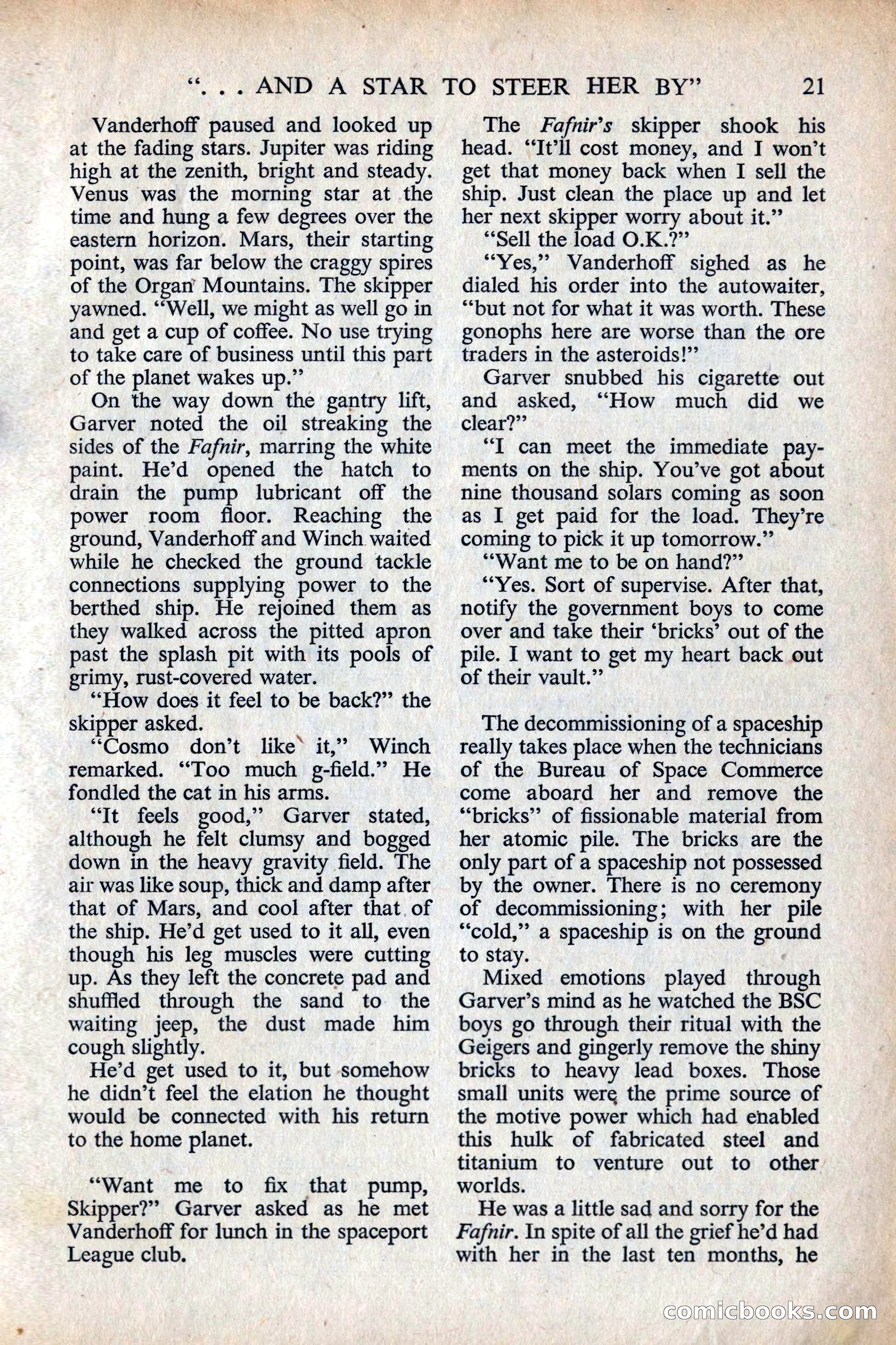
A restored page from Pulp Fiction, 1953. Page through the whole issue in the reader above.
📄 Transcribed text from this page (OCR, searchable)
Machine-transcribed from the original scan — historical spelling and the odd misread are preserved.
. AND A STAR TO STEER HER BY” Vanderhoff paused and looked up at the fading stars. Jupiter was riding high at the zenith, bright and steady. Venus was the morning star at the time and hung a few degrees over the eastern horizon. Mars, their starting point, was far below the craggy spires of the Organ’ Mountains. The skipper yawned. “‘Well, we might as well go in and get a cup of coffee. No use trying to take care of business until this part of the planet wakes up.” On the way down the gantry lift, Garver noted the oil streaking the sides of the Fafnir, marring the white paint. He’d opened the hatch to drain the pump lubricant off the power room floor. Reaching the ground, Vanderhoff and Winch waited while he checked the ground tackle connections supplying power to the berthed ship. He rejoined them as they walked across the pitted apron past the splash pit with its pools of grimy, rust-covered water. ““How does it feel to be back?’’ the skipper asked. “Cosmo don’t like* it,’ Winch remarked. ““Too much e-field.” He fondled the cat in his arms. “It feels good,” Garver stated, although he felt clumsy and bogged down in the heavy gravity field. The air was like soup, thick and damp after that of Mars, and cool after that. of the ship. He’d get used to it all, even though his leg muscles were cutting up. As they left the concrete pad and shuffled through the sand to the waiting jeep, the dust made him cough slightly. He’d get used to it, but somehow he didn’t feel the elation he thought would be connected with his return to the home planet. “Want me to fix that pump, Skipper?” Garver asked as he met Vanderhoff for lunch in the spaceport League club. 21 The Fafnir’s skipper shook his head. “It'll cost money, and I won’t get that money back when I sell the ship. Just clean the place up and let her next skipper worry about it.” “Sell the load O.K.?” “Yes,” Vanderhoff sighed as he dialed his order into the autowaiter, “but not for what it was worth. These gonophs here are worse than the ore traders in the asteroids!”’ Garver snubbed his cigarette out and asked, “How much did we clear?” “I can meet the immediate pay- ments on the ship. You’ve got about nine thousand solars coming as soon as I get paid for the load. They’ re coming to pick it up tomorrow.” “Want me to be on hand?” “Yes. Sort of supervise. After that, notify the government boys to come over and take their ‘bricks’ out of the pile. I want to get my heart back out of their vault.” The decommissioning of a spaceship really takes place when the technicians of the Bureau of Space Commerce come aboard her and remove the “bricks” of fissionable material from her atomic pile. The bricks are the only part of a spaceship not possessed by the owner. There is no ceremony of decommissioning; with her pile “cold,” a spaceship is on the ercune to stay. Mixed emotions played through Garver’s mind as he watched the BSC boys go through their ritual with the Geigers and gingerly remove the shiny bricks to heavy lead boxes. Those small units were the prime source of the motive power which had enabled this hulk of fabricated steel and titanium to venture out to other worlds. He was a little sad and sorry for the Fafnir. In spite of all the grief he’d had with her in the last ten months, he Connielooolkks com