
Pulp Fiction, 1953 · page 18 of 132
Astounding Science Fiction, British Edition — page 18: what you’re looking at
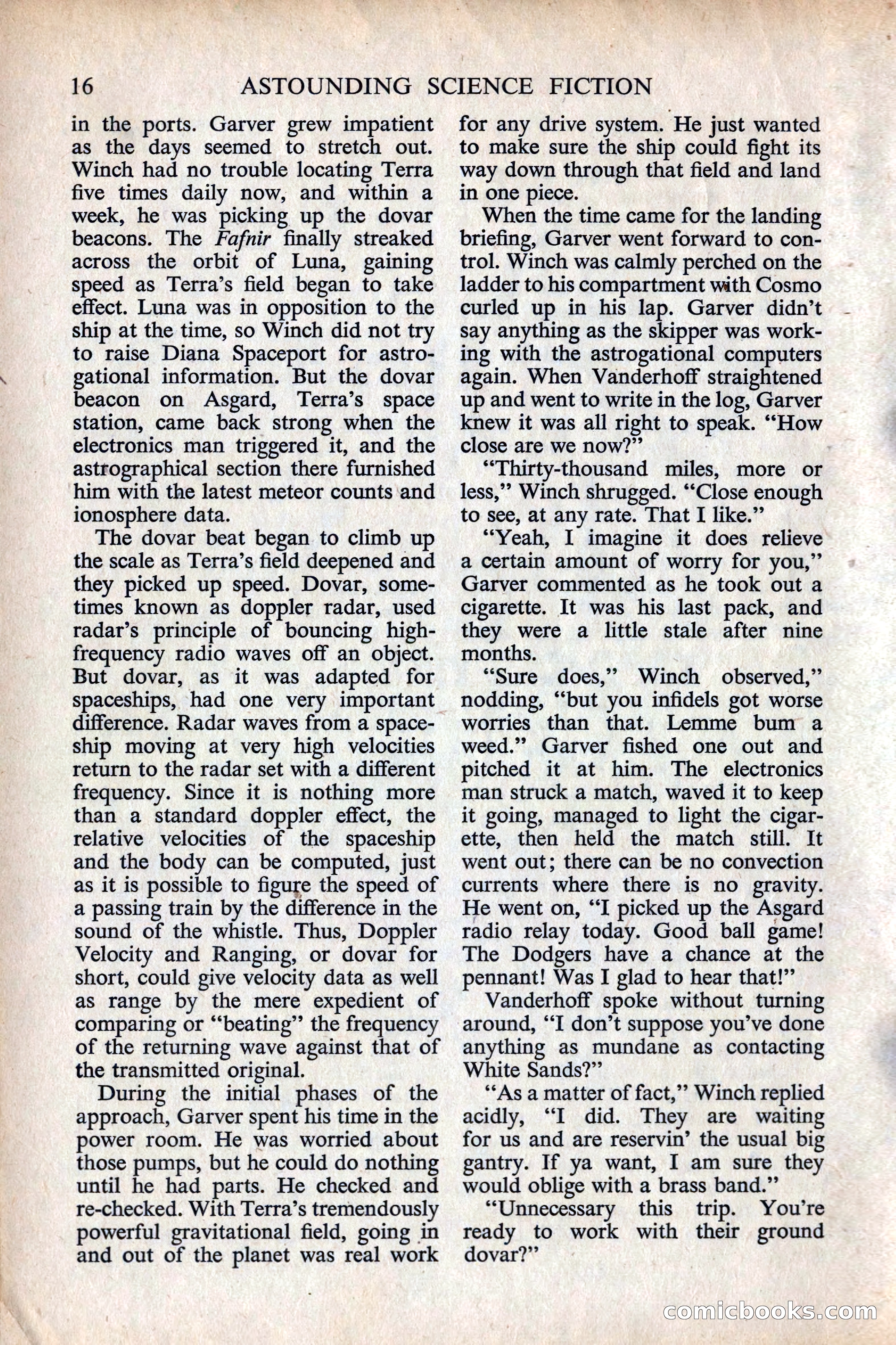
A restored page from Pulp Fiction, 1953. Page through the whole issue in the reader above.
📄 Transcribed text from this page (OCR, searchable)
Machine-transcribed from the original scan — historical spelling and the odd misread are preserved.
16 ASTOUNDING SCIENCE FICTION in the ports. Garver grew impatient as the days seemed to stretch out. Winch had no trouble locating Terra five times daily now, and within a week, he was picking up the dovar beacons. The Fafnir finally streaked across the orbit of Luna, gaining speed as Terra’s field began to take effect. Luna was in opposition to the ship at the time, so Winch did not try to raise Diana Spaceport for astro- gational information. But the dovar beacon on Asgard, Terra’s space station, came back strong when the electronics man triggered it, and the astrographical section there furnished him with the latest meteor counts and ionosphere data. The dovar beat began to climb up the scale as Terra’s field deepened and they picked up speed. Dovar, some- times known as doppler radar, used radar’s principle of bouncing high- frequency radio waves off an object. But dovar, as it was adapted for spaceships, had one very important difference. Radar waves from a space- ship moving at very high velocities return to the radar set with a different frequency. Since it is nothing more than a standard doppler effect, the relative velocities of the spaceship and the body can be computed, just as it is possible to figure the speed of a passing train by the difference in the sound of the whistle. Thus, Doppler Velocity and Ranging, or dovar for short, could give velocity data as well as range by the mere expedient of comparing or “‘beating”’ the frequency of the returning wave against that of the transmitted original. During the initial phases of the approach, Garver spent his time in the power room. He was worried about those pumps, but he could do nothing until he had parts. He checked and re-checked. With Terra’s tremendously powerful gravitational field, going in and out of the planet was real work for any drive system. He just wanted to make sure the ship could fight its way down through that field and land in one piece. When the time came for the landing briefing, Garver went forward to con- trol. Winch was calmly perched on the ladder to his compartment with Cosmo curled up in his lap. Garver didn’t say anything as the skipper was work- ing with the astrogational computers again. When Vanderhoff straightened up and went to write in the log, Garver knew it was all right to speak. ““How close are we now?” “Thirty-thousand miles, more or less,”” Winch shrugged. “‘Close enough to see, at any rate. That I like.” “Yeah, I imagine it does relieve a certain amount of worry for you,” Garver commented as he took out a cigarette. It was his last pack, and they were a little stale after nine months. “Sure does,’ Winch observed,” nodding, “but you infidels got worse worries than that. Lemme bum a weed.” Garver fished one out and pitched it at him. The electronics man struck a match, waved it to keep it going, managed to light the cigar- ette, then held the match still. It went out; there can be no convection currents where there is no gravity. He went on, “I picked up the Asgard radio relay today. Good ball game! The Dodgers have a chance at the pennant! Was I glad to hear that!” Vanderhoff spoke without turning around, “I don’t suppose you’ve done anything as mundane as contacting White Sands?” **As a matter of fact,”’ Winch replied acidly, “I did. They are waiting for us and are reservin’ the usual big gantry. If ya want, I am sure they would oblige with a brass band.” “Unnecessary this trip. You're ready to work with their ground dovar?” Conniclooolkks,. conn