
Pulp Fiction, 1953 · page 15 of 132
Astounding Science Fiction, British Edition — page 15: what you’re looking at
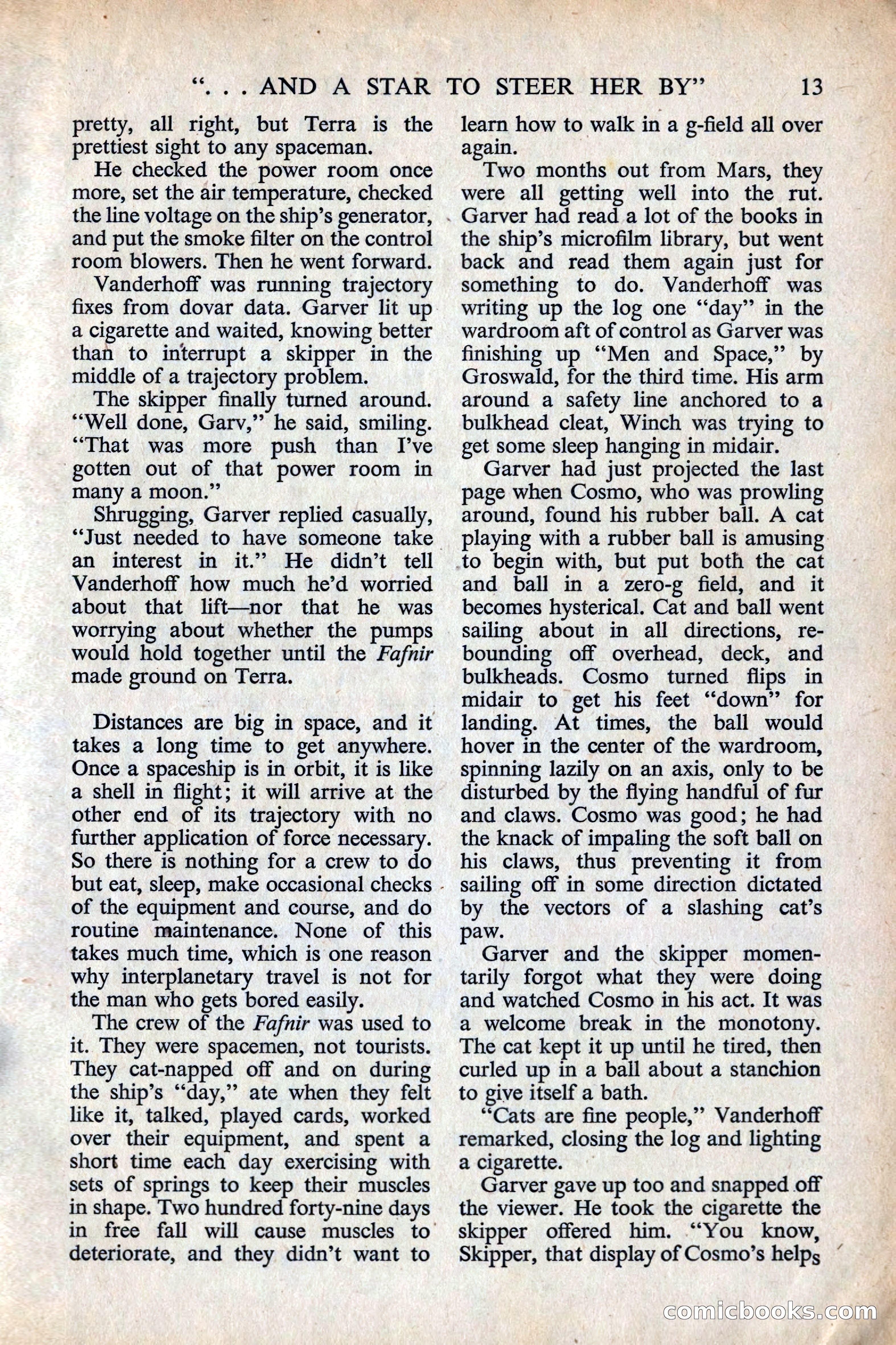
A restored page from Pulp Fiction, 1953. Page through the whole issue in the reader above.
📄 Transcribed text from this page (OCR, searchable)
Machine-transcribed from the original scan — historical spelling and the odd misread are preserved.
“. .. AND‘ A'STAR TO STEER HER BY” pretty, all right, but Terra is the prettiest sight to any spaceman. He checked the power room once more, set the air temperature, checked the line voltage on the ship’s generator, and put the smoke filter on the control room blowers. Then he went forward. Vanderhoff was running trajectory fixes from dovar data. Garver lit up a cigarette and waited, knowing better than to interrupt a skipper in the middle of a trajectory problem. The skipper finally turned around. “Well done, Garv,”’ he said, smiling. “That was more push than I’ve gotten out of that power room in many a moon.” Shrugging, Garver replied casually, *‘Just needed to have someone take an interest in it.’”’ He didn’t tell Vanderhoff how much he’d worried about that lift—nor that he was worrying about whether the pumps would hold together until the Fafnir made ground on Terra. Distances are big in space, and it takes a long time to get anywhere. Once a spaceship is in orbit, it is like a shell in flight; it will arrive at the other end of its trajectory with no further application of force necessary. So there is nothing for a crew to do but eat, sleep, make occasional checks - of the equipment and course, and do routine maintenance. None of this takes much time, which is one reason why interplanetary travel is not for the man who gets bored easily. The crew of the Fafnir was used to it. They were spacemen, not tourists. They cat-napped off and on during the ship’s “‘day,” ate when they felt like it, talked, played cards, worked over their equipment, and spent a short time each day exercising with sets of springs to keep their muscles in shape. Two hundred forty-nine days in free fall will cause muscles to deteriorate, and they didn’t want to 13 learn how to walk in a g-field all over again. Two months out from Mars, they were all getting well into the rut. . Garver had read a lot of the books in the ship’s microfilm library, but went back and read them again just for something to do. Vanderhoff was writing up the log one “day” in the wardroom aft of control as Garver was finishing up “Men and Space,’ by Groswald, for the third time. His arm around a safety line anchored to a bulkhead cleat, Winch was trying to get some sleep hanging in midair. Garver had just projected the last page when Cosmo, who was prowling around, found his rubber ball. A cat playing with a rubber ball is amusing. to begin with, but put both the cat and ball in a zero-g field, and it becomes hysterical. Cat and ball went sailing about in all directions, re- bounding off overhead, deck, and bulkheads. Cosmo turned flips in midair to get his feet “down” for landing. At times, the ball would hover in the center of the wardroom, spinning lazily on an axis, only to be disturbed by the flying handful of fur and claws. Cosmo was good; he had the knack of impaling the soft ball on his claws, thus preventing it from sailing off in some direction dictated by the vectors of a slashing cat’s aw. Garver and the skipper momen- tarily forgot what they were doing and watched Cosmo in his act. It was a welcome break in the monotony. The cat kept it up until he tired, then curled up in a ball about a stanchion to give itself a bath. “Cats are fine people,’’ Vanderhoff remarked, closing the log and lighting a cigarette. Garver gave up too and snapped off the viewer. He took the cigarette the skipper offered him. “You know, Skipper, that display of Cosmo’s helps Connicloooks com