
Pulp Fiction, 1953 · page 123 of 132
Astounding Science Fiction, British Edition — page 123: what you’re looking at
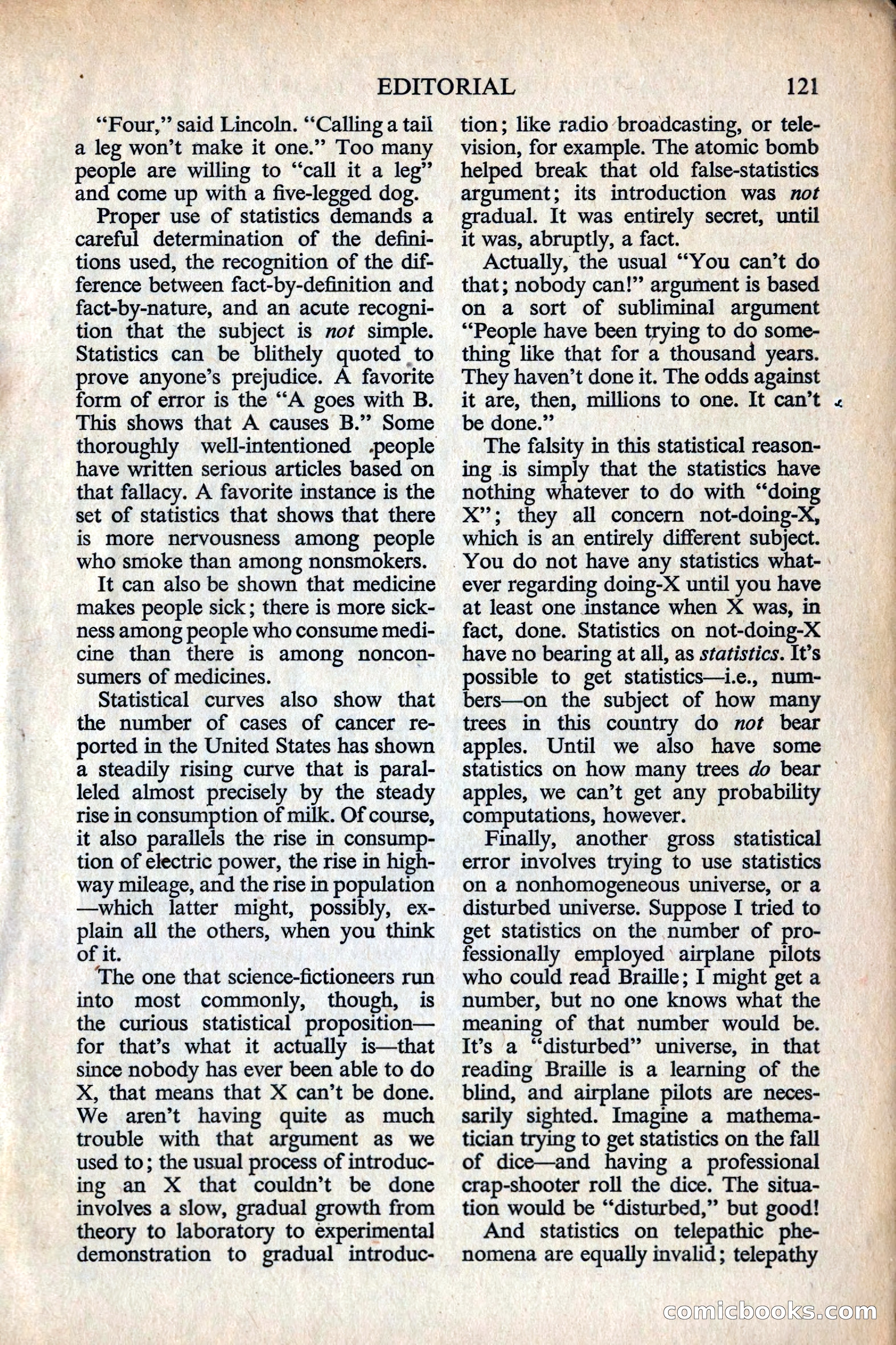
A restored page from Pulp Fiction, 1953. Page through the whole issue in the reader above.
📄 Transcribed text from this page (OCR, searchable)
Machine-transcribed from the original scan — historical spelling and the odd misread are preserved.
EDITORIAL “Four,” said Lincoln. ‘‘Calling a tail a leg won’t make it one.” Too many people are willing to “call it a leg” and come up with a five-legged dog. Proper use of statistics demands a careful determination of the defini- tions used, the recognition of the dif- ference between fact-by-definition and fact-by-nature, and an acute recogni- tion that the subject is not simple. Statistics can be blithely quoted to prove anyone’s prejudice. A favorite form of error is the “A goes with B. This shows that A causes B.” Some thoroughly well-intentioned -people have written serious articles based on that fallacy. A favorite instance is the set of statistics that shows that there is more nervousness among people who smoke than among nonsmokers. It can also be shown that medicine makes people sick ; there is more sick- ness among people who consume medi- cine than there is among noncon- sumers of medicines. Statistical curves also show that the number of cases of cancer re- ported in the United States has shown a steadily rising curve that is paral- leled almost precisely by the steady rise in consumption of milk. Of course, it also parallels the rise in consump- tion of electric power, the rise in high- way mileage, and the rise in population —which latter might, possibly, ex- plain all the others, when you think of it. The one that science-fictioneers run into most commonly, though, is the curious statistical proposition— for that’s what it actually is—that since nobody has ever been able to do X, that means that X can’t be done. We aren’t having quite as much trouble with that argument as we used to; the usual process of introduc- ing an X that couldn’t be done involves a slow, gradual growth from theory to laboratory to experimental demonstration to gradual introduc- 121 tion; like radio broadcasting, or tele- vision, for example. The atomic bomb helped break that old false-statistics argument; its introduction was not gradual. It was entirely secret, until it was, abruptly, a fact. Actually, the usual “You can’t do that; nobody can!” argument is based on a sort of subliminal argument “People have been trying to do some- thing like that for a thousand years. They haven’t done it. The odds against it are, then, millions to one. It can’t be done.” , The falsity in this statistical reason- ing is simply that the statistics have nothing whatever to do with “doing X”’; they all concern not-doing-X, which is an entirely different subject. You do not have any statistics what- | ever regarding doing-X until you have at least one instance when X was, in fact, done. Statistics on not-doing-X have no bearing at all, as statistics. It’s possible to get statistics—i.e., num- bers—on the subject of how many trees in this country do not bear apples. Until we also have some Statistics on how many trees do bear apples, we can’t get any probability computations, however. Finally, another gross statistical error involves trying to use statistics on a nonhomogeneous universe, or a disturbed universe. Suppose I tried to get statistics on the number of pro- fessionally employed airplane pilots who could read Braille; I might get a number, but no one knows what the meaning of that number would be. It’s a “‘disturbed” universe, in that reading Braille is a learning of the blind, and airplane pilots are neces- sarily sighted. Imagine a mathema- tician trying to get statistics on the fall of dice—and having a professional crap-shooter roll the dice. The situa- tion would be “disturbed,” but good! And statistics on telepathic phe- nomena are equally invalid; telepathy CoOnnicloooks COLA