
Pulp Fiction, 1953 · page 121 of 132
Astounding Science Fiction, British Edition — page 121: what you’re looking at
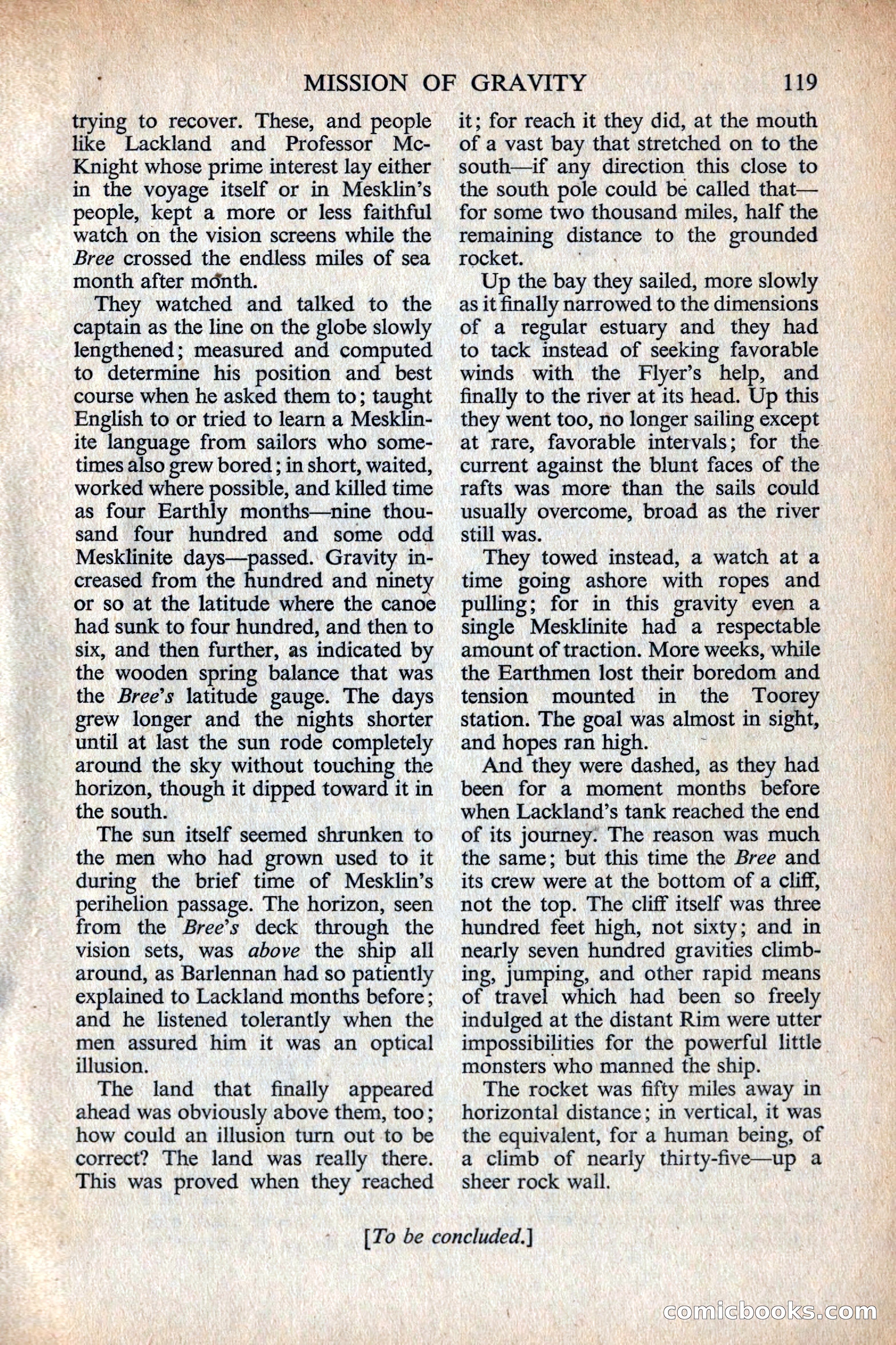
A restored page from Pulp Fiction, 1953. Page through the whole issue in the reader above.
📄 Transcribed text from this page (OCR, searchable)
Machine-transcribed from the original scan — historical spelling and the odd misread are preserved.
MISSION OF GRAVITY trying to recover. These, and people like Lackland and Professor Mc- Knight whose prime interest lay either in the voyage itself or in Mesklin’s people, kept a more or less faithful watch on the vision screens while the Bree crossed the endless miles of sea month after month. They watched and talked to the captain as the line on the globe slowly lengthened; measured and computed to determine his position and best course when he asked them to; taught English to or tried to learn a Mesklin- ite language from sailors who some- times also grew bored ; in short, waited, worked where possible, and killed time as four Earthly months—nine thou- sand four hundred and some odd Mesklinite days—passed. Gravity in- creased from the hundred and ninety or so at the latitude where the canoe had sunk to four hundred, and then to six, and then further, as indicated by the wooden spring balance that was the Bree’s latitude gauge. The days grew longer and the nights shorter until at last the sun rode completely around the sky without touching the horizon, though it dipped toward it in the south. The sun itself seemed shrunken to the men who had grown used to it during the brief time of Mesklin’s perihelion passage. The horizon, seen from the Bree’s deck through the vision sets, was above the ship all around, as Barlennan had so patiently explained to Lackland months before; and he listened tolerantly when the men assured him it was an optical illusion. The land that finally appeared ahead was obviously above them, too; how could an illusion turn out to be correct? The land was really there. This was proved when they reached 119 it; for reach it they did, at the mouth of a vast bay that stretched on to the south—if any direction this close to the south pole could be called that— for some two thousand miles, half the remaining distance to the grounded rocket. pay Up the bay they sailed, more slowly as it finally narrowed to the dimensions of a regular estuary and they had to tack instead of seeking favorable winds with the Flyer’s help, and finally to the river at its head. Up this they went too, no longer sailing except at rate, favorable intervals; for the. current against the blunt faces of the rafts was more than the sails could usually overcome, broad as the river still was. They towed instead, a watch at a time going ashore with ropes and pulling; for in this gravity even a single Mesklinite had a respectable amount of traction. More weeks, while the Earthmen lost their boredom and tension mounted in the Toorey station. The goal was almost in sight, and hopes ran high. ; And they were dashed, as they had been for a moment months before when Lackland’s tank reached the end of its journey. The reason was much the same; but this time the Bree and its crew were at the bottom of a cliff, not the top. The cliff itself was three hundred feet high, not sixty; and in nearly seven hundred gravities climb- ing, jumping, and other rapid means of travel which had been so freely indulged at the distant Rim were utter impossibilities for the powerful little monsters who manned the ship. The rocket was fifty miles away in horizontal distance; in vertical, it was the equivalent, for a human being, of a climb of nearly thirty-five—up a sheer rock wall. [Zo be concluded.) CONnnicloooks com