
Pulp Fiction, 1953 · page 111 of 132
Astounding Science Fiction, British Edition — page 111: what you’re looking at
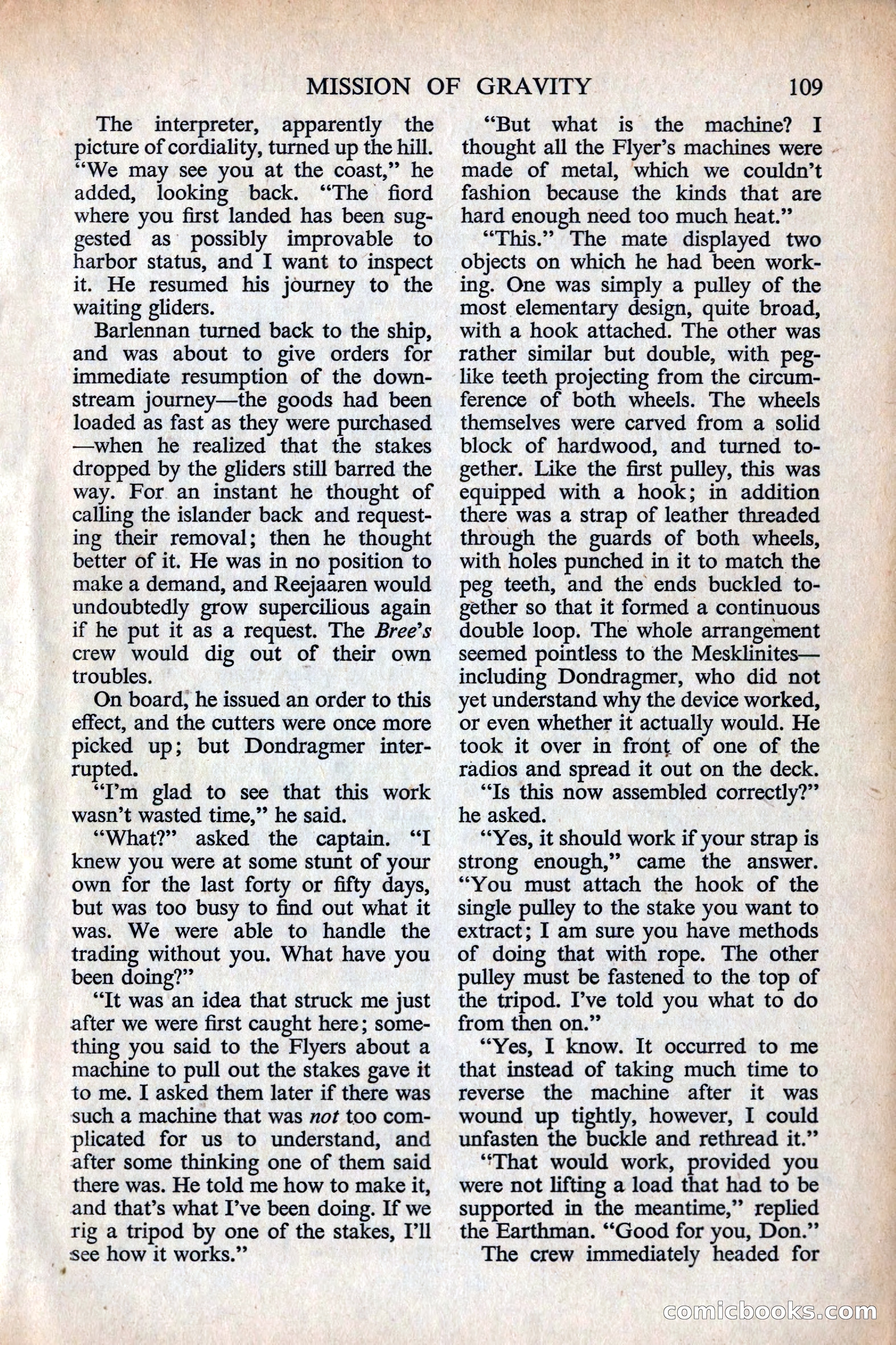
A restored page from Pulp Fiction, 1953. Page through the whole issue in the reader above.
📄 Transcribed text from this page (OCR, searchable)
Machine-transcribed from the original scan — historical spelling and the odd misread are preserved.
MISSION OF GRAVITY The interpreter, apparently the picture of cordiality, turned up the hill. ‘““We may see you at the coast,” he added, looking back. “The fiord where you first landed has been sug- gested as possibly improvable to harbor status, and I want to inspect it. He resumed his journey to the waiting gliders. Barlennan turned back to the ship, and was about to give orders for immediate resumption of the down- stream journey—the goods had been loaded as fast as they were purchased —when he realized that the stakes dropped by the gliders still barred the way. For. an instant he thought of calling the islander back and request- ing their removal; then he thought better of it. He was in no position to make a demand, and Reejaaren would undoubtedly grow supercilious again if he put it as a request. The Bree’s _ crew would dig out of their own troubles. On board, he issued an order to this effect, and the cutters were once more picked up; but Dondragmer inter- rupted. “Tm glad to see that this work wasn’t wasted time,” he said. “What?” asked the captain. “I knew you were at some stunt of your own for the last forty or fifty days, but was too busy to find out what it was. We were able to handle the trading without you. What have you been doing?” “It was an idea that struck me just after we were first caught here; some- thing you said to the Flyers about a machine to pull out the stakes gave it to me. I asked them later if there was such a machine that was not too com- plicated for us to understand, and after some thinking one of them said there was. He told me how to make it, and that’s what I’ve been doing. If we rig a tripod by one of the stakes, I'll _ See how it works.” | 109 “But what is the machine? I thought all the Flyer’s machines were - made of metal, which we couldn’t fashion because the kinds that are hard enough need too much heat.” “This.” The mate displayed two objects on which he had been work- ing. One was simply a pulley of the most elementary design, quite broad, with a hook attached. The other was rather similar but double, with peg- like teeth projecting from the circum- ference of both wheels. The wheels themselves were carved from a solid block of hardwood, and turned to- gether. Like the first pulley, this was equipped with a hook; in addition there was a strap of leather threaded through the guards of both wheels, with holes punched in it to match the peg teeth, and the ends buckled to- gether so that it formed a continuous double loop. The whole arrangement seemed pointless to the Mesklinites— including Dondragmer, who did not yet understand why the device worked, or even whether it actually would. He took it over in front of one of the radios and spread it out on the deck. “Is this now assembled correctly?” he asked. | “Yes, it should work if your strap is strong enough,” came the answer. “You must attach the hook of the single pulley to the stake you want to extract; I am sure you have methods of doing that with rope. The other pulley must be fastened to the top of the tripod. I’ve told you what to do from then on.” “Yes, 1 know. It occurred to me that instead of taking much time to reverse the machine after it was wound up tightly, however, I could unfasten the buckle and rethread it.” ‘That would work, provided you were not lifting a load that had to be supported in the meantime,” replied the Earthman. “Good for you, Don.” The crew immediately headed for Conic ooolks com