
Pulp Fiction, 1953 · page 108 of 132
Astounding Science Fiction, British Edition — page 108: what you’re looking at
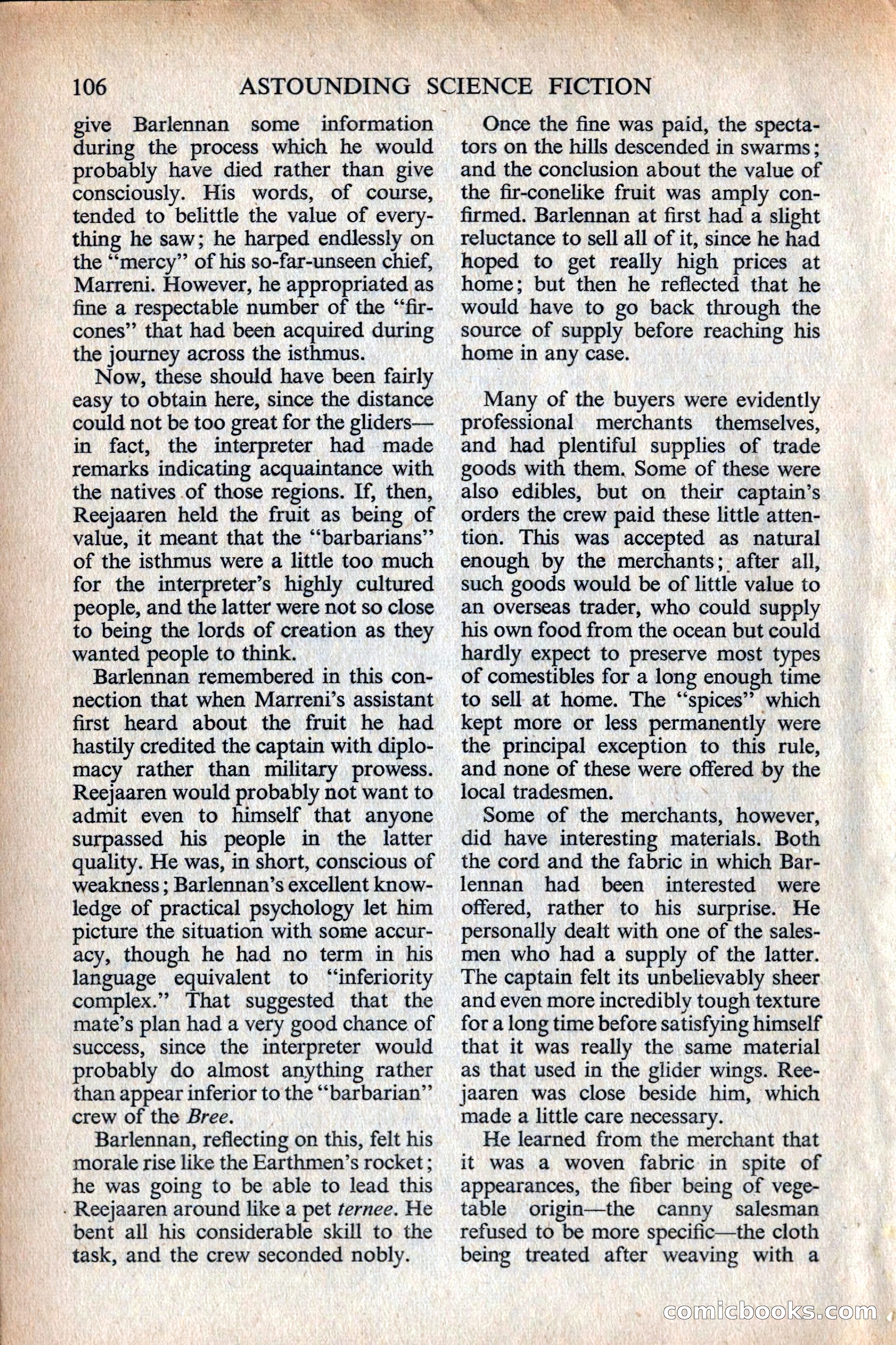
A restored page from Pulp Fiction, 1953. Page through the whole issue in the reader above.
📄 Transcribed text from this page (OCR, searchable)
Machine-transcribed from the original scan — historical spelling and the odd misread are preserved.
my ys oe a et ie ee Te ey Cee praia ot teNeee ee soar | - 106 give Barlennan some information during the process which he would probably have died rather than give consciously. His words, of course, tended to belittle the value of every- thing he saw; he harped endlessly on the “‘mercy”’ of his so-far-unseen chief, Marreni. However, he appropriated as fine a respectable number of the “‘fir- cones”’ that had been acquired during the journey across the isthmus. Now, these should have been fairly easy to obtain here, since the distance could not be too great for the gliders— in fact, the interpreter had made remarks indicating acquaintance with the natives of those regions. If, then, Reejaaren held the fruit as being of value, it meant that the “barbarians” of the isthmus were a little too much for the interpreter’s highly cultured people, and the latter were not so close to being the lords of creation as they wanted people to think. Barlennan remembered in this con- nection that when Marreni’s assistant first heard about the fruit he had hastily credited the captain with diplo- macy rather than military prowess. Reejaaren would probably not want to admit even to himself that anyone surpassed his people in the latter quality. He was, in short, conscious of weakness ; Barlennan’s excellent know- ledge of practical psychology let him picture the situation with some accur- acy, though he had no term in his language equivalent to “inferiority complex.’”’ That suggested that the mate’s plan had a very good chance of success, since the interpreter would probably do almost anything rather than appear inferior to the “barbarian’’ crew of the Bree. Barlennan, reflecting on this, felt his morale rise like the Earthmen’s rocket; he was going to be able to lead this - Reejaaren around like a pet ternee. He bent all his considerable skill to the task, and the crew seconded nobly. A 2 fe SB SPT : MOL ogre : ASTOUNDING SCIENCE FICTION Once the fine was paid, the specta- tors on the hills descended in swarms; and the conclusion about the value of the fir-conelike fruit was amply con- firmed. Barlennan at first had a slight reluctance to sell all of it, since he had hoped to get really high prices at home; but then he reflected that he would have to go back through the source of supply before reaching his home in any case. Many of the buyers were evidently professional merchants themselves, and had plentiful supplies of trade goods with them. Some of these were also edibles, but on their captain’s orders the crew paid these little atten- tion. This was accepted as natural enough by the merchants; after all, such goods would be of little value to an overseas trader, who could supply his own food from the ocean but could hardly expect to preserve most types of comestibles for a long enough time to sell at home. The “spices”? which kept more or less permanently were the principal exception to this rule, and none of these were offered by the local tradesmen. Some of the merchants, however, did have interesting materials. Both the cord and the fabric in which Bar- lennan had been interested were offered, rather to his surprise. He personally dealt with one of the sales- men who had a supply of the latter. The captain felt its unbelievably sheer and even more incredibly tough texture for a long time before satisfying himself that it was really the same material as that used in the glider wings. Ree- jaaren was close beside him, which made a little care necessary. He learned from the merchant that it was a woven fabric in spite of appearances, the fiber being of vege- table origin—the canny salesman refused to be more specific—the cloth being treated after weaving with a Conniclooolkks Conmiy