
Pulp Fiction, 1953 · page 101 of 132
Astounding Science Fiction, British Edition — page 101: what you’re looking at
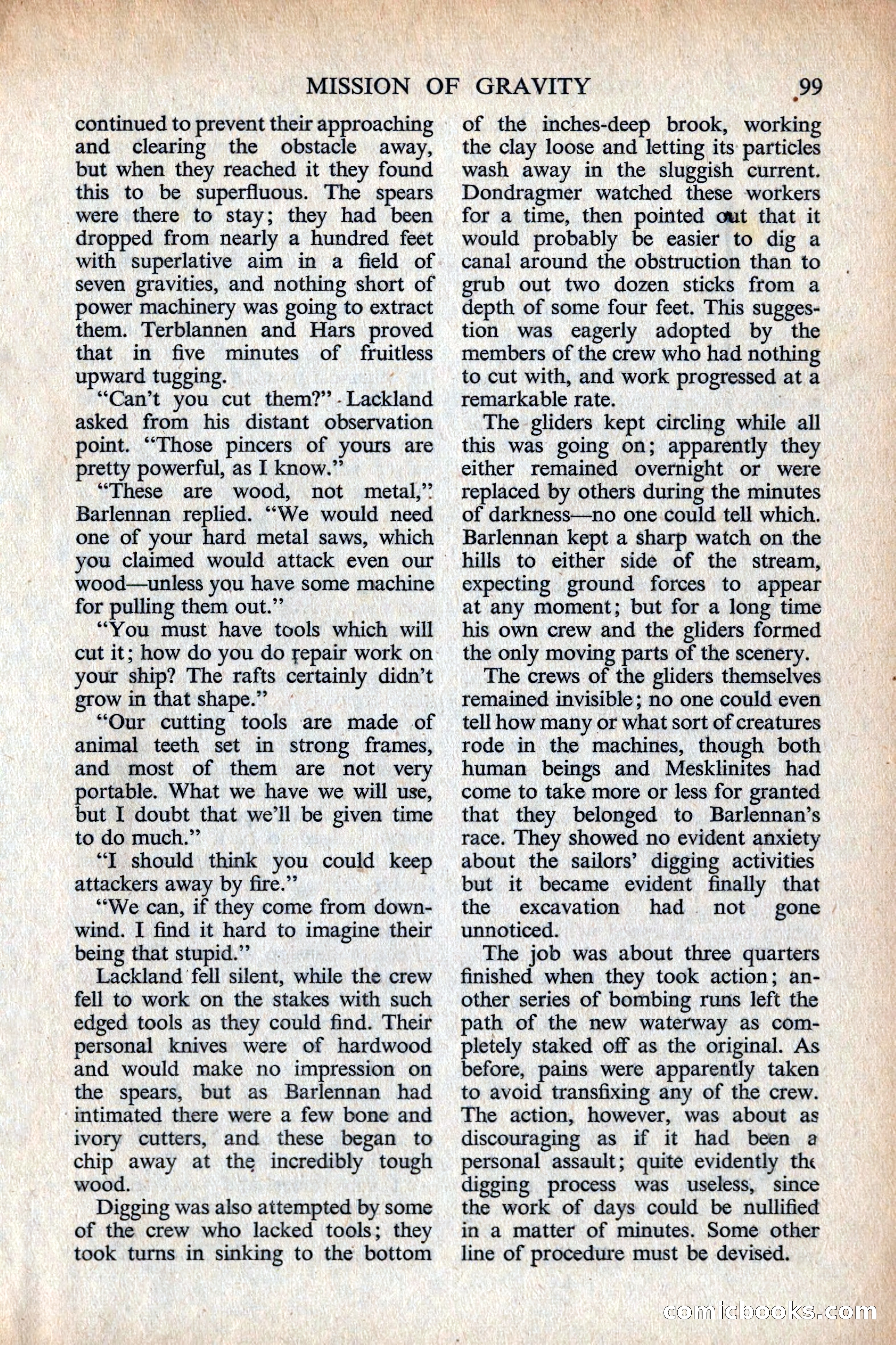
A restored page from Pulp Fiction, 1953. Page through the whole issue in the reader above.
📄 Transcribed text from this page (OCR, searchable)
Machine-transcribed from the original scan — historical spelling and the odd misread are preserved.
MISSION OF GRAVITY continued to prevent their approaching and clearing the obstacle away, but when they reached it they found this to be superfluous. The spears were there to stay; they had been dropped from nearly a hundred feet with superlative aim in a field of seven gravities, and nothing short of power machinery was going to extract them. Terblannen and Hars proved that in five minutes of fruitless upward tugging. “Can’t you cut them?” Lackland asked from his distant observation point. “Those pincers of yours are pretty powerful, as I know.” “These are wood, not metal,” Barlennan replied. “We would need one of your hard metal saws, which you claimed would attack even our wood—unless you have some machine for pulling them out.” “You must have tools which will cut it; how do you do repair work on your ship? The rafts certainly didn’t grow in that shape.” “Our cutting tools are made of animal teeth set in strong frames, and most of them are not very portable. What we have we will use, but I doubt that we'll be given time to do much.” “I should think you could keep attackers away by fire.” “We can, if they come from down- wind. I find it hard to imagine their being that stupid.” Lackland fell silent, while the crew fell to work on the stakes with such edged tools as they could find. Their personal knives were of hardwood and would make no impression on the spears, but as Barlennan had intimated there were a few bone and ivory cutters, and these began to chip away at the incredibly tough wood. Digging was also attempted by some of the crew who lacked tools; they took turns in sinking to the bottom yas cay bib 7 Su ANT NaN gly * s+ t 99 of the inches-deep brook, working the clay loose and letting its particles wash away in the sluggish current. Dondragmer watched these workers for a time, then pointed out that it would probably be easier to dig a canal around the obstruction than to grub out two dozen sticks from a depth of some four feet. This sugges- tion was eagerly adopted by the members of the crew who had nothing to cut with, and work progressed ata remarkable rate. The gliders kept circling while all this was going on; apparently they either remained overnight or were replaced by others during the minutes of darkness—no one could tell which. Barlennan kept a sharp watch on the hills to either side of the stream, expecting ground forces to appear at any moment; but for a long time his own crew and the gliders formed the only moving parts of the scenery. The crews of the gliders themselves remained invisible; no one could even tell how many or what sort of creatures rode in the machines, though both human beings and Mesklinites had come to take more or less for granted that they belonged to Barlennan’s race. They showed no evident anxiety about the sailors’ digging activities but it became evident finally that the excavation had. not gone unnoticed. The job was about three quarters finished when they took action; an- other series of bombing runs left the path of the new waterway as com- pletely staked off as the original. As before, pains were apparently taken to avoid transfixing any of the crew. The action, however, was about as discouraging as if it had been a personal assault; quite evidently the digging process was useless, since the work of days could be nullified in a matter of minutes. Some other line of procedure must be devised. COMIGIOOKS: COLA