
Pulp Fiction, 1955 · page 92 of 133
Astounding Science Fiction, British Edition, December 1955 — page 92: what you’re looking at
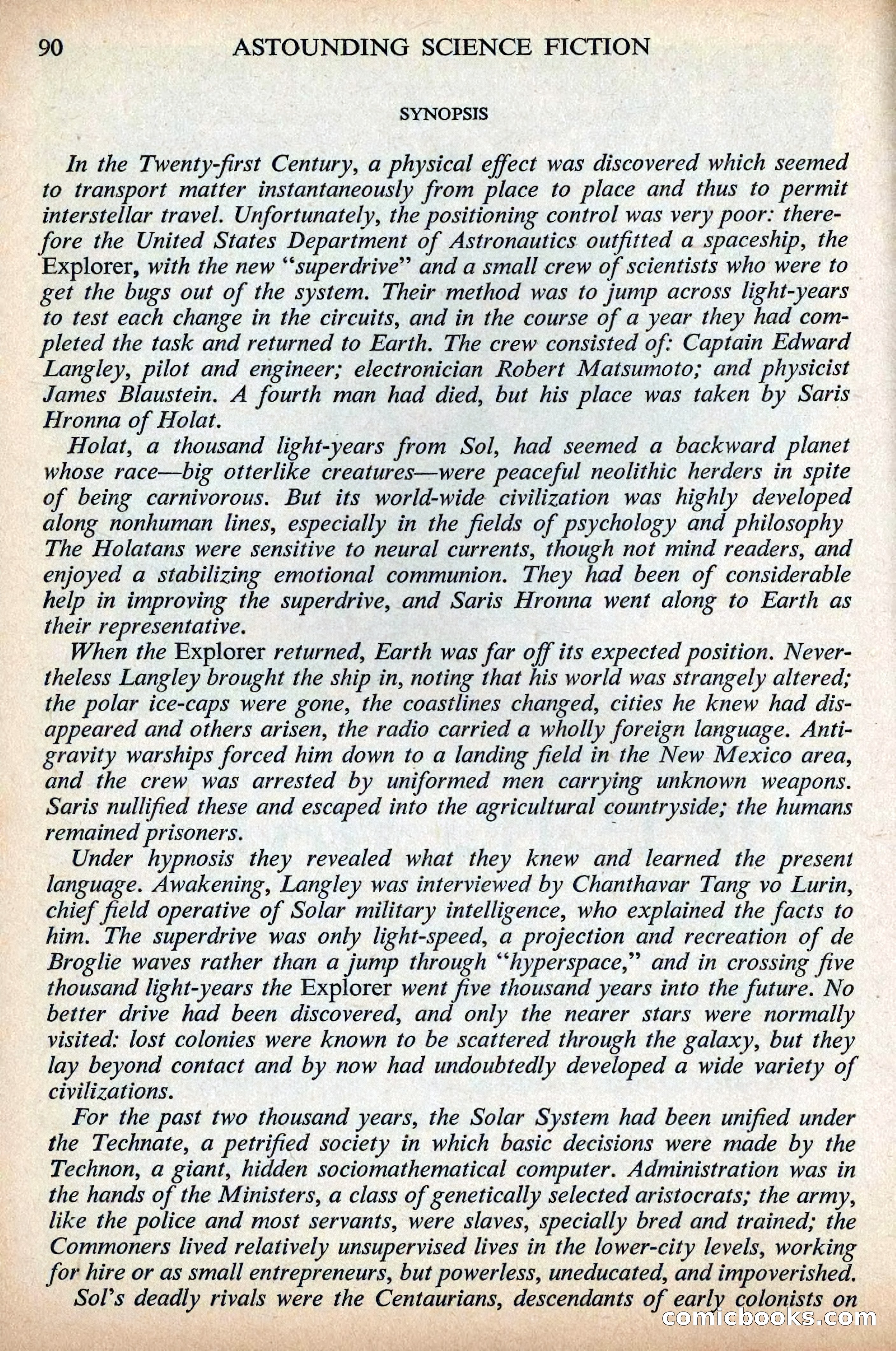
A restored page from Pulp Fiction, 1955. Page through the whole issue in the reader above.
📄 Transcribed text from this page (OCR, searchable)
Machine-transcribed from the original scan — historical spelling and the odd misread are preserved.
90 ASTOUNDING SCIENCE FICTION SYNOPSIS In the Twenty-first Century, a physical effect was discovered which seemed to transport matter instantaneously from place to place and thus to permit interstellar travel. Unfortunately, the positioning control was very poor: there- fore the United States Department of Astronautics outfitted a spaceship, the Explorer, with the new “‘superdrive” and a small crew of scientists who were to get the bugs out of the system. Their method was to jump across light-years to test each change in the circuits, and in the course of a year they had com- pleted the task and returned to Earth. The crew consisted of: Captain Edward Langley, pilot and engineer; electronician Robert Matsumoto; and physicist James Blaustein. A fourth man had died, but his place was taken by Saris Hronna of Holat. Holat, a thousand light-years from Sol, had seemed a backward planet whose race—big otterlike creatures—were peaceful neolithic herders in spite of being carnivorous. But its world-wide civilization was highly developed along nonhuman lines, especially in the fields of psychology and philosophy The Holatans were sensitive to neural currents, though not mind readers, and enjoyed a stabilizing emotional communion. They had been of considerable help in improving the superdrive, and Saris Hronna went along to Earth as their representative. When the Explorer returned, Earth was far off its expected position. Never- theless Langley brought the ship in, noting that his world was strangely altered; the polar ice-caps were gone, the coastlines changed, cities he knew had dis- appeared and others arisen, the radio carried a wholly foreign language. Anti- gravity warships forced him down to a landing field in the New Mexico area, and the crew was arrested by uniformed men carrying unknown weapons. Saris nullified these and escaped into the agricultural countryside; the humans remained prisoners. Under hypnosis they revealed what they knew and learned the present language. Awakening, Langley was interviewed by Chanthavar Tang vo Lurin, chief field operative of Solar military intelligence, who explained the facts to him. The superdrive was only light-speed, a projection and recreation of de Broglie waves rather than a jump through “hyperspace,” and in crossing five thousand light-years the Explorer went five thousand years into the future. No better drive had been discovered, and only the nearer stars were normally visited: lost colonies were known to be scattered through the galaxy, but they lay beyond contact and by now had undoubtedly developed a wide variety of civilizations. For the past two thousand years, the Solar System had been unified under the Technate, a petrified society in which basic decisions were made by the Technon, a giant, hidden sociomathematical computer. Administration was in the hands of the Ministers, a class of genetically selected aristocrats; the army, like the police and most servants, were slaves, specially bred and trained; the Commoners lived relatively unsupervised lives in the lower-city levels, working for hire or as small entrepreneurs, but powerless, uneducated, and impoverished. Sol’s deadly rivals were the Centaurians, descendants of early colonists on COMMEMICOL<S.(6OLu) hie bh