
Pulp Fiction, 1955 · page 7 of 133
Astounding Science Fiction, British Edition, December 1955 — page 7: what you’re looking at
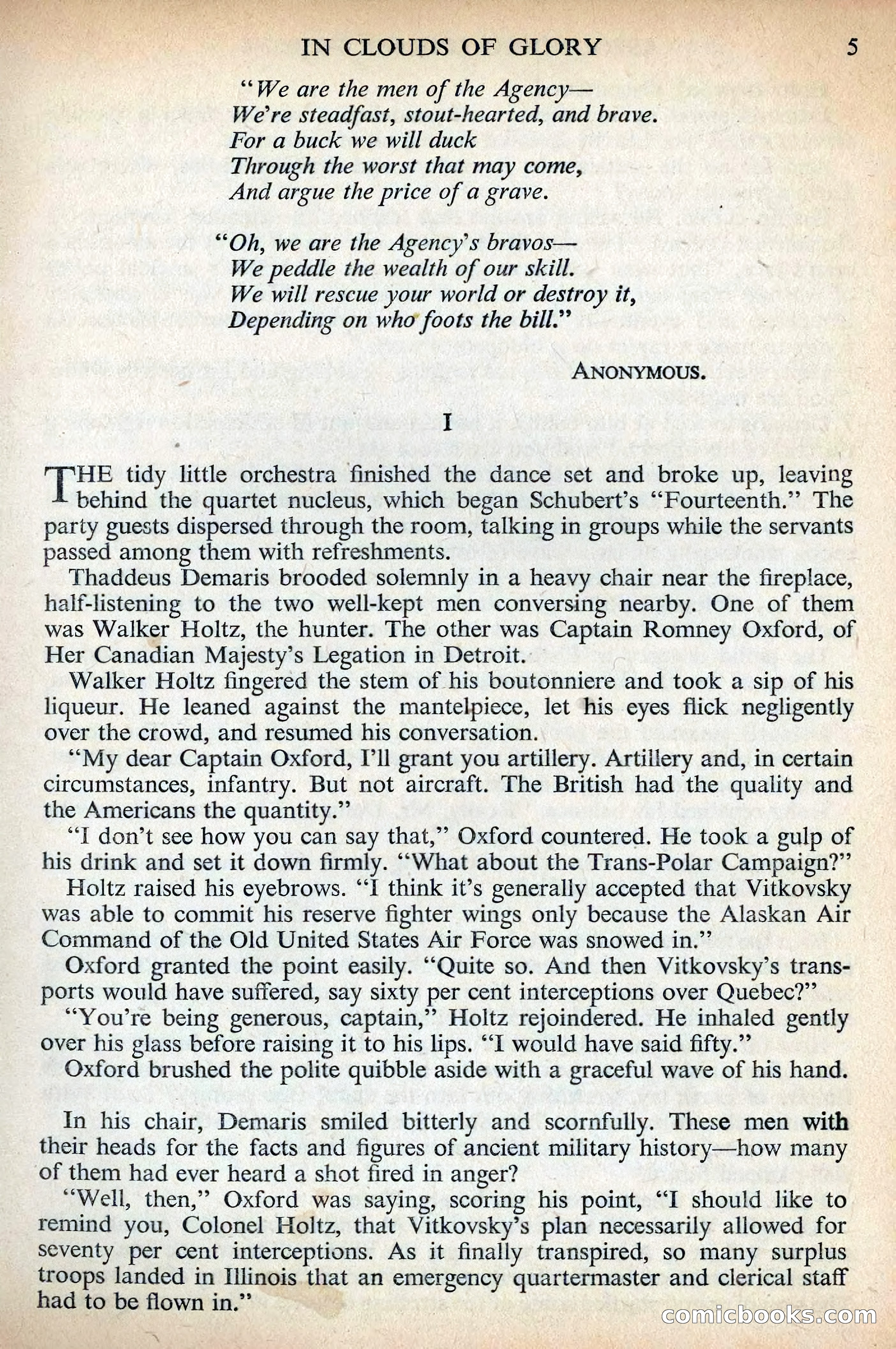
A restored page from Pulp Fiction, 1955. Page through the whole issue in the reader above.
📄 Transcribed text from this page (OCR, searchable)
Machine-transcribed from the original scan — historical spelling and the odd misread are preserved.
IN CLOUDS OF GLORY 5 ““We are the men of the Agency— We're steadfast, stout-hearted, and brave. For a buck we will duck Through the worst that may come, And argue the price of a grave. “Oh, we are the Agency's bravos— We peddle the wealth of our skill. We will rescue your world or destroy it, Depending on who foots the bill.” ANONYMOUS. I ieee tidy little orchestra finished the dance set and broke up, leaving behind the quartet nucleus, which began Schubert’s “‘Fourteenth.”’ The party guests dispersed through the room, talking in groups while the servants passed among them with refreshments. Thaddeus Demaris brooded solemnly in a heavy chair near the fireplace, half-listening to the two well-kept men conversing nearby. One of them was Walker Holtz, the hunter. The other was Captain Romney Oxford, of Her Canadian Majesty’s Legation in Detroit. Walker Holtz fingered the stem of his boutonniere and took a sip of his liqueur. He leaned against the mantelpiece, let his eyes flick negligently over the crowd, and resumed his conversation. “My dear Captain Oxford, I'll grant you artillery. Artillery and, in certain circumstances, infantry. But not aircraft. The British had the quality and the Americans the quantity.” “I don’t see how you can say that,” Oxford countered. He took a gulp of his drink and set it down firmly. “What about the Trans-Polar Campaign?” Holtz raised his eyebrows. “I think it’s generally accepted that Vitkovsky was able to commit his reserve fighter wings only because the Alaskan Air Command of the Old United States Air Force was snowed in.” Oxford granted the point easily. “Quite so. And then Vitkovsky’s trans- ports would have suffered, say sixty per cent interceptions over Quebec?” “You’re being generous, captain,’ Holtz rejoindered. He inhaled gently over his glass before raising it to his lips. “‘I would have said fifty.” Oxford brushed the polite quibble aside with a graceful wave of his hand. In his chair, Demaris smiled bitterly and scornfully. These men with their heads for the facts and figures of ancient military history—how many of them had ever heard a shot fired in anger? “Well, then,” Oxford was saying, scoring his point, “I should like to remind you, Colonel Holtz, that Vitkovsky’s plan necessarily allowed for seventy per cent interceptions. As it finally transpired, so many surplus troops landed in Illinois that an emergency quartermaster and clerical staff had to in,’ i be flown in. conmmiclsooks. conn B*