
Pulp Fiction, 1955 · page 64 of 133
Astounding Science Fiction, British Edition, December 1955 — page 64: what you’re looking at
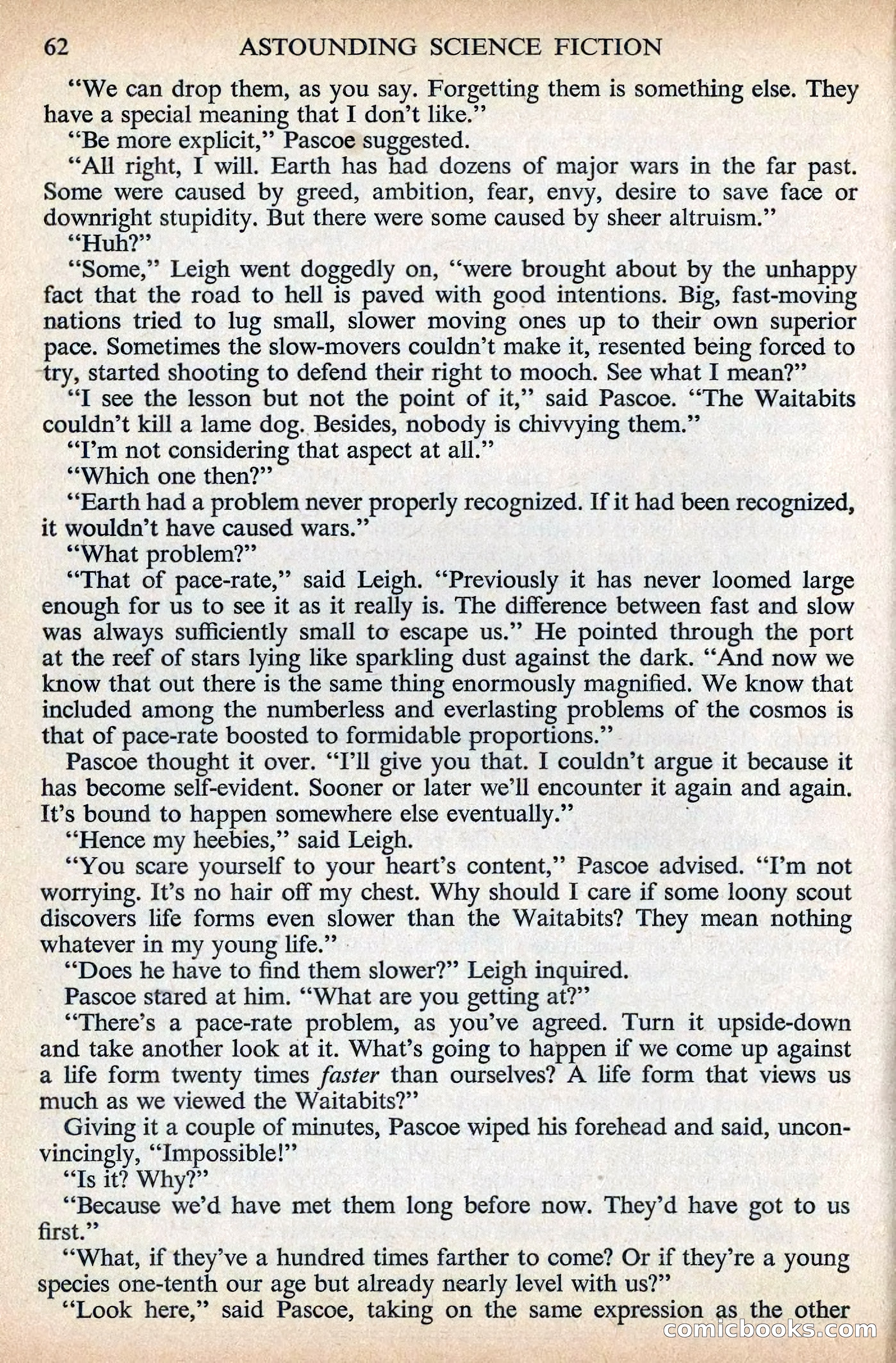
A restored page from Pulp Fiction, 1955. Page through the whole issue in the reader above.
📄 Transcribed text from this page (OCR, searchable)
Machine-transcribed from the original scan — historical spelling and the odd misread are preserved.
62 ASTOUNDING SCIENCE FICTION ““We can drop them, as you say. Forgetting them is something else. They have a special meaning that I don’t like.” *“Be more explicit,” Pascoe suggested. “All right, I will. Earth has had dozens of major wars in the far past. Some were caused by greed, ambition, fear, envy, desire to save face or downright stupidity. But there were some caused by sheer altruism.” **“Huh?’’ “Some,” Leigh went doggedly on, “‘were brought about by the unhappy fact that the road to hell is paved with good intentions. Big, fast-moving nations tried to lug small, slower moving ones up to their own superior pace. Sometimes the slow-movers couldn’t make it, resented being forced to try, started shooting to defend their right to mooch. See what I mean?” “T see the lesson but not the point of it,” said Pascoe. ““The Waitabits couldn’t kill a lame dog. Besides, nobody is chivvying them.” “I’m not considering that aspect at all.” “Which one then?” “‘Earth had a problem never properly recognized. If it had been recognized, it wouldn’t have caused wars.” *“What problem?” “That of pace-rate,” said Leigh. “Previously it has never loomed large enough for us to see it as it really is. The difference between fast and slow was always sufficiently small to escape us.” He pointed through the port at the reef of stars lying like sparkling dust against the dark. “And now we know that out there is the same thing enormously magnified. We know that included among the numberless and everlasting problems of the cosmos is that of pace-rate boosted to formidable proportions.”’ Pascoe thought it over. “I'll give you that. I couldn’t argue it because it has become self-evident. Sooner or later we'll encounter it again and again. It’s bound to happen somewhere else eventually.” “Hence my heebies,’’ said Leigh. “You scare yourself to your heart’s content,’’ Pascoe advised. “I’m not worrying. It’s no hair off my chest. Why should I care if some loony scout discovers life forms even slower than the Waitabits? They mean nothing whatever in my young life.”’ “Does he have to find them slower?” Leigh inquired. Pascoe stared at him. “What are you getting at?” ““There’s a pace-rate problem, as you’ve agreed. Turn it upside-down and take another look at it. What’s going to happen if we come up against a life form twenty times faster than ourselves? A life form that views us much as we viewed the Waitabits?’’ Giving it a couple of minutes, Pascoe wiped his forehead and said, uncon- vincingly, ““Impossible!’’ “Ts it? Why?” “Because we’d have met them long before now. They’d have got to us first.” “What, if they’ve a hundred times farther to come? Or if they’re a young species one-tenth our age but already nearly level with us?” ““Look here,” said Pascoe, taking on the same expression as the other COMIC DOOKS.COM {