
Pulp Fiction, 1955 · page 53 of 133
Astounding Science Fiction, British Edition, December 1955 — page 53: what you’re looking at
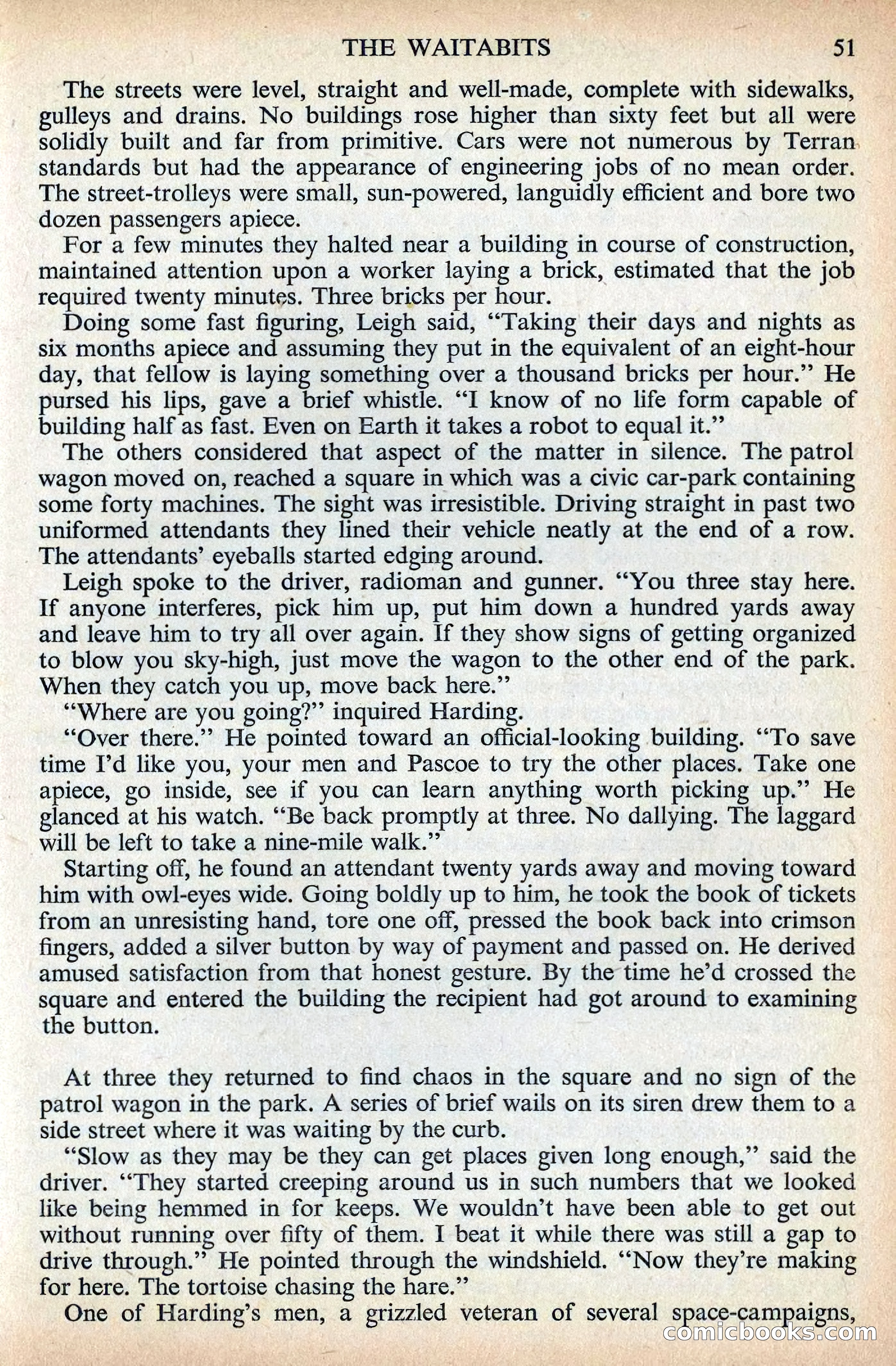
A restored page from Pulp Fiction, 1955. Page through the whole issue in the reader above.
📄 Transcribed text from this page (OCR, searchable)
Machine-transcribed from the original scan — historical spelling and the odd misread are preserved.
THE WAITABITS 51 The streets were level, straight and well-made, complete with sidewalks, gulleys and drains. No buildings rose higher than sixty feet but all were solidly built and far from primitive. Cars were not numerous by Terran. standards but had the appearance of engineering jobs of no mean order. The street-trolleys were small, sun-powered, languidly efficient and bore two dozen passengers apiece. For a few minutes they halted near a building in course of construction, maintained attention upon a worker laying a brick, estimated that the job required twenty minutes. Three bricks per hour. Doing some fast figuring, Leigh said, ‘““Taking their days and nights as six months apiece and assuming they put in the equivalent of an eight-hour day, that fellow is laying something over a thousand bricks per hour.’’ He pursed his lips, gave a brief whistle. “I know of no life form capable of building half as fast. Even on Earth it takes a robot to equal it.” The others considered that aspect of the matter in silence. The patrol wagon moved on, reached a square in which was a civic car-park containing some forty machines. The sight was irresistible. Driving straight in past two uniformed attendants they lined their vehicle neatly at the end of a row. The attendants’ eyeballs started edging around. Leigh spoke to the driver, radioman and gunner. “You three stay here. If anyone interferes, pick him up, put him down a hundred yards away and leave him to try all over again. If they show signs of getting organized to blow you sky-high, just move the wagon to the other end of the park. When they catch you up, move back here.” ““Where are you going?” inquired Harding. 3 “Over there.” He pointed toward an official-looking building. “To save time I’d like you, your men and Pascoe to try the other places. Take one apiece, go inside, see if you can learn anything worth picking up.” He glanced at his watch. ““Be back promptly at three. No dallying. The laggard will be left to take a nine-mile walk.” Starting off, he found an attendant twenty yards away and moving toward him with owl-eyes wide. Going boldly up to him, he took the book of tickets from an unresisting hand, tore one off, pressed the book back into crimson fingers, added a silver button by way of payment and passed on. He derived amused satisfaction from that honest gesture. By the time he’d crossed the square and entered the building the recipient had got around to examining the button. At three they returned to find chaos in the square and no sign of the patrol wagon in the park. A series of brief wails on its siren drew them to a side street where it was waiting by the curb. “Slow as they may be they can get places given long enough,” said the driver. ““They started creeping around us in such numbers that we looked like being hemmed in for keeps. We wouldn’t have been able to get out without running over fifty of them. I beat it while there was still a gap to drive through.” He pointed through the windshield. ““Now they’re making for here. The tortoise chasing the hare.” One of Harding’s men, a grizzled veteran of several Space-campaigns, HiNICLOOOKSsCO