
Pulp Fiction, 1955 · page 49 of 133
Astounding Science Fiction, British Edition, December 1955 — page 49: what you’re looking at
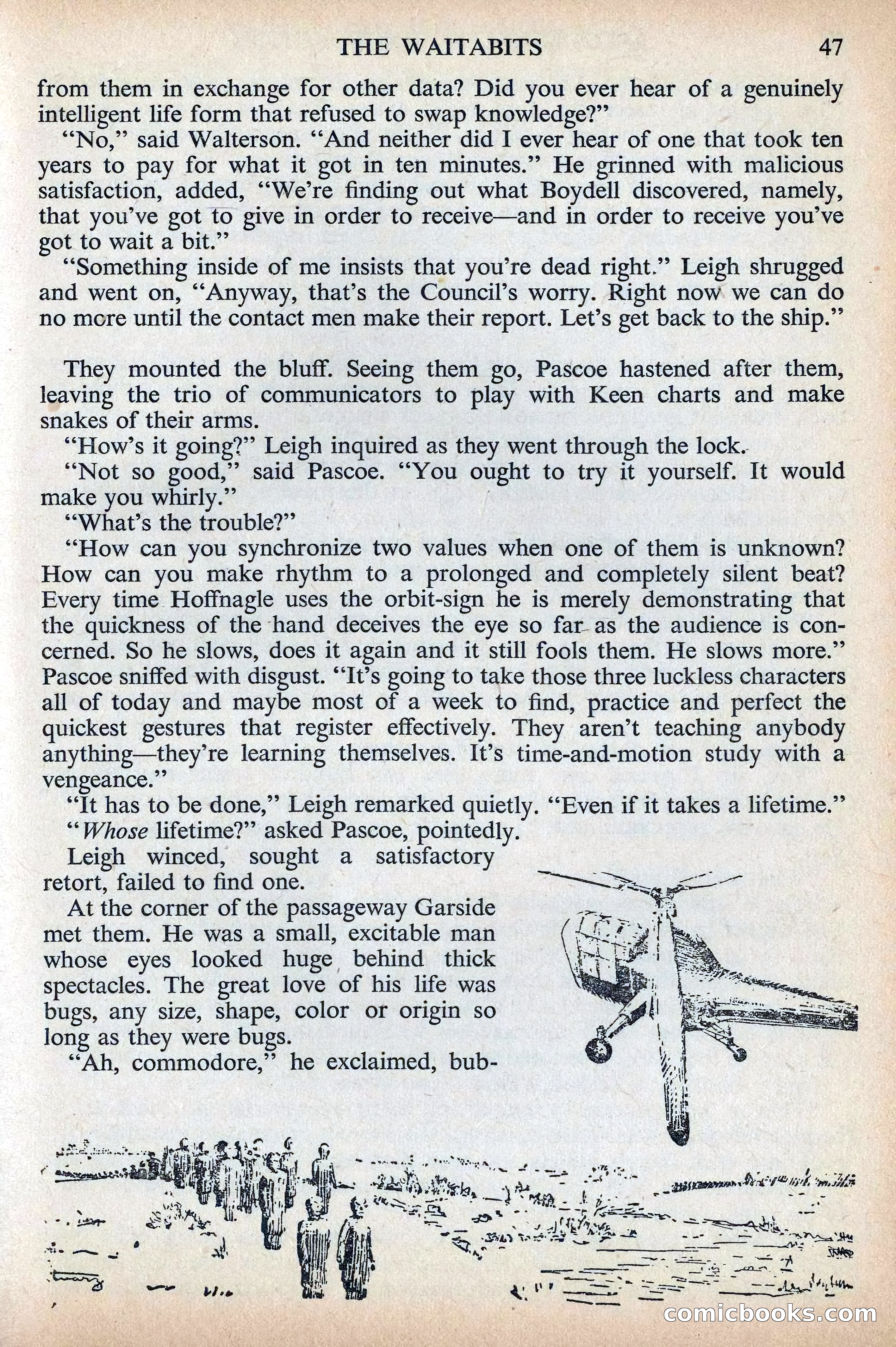
A restored page from Pulp Fiction, 1955. Page through the whole issue in the reader above.
📄 Transcribed text from this page (OCR, searchable)
Machine-transcribed from the original scan — historical spelling and the odd misread are preserved.
THE WAITABITS 47 from them in exchange for other data? Did you ever hear of a genuinely intelligent life form that refused to swap knowledge?”’ ““No,”’ said Walterson. ‘“‘And neither did I ever hear of one that took ten years to pay for what it got in ten minutes.” He grinned with malicious satisfaction, added, “We’re finding out what Boydell discovered, namely, that you’ve got to give in order to receive—and in order to receive you’ve got to wait a bit.” “Something inside of me insists that you’re dead right.” Leigh shrugged and went on, ““Anyway, that’s the Council’s worry. Right now we can do no more until the contact men make their report. Let’s get back to the ship.” They mounted the bluff. Seeing them go, Pascoe hastened after them, leaving the trio of communicators to play with Keen charts and make snakes of their arms. ““How’s it going?” Leigh inquired as they went through the lock. “Not so good,” said Pascoe. “You ought to try it yourself. It would make you whirly.” 7 ‘““What’s the trouble?” ‘““How can you synchronize two values when one of them is unknown? How can you make rhythm to a prolonged and completely silent beat? Every time Hoffnagle uses the orbit-sign he is merely demonstrating that the quickness of the hand deceives the eye so far as the audience is con- cerned. So he slows, does it again and it still fools them. He slows more.” Pascoe sniffed with disgust. “‘It’s going to take those three luckless characters all of today and maybe most of a week to find, practice and perfect the quickest gestures that register effectively. They aren’t teaching anybody anything—they’re learning themselves. It’s time-and-motion study with a vengeance.”’ “It has to be done,” Leigh remarked quietly. “‘Even if it takes a lifetime.” ‘Whose lifetime?” asked Pascoe, pointedly. Leigh winced, sought a satisfactory retort, failed to find one. At the corner of the passageway Garside met them. He was a small, excitable man whose eyes looked huge behind thick spectacles. The great love of his life was bugs, any size, shape, color or origin so long as they were bugs. “Ah, commodore,” he exclaimed, bub- a -- ee oe. = So ad Elie eh S wove ee pee eat RN oes ks ae cts PD ee Dig ap cana = = he ? eee tr Nee pak eo. qe ee ee ~~ Aa tte ts eek —_— COMME YOO. ‘com