
Pulp Fiction, 1955 · page 38 of 133
Astounding Science Fiction, British Edition, December 1955 — page 38: what you’re looking at
A restored page from Pulp Fiction, 1955. Page through the whole issue in the reader above.
📄 Transcribed text from this page (OCR, searchable)
Machine-transcribed from the original scan — historical spelling and the odd misread are preserved.
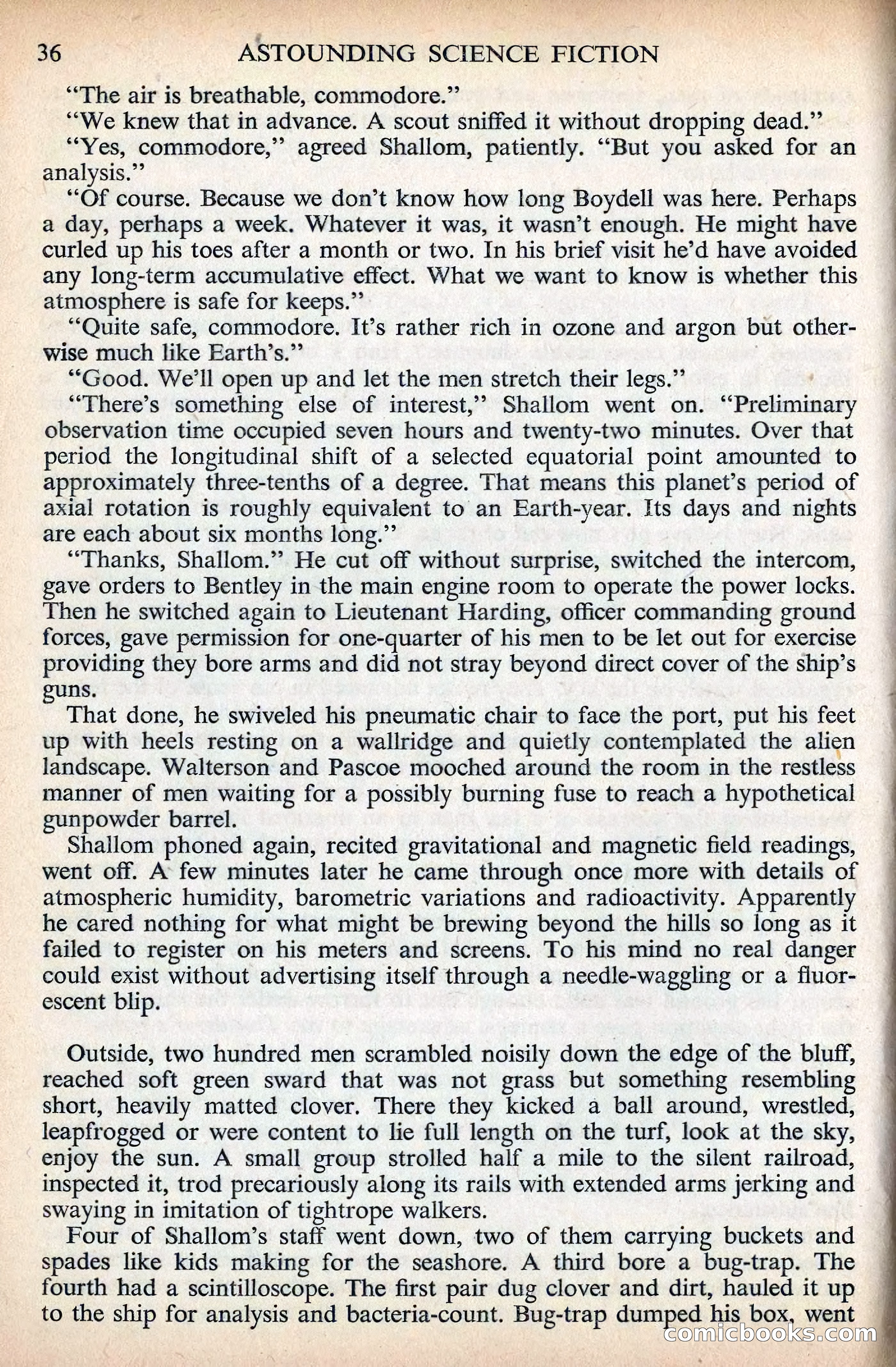
36 ASTOUNDING SCIENCE FICTION ‘**The air is breathable, commodore.”’ “We knew that in advance. A scout sniffed it without dropping dead.” “Yes, commodore,’ agreed Shallom, patiently. “But you asked for an analysis.” “Of course. Because we don’t know how long Boydell was here. Perhaps a day, perhaps a week. Whatever it was, it wasn’t enough. He might have curled up his toes after a month or two. In his brief visit he’d have avoided any long-term accumulative effect. What we want to know is whether this atmosphere is safe for keeps.”’ “Quite safe, commodore. It’s rather rich in ozone and argon but other- wise much like Earth’s.” “Good. We'll open up and let the men stretch their legs.” ‘““There’s something else of interest,’ Shallom went on. “Preliminary observation time occupied seven hours and twenty-two minutes. Over that period the longitudinal shift of a selected equatorial point amounted to approximately three-tenths of a degree. That means this planet’s period of axial rotation is roughly equivalent to an Earth-year. Its days and nights are each about six months long.”’ “Thanks, Shallom.”? He cut off without surprise, switched the intercom, gave orders to Bentley in the main engine room to operate the power locks. Then he switched again to Lieutenant Harding, officer commanding ground forces, gave permission for one-quarter of his men to be let out for exercise providing they bore arms and did not stray beyond direct cover of the ship’s ns. That done, he swiveled his pneumatic chair to face the port, put his feet up with heels resting on a wallridge and quietly contemplated the alien landscape. Walterson and Pascoe mooched around the room in the restless manner of men waiting for a possibly burning fuse to reach a hypothetical gunpowder barrel. Shallom phoned again, recited gravitational and magnetic field readings, went off. A few minutes later he came through once more with details of atmospheric humidity, barometric variations and radioactivity. Apparently he cared nothing for what might be brewing beyond the hills so long as it failed to register on his meters and screens. To his mind no real danger could exist without advertising itself through a needle-waggling or a fluor- escent blip. Outside, two hundred men scrambled noisily down the edge of the bluff, reached soft green sward that was not grass but something resembling short, heavily matted clover. There they kicked a ball around, wrestled, leapfrogged or were content to lie full length on the turf, look at the sky, enjoy the sun. A small group strolled half a mile to the silent railroad, inspected it, trod precariously along its rails with extended arms jerking and swaying in imitation of tightrope walkers. Four of Shallom’s staff went down, two of them carrying buckets and spades like kids making for the seashore. A third bore a bug-trap. The fourth had a scintilloscope. The first pair dug clover and dirt, hauled it up to the ship for analysis and bacteria-count. Bug-trap re abe his boy went i