
Pulp Fiction, 1955 · page 35 of 133
Astounding Science Fiction, British Edition, December 1955 — page 35: what you’re looking at
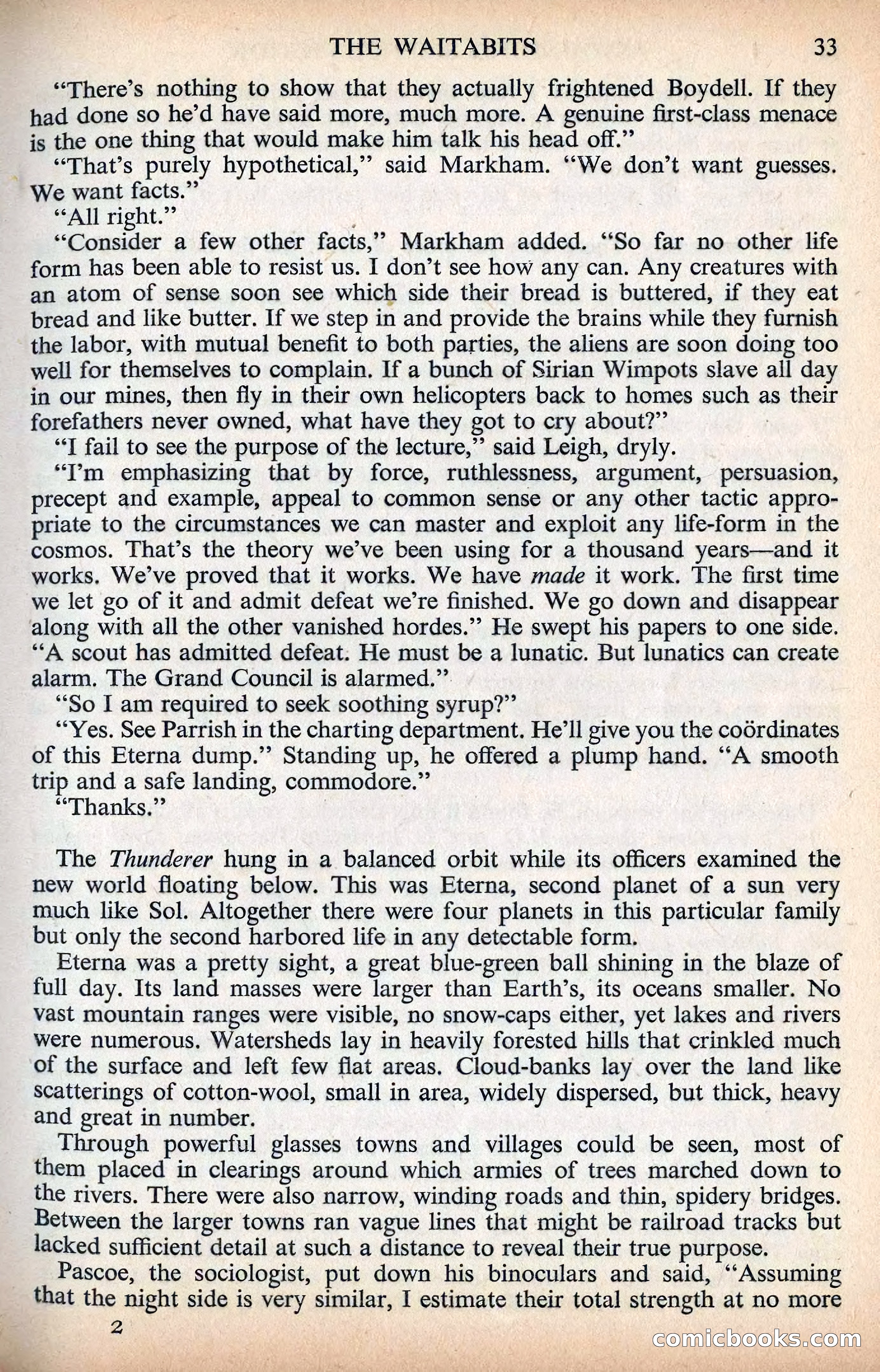
A restored page from Pulp Fiction, 1955. Page through the whole issue in the reader above.
📄 Transcribed text from this page (OCR, searchable)
Machine-transcribed from the original scan — historical spelling and the odd misread are preserved.
THE WAITABITS 33 ‘“There’s nothing to show that they actually frightened Boydell. If they had done so he’d have said more, much more. A genuine first-class menace is the one thing that would make him talk his head off.” _ That’s purely hypothetical,” said Markham. “We don’t want guesses. We want facts.” “All right.” : *““Consider a few other facts,” Markham added. “So far no other life form has been able to resist us. I don’t see how any can. Any creatures with an atom of sense soon see which side their bread is buttered, if they eat bread and like butter. If we step in and provide the brains while they furnish the labor, with mutual benefit to both parties, the aliens are soon doing too well for themselves to complain. If a bunch of Sirian Wimpots slave all day in our mines, then fly in their own helicopters back to homes such as their forefathers never owned, what have they got to cry about?” : “I fail to see the purpose of the lecture,” said Leigh, dryly. “I’m emphasizing that by force, ruthlessness, argument, persuasion, precept and example, appeal to common sense or any other tactic appro- priate to the circumstances we can master and exploit any life-form in the cosmos. That’s the theory we’ve been using for a thousand years—and it works, We’ve proved that it works. We have made it work. The first time we let go of it and admit defeat we’re finished. We go down and disappear along with all the other vanished hordes.”’ He swept his papers to one side. “A scout has admitted defeat. He must be a lunatic. But lunatics can create alarm. The Grand Council is alarmed.” “So I am required to seek soothing syrup?” “Yes. See Parrish in the charting department. He’ll give you the coordinates of this Eterna dump.” Standing up, he offered a plump hand. “A smooth trip and a safe landing, commodore.” “Thanks.” | The Thunderer hung in a balanced orbit while its officers examined the new world floating below. This was Eterna, second planet of a sun very much like Sol. Altogether there were four planets in this particular family but only the second harbored life in any detectable form. Eterna was a pretty sight, a great blue-green ball shining in the blaze of full day. Its land masses were larger than Earth’s, its oceans smaller. No vast mountain ranges were visible, no snow-caps either, yet lakes and rivers were numerous. Watersheds lay in heavily forested hills that crinkled much of the surface and left few flat areas. Cloud-banks lay over the land like scatterings of cotton-wool, small in area, widely dispersed, but thick, heavy and great in number. Through powerful glasses towns and villages could be seen, most of them placed in clearings around which armies of trees marched down to the rivers. There were also narrow, winding roads and thin, spidery bridges. Between the larger towns ran vague lines that might be railroad tracks but lacked sufficient detail at such a distance to reveal their true purpose. Pascoe, the sociologist, put down his binoculars and said, “‘Assuming that the night side is very similar, I estimate their total strength at no more s COnmicoooks. corn