
Pulp Fiction, 1955 · page 27 of 133
Astounding Science Fiction, British Edition, December 1955 — page 27: what you’re looking at
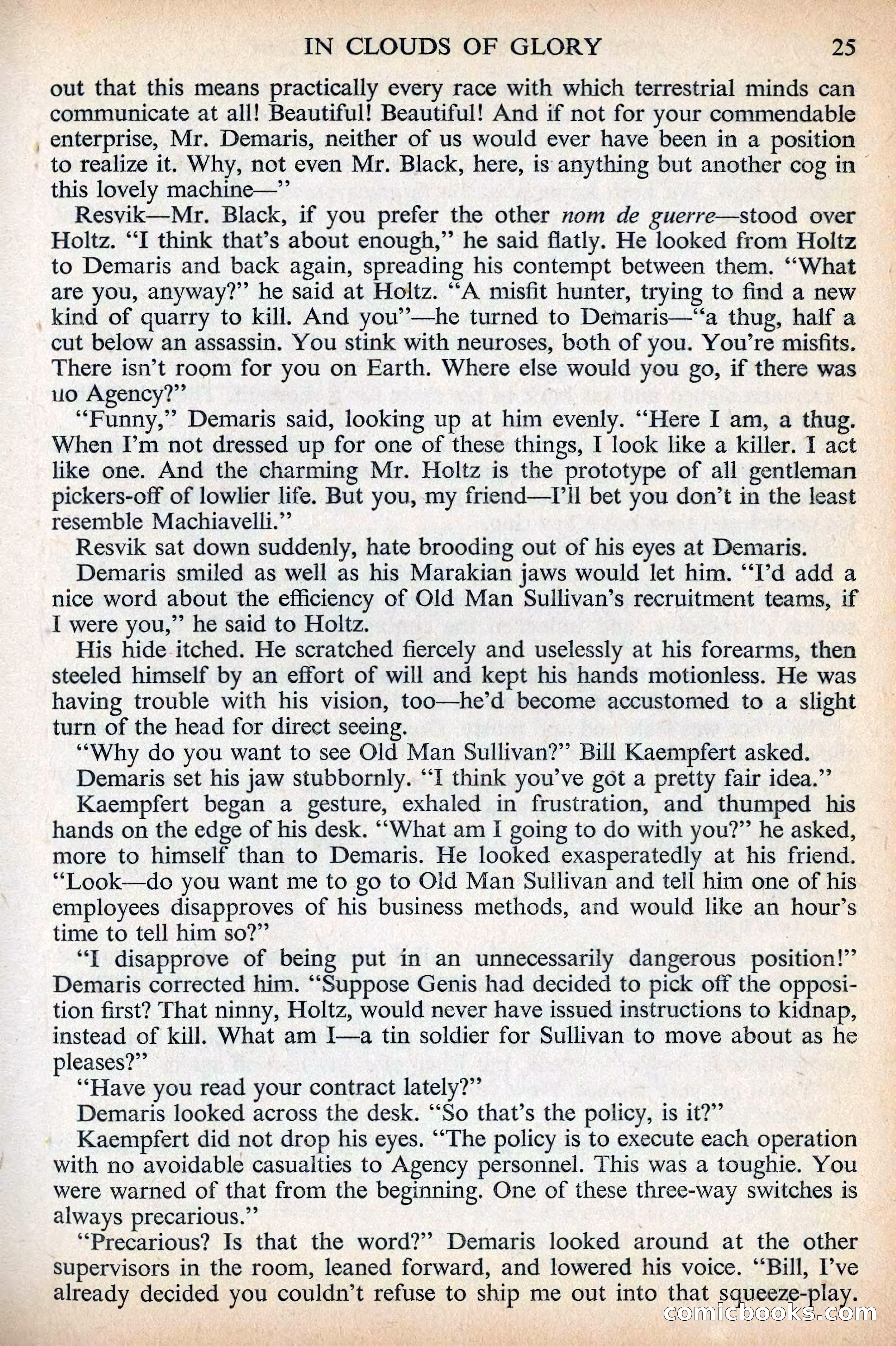
A restored page from Pulp Fiction, 1955. Page through the whole issue in the reader above.
📄 Transcribed text from this page (OCR, searchable)
Machine-transcribed from the original scan — historical spelling and the odd misread are preserved.
IN CLOUDS OF GLORY 25 out that this means practically every race with which terrestrial minds can communicate at all! Beautiful! Beautiful! And if not for your commendable enterprise, Mr. Demaris, neither of us would ever have been in a position to realize it. Why, not even Mr. Black, here, is anything but another cog in | this lovely machine—”’ Resvik—Mr. Black, if you prefer the other nom de guerre—stood over Holtz. “I think that’s about enough,” he said flatly. He looked from Holtz to Demaris and back again, spreading his contempt between them. “‘What are you, anyway?” he said at Holtz. “A misfit hunter, trying to find a new kind of quarry to kill. And you’’—he turned to Demaris—“a thug, half a cut below an assassin. You stink with neuroses, both of you. You’re misfits. There isn’t room for you on Earth. Where else would you go, if there was uo Agency?” ‘Funny,’ Demaris said, looking up at him evenly. “Here I am, a thug. When I’m not dressed up for one of these things, I look like a killer. I act like one. And the charming Mr. Holtz is the prototype of all gentleman pickers-off of lowlier life. But you, my friend—Tll bet you don’t in the least resemble Machiavelli.” Resvik sat down suddenly, hate brooding out of his eyes at Demaris. Demaris smiled as well as his Marakian jaws would let him. “I’d add a nice word about the efficiency of Old Man Sullivan’s recruitment teams, if I were you,” he said to Holtz. His hide itched. He scratched fiercely and uselessly at his forearms, then steeled himself by an effort of will and kept his hands motionless. He was having trouble with his vision, too—he’d become accustomed to a slight turn of the head for direct seeing. ‘““Why do you want to see Old Man Sullivan?” Bill Kaempfert asked. Demaris set his jaw stubbornly. “I think you’ve got a pretty fair idea.” Kaempfert began a gesture, exhaled in frustration, and thumped his hands on the edge of his desk. ““What am I going to do with you?” he asked, more to himself than to Demaris. He looked exasperatedly at his friend. “‘Look—do you want me to go to Old Man Sullivan and tell him one of his employees disapproves of his business methods, and would like an hour’s time to tell him so?” “T disapprove of being put in an unnecessarily dangerous position!” Demaris corrected him. “Suppose Genis had decided to pick off the opposi- tion first? That ninny, Holtz, would never have issued instructions to kidnap, instead of kill. What am I—a tin soldier for Sullivan to move about as he pleases?” “Have you read your contract lately?” Demaris looked across the desk. “‘So that’s the policy, is it?” Kaempfert did not drop his eyes. ““The policy is to execute each operation with no avoidable casualties to Agency personnel. This was a toughie. You were warned of that from the beginning. One of these three-way switches is always precarious.” ‘Precarious? Is that the word?’ Demaris looked around at the other supervisors in the room, leaned forward, and lowered his voice. “Bill, I’ve already decided you couldn’t refuse to ship me out into that squeeze-play. y y P CGIICOOIe RCona