
Pulp Fiction, 1955 · page 20 of 133
Astounding Science Fiction, British Edition, December 1955 — page 20: what you’re looking at
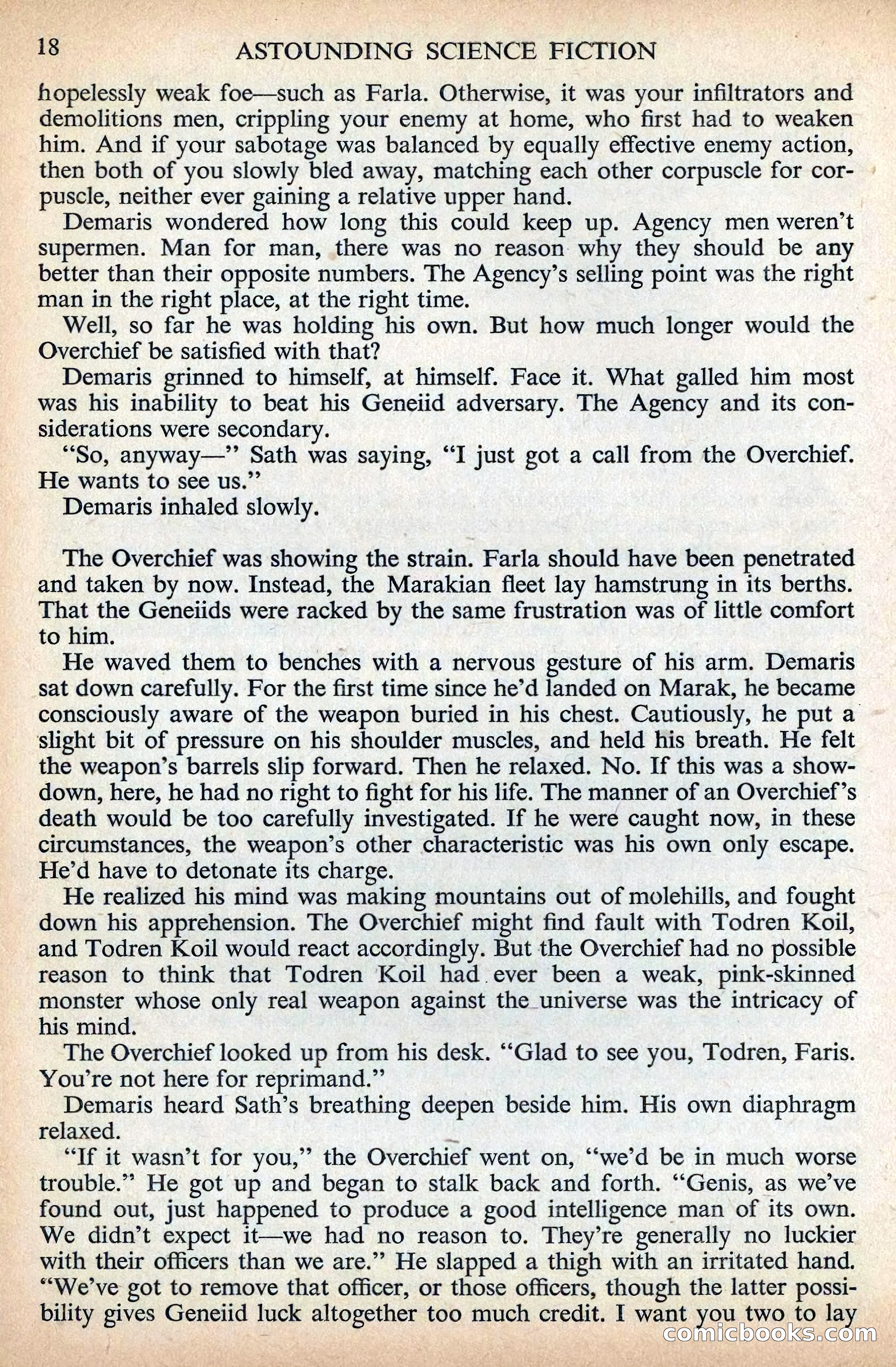
A restored page from Pulp Fiction, 1955. Page through the whole issue in the reader above.
📄 Transcribed text from this page (OCR, searchable)
Machine-transcribed from the original scan — historical spelling and the odd misread are preserved.
18 ASTOUNDING SCIENCE FICTION hopelessly weak foe—such as Farla. Otherwise, it was your infiltrators and demolitions men, crippling your enemy at home, who first had to weaken him. And if your sabotage was balanced by equally effective enemy action, then both of you slowly bled away, matching each other corpuscle for cor- puscle, neither ever gaining a relative upper hand. Demaris wondered how long this could keep up. Agency men weren’t supermen. Man for man, there was no reason why they should be any better than their opposite numbers. The Agency’s selling point was the right man in the right place, at the right time. Well, so far he was holding his own. But how much longer would the Overchief be satisfied with that? Demaris grinned to himself, at himself. Face it. What galled him most was his inability to beat his Geneiid adversary. The Agency and its con- siderations were secondary. “So, anyway—’’ Sath was saying, “I just got a call from the Overchief. He wants to see us.”’ Demaris inhaled slowly. The Overchief was showing the strain. Farla should have been penetrated and taken by now. Instead, the Marakian fleet lay hamstrung in its berths. That the Geneiids were racked by the same frustration was of little comfort to him. He waved them to benches with a nervous gesture of his arm. Demaris sat down carefully. For the first time since he’d landed on Marak, he became consciously aware of the weapon buried in his chest. Cautiously, he put a slight bit of pressure on his shoulder muscles, and held his breath. He felt the weapon’s barrels slip forward. Then he relaxed. No. If this was a show- down, here, he had no right to fight for his life. The manner of an Overchief’s death would be too carefully investigated. If he were caught now, in these circumstances, the weapon’s other characteristic was his own only escape. He’d have to detonate its charge. He realized his mind was making mountains out of molehills, and fought down his apprehension. The Overchief might find fault with Todren Koil, and Todren Koil would react accordingly. But the Overchief had no possible reason to think that Todren Koil had ever been a weak, pink-skinned monster whose only real weapon against the universe was the intricacy of his mind. The Overchief looked up from his desk. “Glad to see you, Todren, Faris. You’re not here for reprimand.” Demaris heard Sath’s breathing deepen beside him. His own diaphragm relaxed. “If it wasn’t for you,” the Overchief went on, “‘we’d be in much worse trouble.” He got up and began to stalk back and forth. ““Genis, as we’ve found out, just happened to produce a good intelligence man of its own. We didn’t expect it—we had no reason to. They’re generally no luckier with their officers than we are.’”’ He slapped a thigh with an irritated hand. “We’ve got to remove that officer, or those officers, though the latter possi- bility ae Geneiid luck altogether too much credit. I went t yo yu ie ed la icbooks com